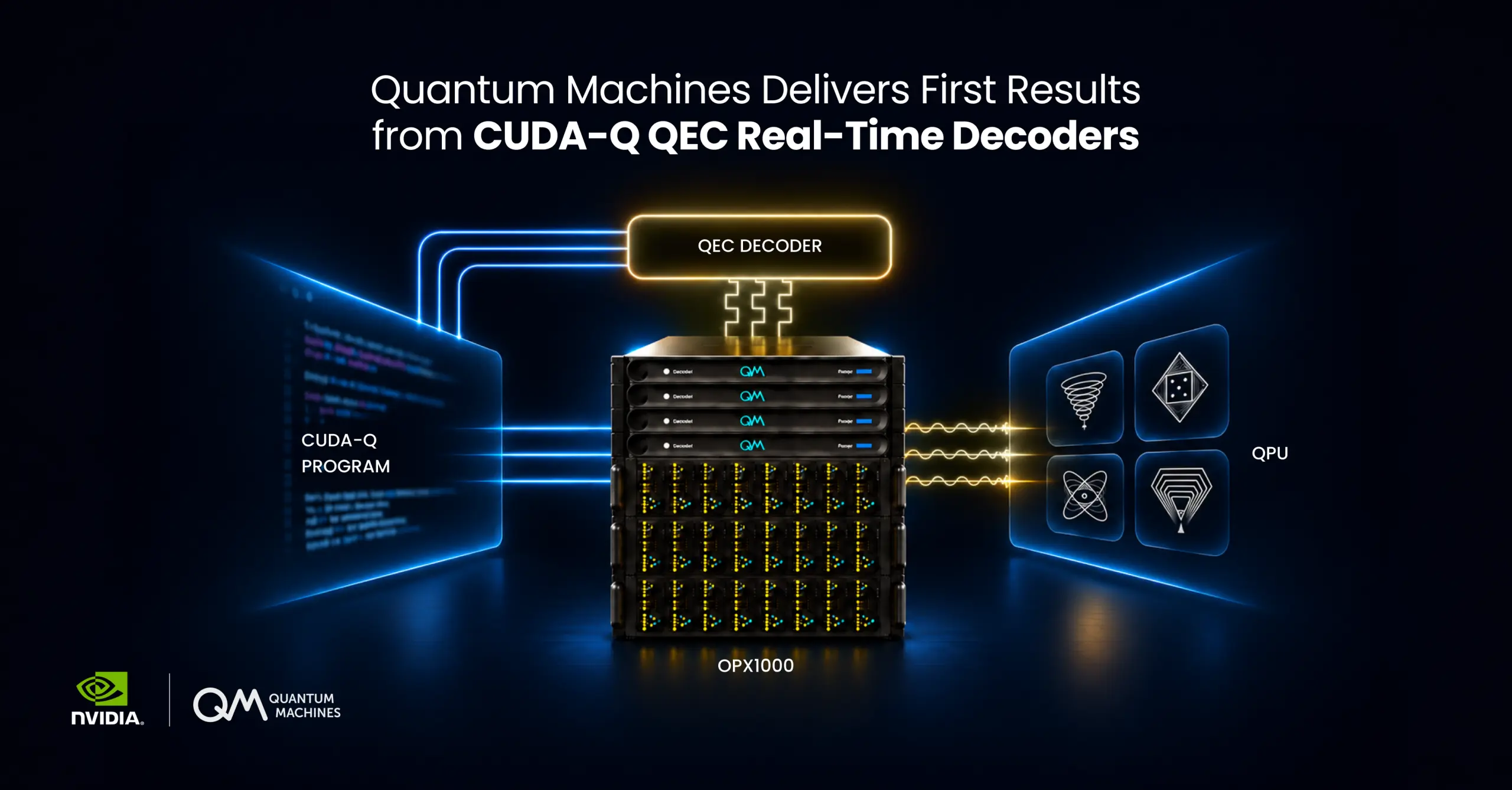
Quantum Machines reports signals now travel to and from its OPX1000 quantum control system and NVIDIA’s CUDA-Q decoder in approximately 2.4 microseconds, a speed enabled by NVIDIA NVQLink. This connection allows for real-time, mid-circuit decoding, a critical step toward viable error-corrected quantum computers, by processing error-check data as the quantum circuit executes. “Error correction only works if decoding can keep pace with the quantum hardware,” said Yonatan Cohen, co-founder and CTO of Quantum Machines. An early version of the CUDA-Q QEC decoding server will be available for installation by OPX1000 customers starting in December 2026.
OPX1000 and NVIDIA CUDA-Q Enable Real-Time QEC Decoding
This speed is critical for maintaining error correction during quantum computation, as delays can allow errors to accumulate faster than they can be resolved. The integration allows for a single program to manage both quantum and classical workloads, streaming error-correction data and triggering decoding software while the quantum circuit is still executing, rather than processing data after completion.
To demonstrate this end-to-end functionality, the team ran a test using simulated error data, with signals traveling to the decoder and back in about 2.4 microseconds, NVIDIA says. The program used the OPX1000 to call the CUDA-Q QEC decoder, resetting the decoder, enqueuing syndromes and retrieving corrections, with each call running on a classical accelerator server.
The resulting corrections were then returned to the OPX1000 within the same shot, enabling real-time feedback and adjustment. “Getting new error-correction methods into working quantum systems is a critical step toward fault tolerance,” said Sam Stanwyck, Director of Quantum Product at NVIDIA. Integration with NVIDIA CUDA-Q provides developers with a unified platform to test diverse decoders through a single control system, accelerating the transition from algorithm research to real-time validation.
Getting new error-correction methods into working quantum systems is a critical step toward fault tolerance.
Sam Stanwyck, Director of Quantum Product at NVIDIA
Microsecond-Latency Performance Achieved with NVQLink and CUDA-Q Realtime API
The integration of Quantum Machines’ OPX1000 with NVIDIA’s CUDA-Q platform now enables real-time, mid-circuit decoding of quantum error correction data, a capability achieved through the use of NVIDIA NVQLink for accelerated computing. Syndromes, representing error-check measurements, and subsequent corrections now travel along the same NVQLink path, minimizing latency and maximizing the speed of feedback within the quantum circuit.
This architecture relies on a new runtime API within CUDA-Q Realtime, facilitating microsecond-latency callbacks between quantum controllers and classical compute resources. The system dispatches requests to registered handlers running on either host CPU or GPU threads, allowing any control system to connect by implementing a bridge to the platform.
Quantum Machines implemented this bridge for the OPX1000, establishing a pathway for error-check measurements to reach the decoder and for corrections to return with minimal delay. “With the OPX1000 connecting to NVIDIA decoders seamlessly over NVQLink, we have brought state-of-the-art decoding closer to every quantum computer using our platform.” Currently, this early implementation uses the CPU dispatch path for syndrome data, with GPU dispatch planned for future development.
The system supports static memory circuits, which are designed to store logical qubits without performing logic operations, and uses CUDA-Q compilation through Quake to QUA. The CUDA-Q QEC decoding server is transport-agnostic, meaning the same software stack and decoder configurations can be used regardless of the underlying transport layer.
OPX1000 customers will have access to run CUDA-Q QEC decoders, or their own custom solutions, through the CUDA-Q decoding server, offering a unified platform for testing diverse decoding algorithms. The ability to rapidly iterate on and deploy new error-correction methods is now significantly enhanced by this streamlined integration.
Error correction only works if decoding can keep pace with the quantum hardware. With the OPX1000 connecting to NVIDIA decoders seamlessly over NVQLink, we have brought state-of-the-art decoding closer to every quantum computer using our platform.
Yonatan Cohen, co-founder and CTO of Quantum Machines


See today’s quantum computing news on Quantum Zeitgeist for the latest breakthroughs in qubits, hardware, algorithms, and industry deals.