Henry Haggard (A27) and Albert Shapiro (A27) devoted twenty hours each this summer to preparation, not for typical student pursuits, but for a three-day quantum optics workshop at Colgate University. Invited by Eddie Schodowski, director of the St. John’s College Laboratory Program in Annapolis, the students attended the event hosted by physicist Enrique Galvez and organized by the Advanced Laboratory Physics Association, founded in 2007. “We put in about 20 hours of work each, going into this,” Haggard says, reflecting a St. John’s College tradition where rigorous laboratory study, including quantum mechanics, complements its renowned Great Books curriculum.
ALPhA Workshop Extends Quantum Optics to St. John’s Students
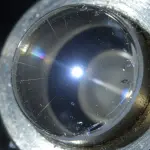
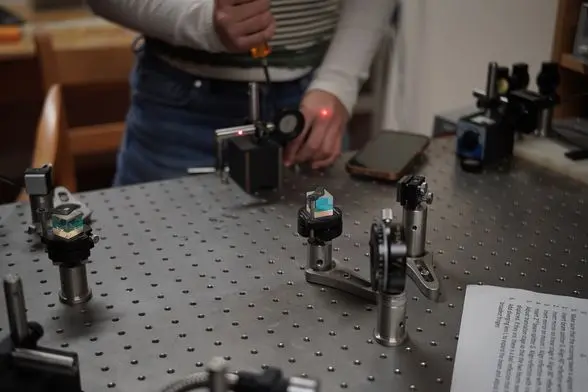
The Advanced Laboratory Physics Association (ALPhA) workshop at Colgate University provided an opportunity for undergraduates Henry Haggard and Albert Shapiro to participate in a three-day quantum optics workshop. Unlike conventional laboratory experiences, the immersion began with a bare optical breadboard, an aluminum tabletop with standardized holes intended to force participants to build their experimental setup from the ground up. The initial task for the St. John’s students, alongside other attendees, was to generate paired photons using a process called parametric down-conversion, splitting single photons into two.
This immersive approach reflects an effort by Colgate University physics professor Enrique Galvez to design quantum experiments accessible to undergraduates. Galvez’s lab, which inspired the creation of a similar quantum lab at St. John’s College Annapolis, uses lasers, crystals and detectors to allow students to directly observe quantum effects.
Mark Daly, the former lab director at St. John’s, initially visited Galvez’s lab through an ALPhA-affiliated event, establishing a connection that ultimately led to Haggard and Shapiro’s participation. “Although it’s a liberal arts school, St. John’s has a very rigorous and intense STEM education that allows us to operate at the level of experts in certain places when we do extra work,” Shapiro says, highlighting the college’s unique approach to science education.
Schodowski reasoned that a strong focus on learning, even extending to the tutors, should justify including a lab assistant in the advanced workshop. He emphasizes that lab assistants “often actually the ones that are setting up the equipment,” highlighting the practical skills gained through hands-on experience.
Haggard reflects that the St. John’s curriculum supports a different kind of learning. “It trains us to learn things quickly, even if we don’t cover them in the Program,” he says, suggesting the college’s emphasis on critical thinking and adaptability prepares students for rapid knowledge acquisition. The workshop’s emphasis on understanding how to account for phenomena, rather than simply obtaining the correct answer, aligns with St. John’s College’s broader educational philosophy.
“I don’t think I would be able to grasp the background and history that led to quantum physics being a real, viable science,” he explains. Now, as a senior lab assistant, Haggard is actively applying the skills and knowledge gained at the ALPhA workshop to his work at St. John’s, demonstrating the lasting impact of the immersive experience.
We put in about 20 hours of work each, going into this: me mostly in the lab, and Albert mostly with the readings.
Henry Haggard (A27)
St. John’s Curriculum Integrates Quantum Physics with Great Books
John’s College this summer, marking the first time undergraduates from the institution had attended the immersive training. Eddie Schodowski, director of the St. John’s College Laboratory Program in Annapolis, accompanied Henry Haggard and Albert Shapiro to the three-day event, a departure from typical summer breaks for the students. Dean Suzy Paalman of St. John’s Annapolis notes the college’s pedagogical style, stating, “St. John’s is interested in learning how to think through phenomena, which is different from strictly solving a problem.”
Galvez, the host physicist at Colgate developed experiments specifically accessible to undergraduates, facilitating a deeper engagement with complex concepts. “If everyone at St. John’s is focused on learning, even the tutor, there should be no reason why we can’t bring a lab assistant to a quantum physics workshop,” Schodowski explained. The workshop’s curriculum included demonstrations of fundamental quantum mechanics principles, such as single-photon existence and interference.
If everyone at St. John’s is focused on learning, even the tutor, there should be no reason why we can’t bring a lab assistant to a quantum physics workshop.
Eddie Schodowski, Director of the St. John’s College Laboratory Program in Annapolis
Experiments at Colgate Validate St. John’s Hands-On Physics Approach
The Advanced Laboratory Physics Association (ALPhA) facilitated an unusual educational exchange this summer, sending undergraduates from St. Each day began with a lecture and included data collection on the foundational experiments of quantum mechanics. Haggard fondly remembers late nights alongside Shapiro preparing for the following day: “It was fun getting ready for the next morning,” he says, “having serious discussions while working on our papers.”
Shapiro noted a desire to ensure discussions about quantum mechanics were grounded in some experience that’s worthwhile and presents important questions. Founded in 2007, ALPhA offers a rotating assortment of training sessions, workshops, and conferences for college instructors teaching advanced physics classes. In addition to a flagship conference held every few years, the organization offers multi-day summer Laboratory Immersions through participating colleges as well as additional educational programming.
Although it’s a liberal arts school, St. John’s has a very rigorous and intense STEM education that allows us to operate at the level of experts in certain places when we do extra work.
Haggard

See today’s quantum computing news on Quantum Zeitgeist for the latest breakthroughs in qubits, hardware, algorithms, and industry deals.