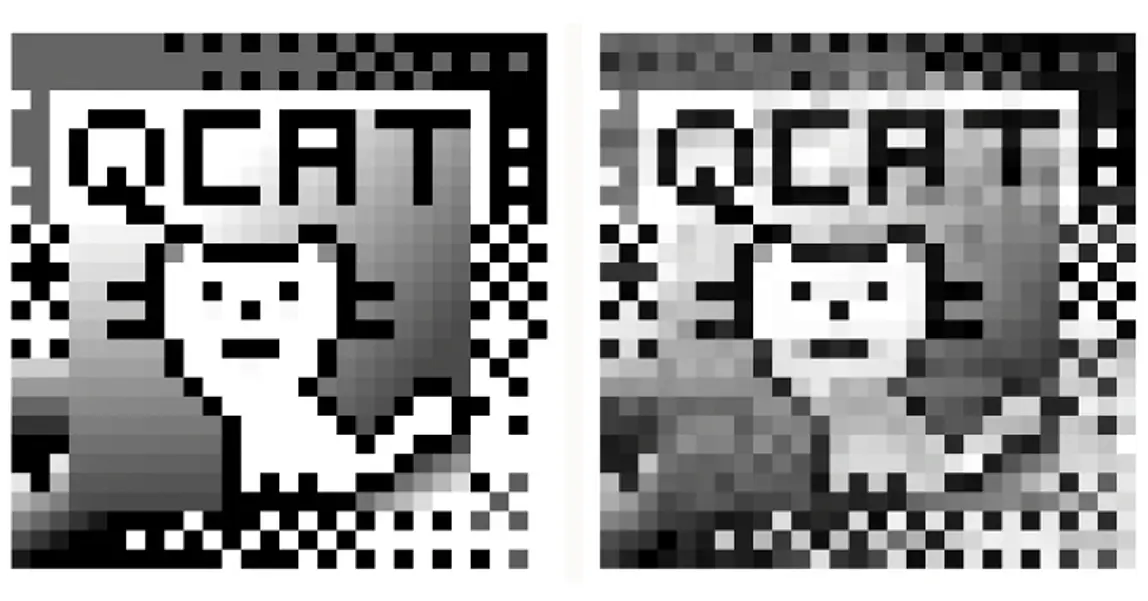
Moth has established a new record for quantum data encoding by successfully encoding and reading back a pixel-art cat, dubbed QCAT and drawn by Daniel Bultrini, across all 120 qubits of an IBM Quantum Nighthawk r2 processor, the company says. The company’s new method, Tessa, encoded 1,568 numbers, enough to represent a small color picture, and then recovered the image, surpassing the previous record of 128 values.
“Every quantum computer has to get data in before it can do anything useful with it, and that step has been a bottleneck for fields like quantum machine learning,” explains Moth researcher Daniel Bultrini, adding that Tessa “makes the most of the chip’s capabilities, so the whole processor can be put to work at once.”
Tessa Encoding Achieves Record Data Capacity on IBM Qubit Array
This feat surpasses previous efforts by a factor of over twelve. The largest prior experiment recovered only 128 values, demonstrating a substantial leap in data capacity. The image, created by Daniel Bultrini, served as the test case for Moth’s new encoding method, Tessa, and its successful readout confirms the method’s viability for complex data representation.
Harry Kumar, Moth’s Founder and CCO, emphasized the broader implications of this work, stating, “The quantum applications that will have the greatest impact, including those that work closely with AI, will depend on breakthroughs such as Tessa to meet expectations.” The company is exploring applications in creative industries, including gaming, visual media and music, by using the enhanced data encoding capabilities.
The scientific details of Tessa are available in a paper published on arXiv, and the image processing functionality is accessible for experimentation on Moth’s Atlas platform at mql. While current quantum hardware still exhibits imperfections in data retrieval, the accelerating pace of improvement, exemplified by projected timelines for fault-tolerant computers by 2029, positions Moth’s work as a vital contribution to the advancement of the quantum computing sector.
Every quantum computer has to get data in before it can do anything useful with it, and that step has been a bottleneck for fields like quantum machine learning.
Daniel Bultrini, the Moth researcher who developed Tessa


See today’s quantum computing news on Quantum Zeitgeist for the latest breakthroughs in qubits, hardware, algorithms, and industry deals.