Room temperature spin coherence lasting one point zero six microseconds has been achieved in diamond; this represents an improvement over existing methods for quantum technologies. A negatively-charged gallium vacancy, a naturally occurring crystal imperfection with unique properties, combines favourable characteristics from both nitrogen-vacancy and group IV vacancies. The defect’s D₃d symmetry also provides protection against charge noise which is vital for stable performance.
This newly discovered defect exhibits stable spin coherence even at room temperature, overcoming limitations found in existing materials which often require freezing operating conditions. The search for strong quantum defects, tiny imperfections within materials that can be harnessed like miniature switches or storage units for quantum information, has intensified as researchers strive to build practical quantum technologies.
While nitrogen-vacancy centres have long been favoured, they are vulnerable to disturbances known as charge noise; group IV vacancies offer improved stability but typically require freezing operating conditions. Researchers identified a gallium vacancy, a naturally occurring flaw in diamond’s structure, which appears to combine the best attributes of both these defect types. This newly discovered centre exhibits stable spin coherence, maintaining its delicate quantum state, even at room temperature with a measured lifetime of one point zero six microseconds.
Focused Ion Beam Implantation Creates Controlled Gallium Vacancy Defects
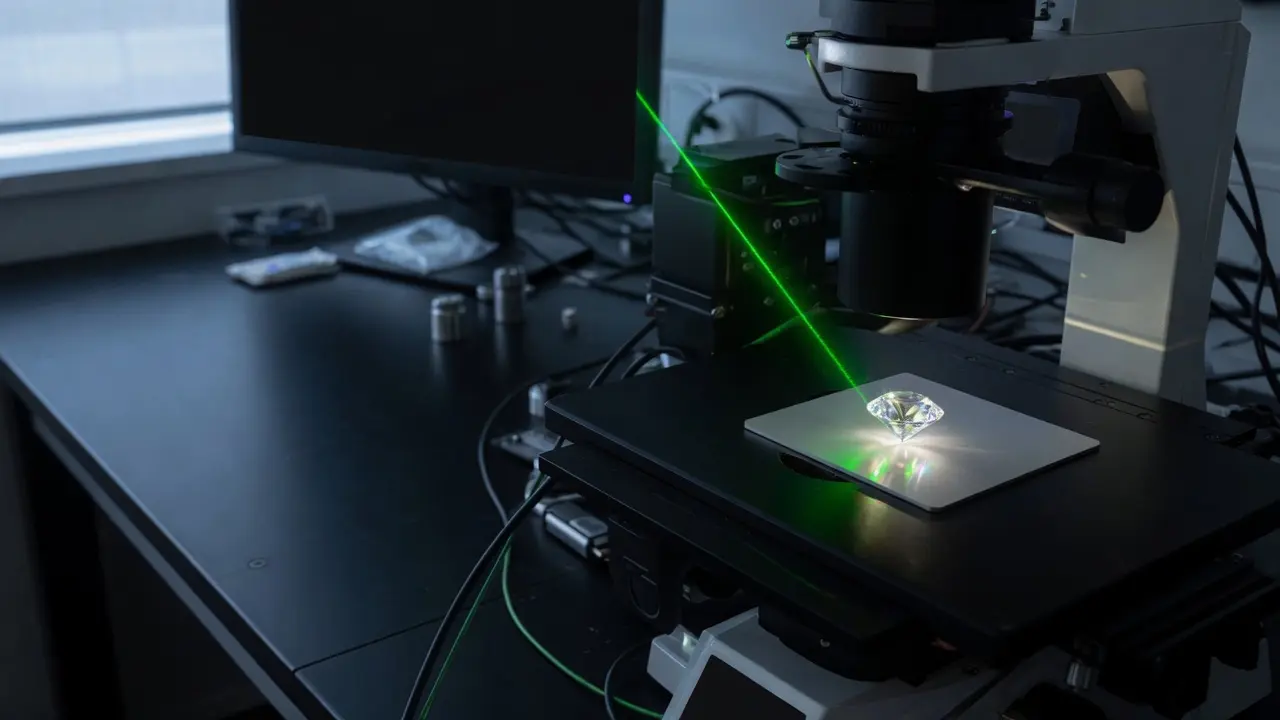
Focused ion beam implantation was central to creating these gallium vacancies within the diamond lattice; this technique precisely delivers ions onto a material’s surface using a focused beam of charged particles. David Simpson and colleagues used an isotopically enriched Gallium source during this process, allowing nanoscale precision in defect introduction, key for studying individual quantum properties. Following implantation, high-pressure/high-temperature annealing ‘healed’ surrounding damage and allowed GaV⁻ defects to form, establishing crystal structure needed for stable spin coherence.
Targeted implantation combined with controlled thermal treatment enabled creation and isolation of the new defect, unlocking its potential as a platform for advanced quantum technologies. The team created gallium-vacancy defects (GaV⁻) in diamond by implanting an enriched isotope of Gallium at 30 keV; subsequent annealing occurred at 1200°C followed by high-pressure/high-temperature treatment at 7.7 GPa and 2100°C for twenty minutes. This approach aimed to combine beneficial properties from both nitrogen-vacancy (NV⁻) and group IV vacancies, specifically room temperature spin coherence lasting up to 1.06 microseconds alongside charge noise protection.
s Enable Room Temperature Spin Coherence and Fast Optical Readout
Room temperature spin coherence, lasting one point zero six microseconds, has been achieved in diamond, a sharp leap forward surpassing previous defects requiring cryogenic conditions for stable quantum states. The team discovered negatively-charged gallium vacancies (GaV⁻), created through focused ion beam implantation and high-pressure/high-temperature annealing.
This discovery exhibits a combination of desirable traits from both nitrogen-vacancy and group IV vacancy centres; its D₃d symmetry provides charge noise protection along with an unexpectedly large Debye-Waller factor around 0.4. The resulting GaV⁻ exhibited a radiative lifetime of approximately 3.83 nanoseconds, suggesting potential for faster readout speeds in quantum devices compared to some existing defects.
Further characterisation revealed the large Debye-Waller factor around 0.4, indicating enhanced stability against environmental disturbances and prolonged spin information storage. Measurements showed that zero-field splitting is sixteen times stronger in GaV⁻ than it is in nitrogen-vacancy centres, potentially enabling more sensitive magnetometry applications. This combination of properties positions gallium vacancies as promising candidates for advanced qubit designs.
Gallium Vacancies Balance Performance and Fabrication Challenges for Room Temperature Qubits
The pursuit of stable, room temperature qubits remains a central challenge in quantum technology; while nitrogen-vacancy centres have been extensively studied, their susceptibility to charge noise limits practical applications, and group IV vacancies demand cryogenic cooling for optimal performance. Gallium vacancies (GaV⁻) offer an intriguing alternative, combining favourable characteristics from both established defect types, but translating these physical properties into functional devices isn’t straightforward. Nevertheless, this discovery represents a step forward because it offers a compelling balance between performance characteristics currently demanding trade-offs in quantum defect research: specifically room temperature operation alongside durability against disruptive charge noise.
This new centre exhibits room temperature spin coherence with inherent protection against charge noise, attributes often found separately but rarely together. This expands possibilities within quantum sensing, networking and computation by potentially overcoming limitations imposed on nitrogen-vacancy centres or group IV vacancies which typically require cryogenic cooling or are susceptible to environmental disturbances.
They discovered this point crystal imperfection demonstrates optically detectable spin coherence at room temperature, lasting 1.06 microseconds, alongside an enhanced resistance to disruptive charge noise. The GaV⁻ also exhibits a radiative lifetime of approximately 3.83 nanoseconds and zero-field splitting sixteen times stronger than that found in nitrogen-vacancy centers, suggesting potential benefits for quantum sensing, networking, and computation applications.
👉 More information
🗞 Optically-detected room-temperature spin-coherence from the GaV$^-$ in diamond
✍️ Adam D. Dodson, Tiamike Dudley and Luca Basso (Affiliation: Center for Integrated Nanotechnologies); Leopold Diaz, Jesse J. Lutz and Jacob Henshaw (Affiliation: Sandia National Laboratory, 1515 Eubank Ave); Raj Patel and Matthew Markham (Fermi Avenue); Andrew M. Mounce (Eubank Ave SE)
🧠 ArXiv: https://arxiv.org/abs/2611.16281


See today’s quantum computing news on Quantum Zeitgeist for the latest breakthroughs in qubits, hardware, algorithms, and industry deals.