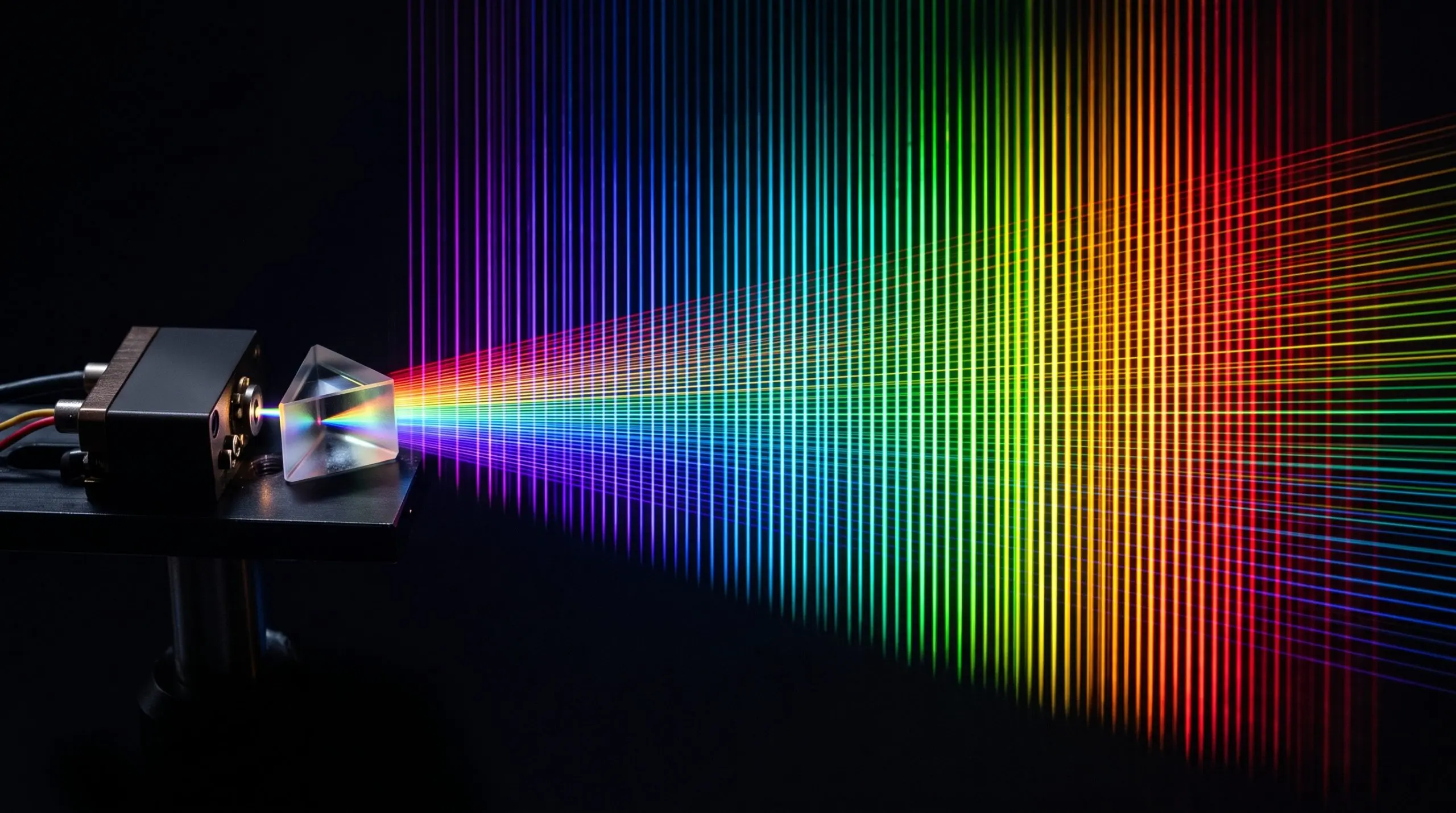
A new method generates or changes vortex light, light with a twisted spiral shape, using coherently prepared hydrogen atoms; previously this required complex optics or nonlinear processes. Manipulating spatial atomic coherence reveals input and output orbital angular momentum (OAM) relate as l₂ equals l₁ plus m, enabling creation of vortices from standard beams or conversion between different OAM modes. Beihang University’s team has unveiled a technique for generating or altering swirling beams of light, known as vortices, using carefully prepared atoms instead of traditional lenses.
This approach manipulates how atoms interact with light to control its twisting motion; it relies on establishing an initial pattern in atomic properties that affects the final vortex shape. Changing this starting arrangement transforms standard light into a vortex beam, or one vortex into another with different characteristics.
Consider setting up a series of switches within an atom, a three-level Λ-type atomic medium, to precisely direct the flow of light based on these settings. The “twist” of the light itself is described by something called orbital angular momentum (OAM); imagine spinning a top faster for a tighter spin, higher OAM means just that.
Hydrogen Atoms Precisely Control Light’s Orbital Angular Momentum
A theoretical scheme achieves an unprecedented level of control over light’s twisting motion, allowing creation of vortices from standard beams and conversion between modes with differing orbital angular momentum (OAM). Previously, generating such swirling beams required complex optical setups; however, coherently prepared hydrogen atoms now offer a method that circumvents limitations related to cost or precise alignment.
The core principle relies on a relationship where output OAM (l₂) equals input OAM (l₁) plus a ‘coherence winding number’ (m), effectively enabling the “twist” of incoming light to be altered via carefully controlled atomic properties. An initial beam lacking twist can gain orbital angular momentum through manipulation of hydrogen atoms at specific energy levels.
Numerical modelling, utilising parameters relevant to hydrogen transitions, confirms both processes are viable and shows strongly suppressed absorption due to electromagnetically induced transparency emerging under resonant conditions. Detailed experimental preparation of this initial spatial coherence, though, remains an open challenge before practical applications become feasible.
Hydrogen Atom Coherence Enables Orbital Angular Momentum Control
Coherently prepared hydrogen atoms serve as the core mechanism; consider it similar to setting up a series of switches with different settings within a three-level Λ-type atomic medium for precise laser manipulation. They introduced a carefully crafted spatial relationship between these atomic states prior to light interaction, imbuing them with an “azimuthal phase” that dictates how light twists during passage through the system.
This technique allows control over orbital angular momentum (OAM), and by manipulating this initial coherence pattern, standard beams can be transformed into vortex beams or existing vortices altered, akin to spinning a top faster for tighter rotation.
Atomic Coherence Limits Practicality of Novel Vortex Beam Generation
While theoretical work offers a potentially elegant solution to vortex beam generation, sidestepping complex optics with carefully controlled atoms, it highlights an ongoing tension within the field: achieving practical control over atomic coherence itself remains elusive. Preparing hydrogen atoms in the necessary initial state is currently unresolved; this isn’t merely a technical hurdle but raises questions about whether such delicate quantum states will ever offer cost-effective manipulation compared to established methods using lenses or nonlinear materials. Still, even if preparing the initial atomic state proves challenging or expensive and current optical techniques remain competitive, this research expands our understanding of light manipulation at a fundamental level. It demonstrates that atoms themselves can act as building blocks for complex optical devices, opening up new avenues to manipulate vortex beams with unprecedented control.
This research demonstrated a method for generating and converting optical vortices within a coherently prepared three-level hydrogen atom system. By establishing a specific spatial relationship between atomic energy levels, researchers showed they could alter the twisting properties of light, its orbital angular momentum, effectively creating or modifying vortex beams from standard inputs. This process relies on electromagnetically induced transparency which suppresses absorption under resonant conditions.
👉 More information
🗞 Generation and conversion of vortex light in coherently prepared hydrogen atoms and hydrogen-like ions
✍️ Fan Meng and Guo-Feng Zhang (Beihang University)
🧠 ArXiv: https://arxiv.org/abs/2611.16367




See today’s quantum computing news on Quantum Zeitgeist for the latest breakthroughs in qubits, hardware, algorithms, and industry deals.