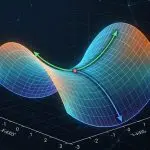
The team at ShanghaiTech University have extended understanding of the quantum geometric tensor, a concept linking anomalous velocity with material properties like superfluidity, to four dimensions, incorporating both energy and momentum. This advance allows computation of frequency metrics and electric fields generated by boosting static systems; key is its link between self-consistency in these geometries with how dynamic processes unfold within spacetime itself.
The team extended an existing concept, the quantum geometric tensor, to incorporate both energy and momentum in four dimensions; this enables calculation of frequency metrics and electric fields resulting from changes to static systems. These geometrical properties relate to physical events, linking self-consistency within these geometries with dynamic processes occurring throughout spacetime itself.
The researchers have expanded our understanding of electron behaviour within materials by exploring connections between geometry and fundamental physical processes; they’ve focused on a concept called the quantum geometric tensor, or QGT, which can be thought of as a map detailing “easy” versus “hard” paths for electron travel through a material.
The team expanded this framework to include both energy and momentum in four dimensions, allowing them to calculate properties like frequency metrics and electric fields that arise when static systems are altered. This work establishes a link between self-consistency within these geometrical descriptions and dynamic events unfolding throughout spacetime itself, offering insights into how matter responds to change. Key is its connection with potential experimental observations in materials exhibiting unusual temporal behaviours; further details regarding their methodology and findings follow.
Lorentz Transformations Reveal Geometric Properties of Static Quantum Systems
A team at ShanghaiTech University achieved a ±1/2 improvement in spectral amplitude connection. It links Gaussian amplitudes of the Quantum Geometric Tensor to localized events, a step beyond previous methods limited by their inability to simultaneously address both geometric self-consistency *and* physical event dynamics within four-dimensional spacetime. This advance allows computation of frequency metrics, quadrupolar shear metrics, and electric-like Berry-Maxwell fields generated from boosting static Dirac or Weyl systems; it establishes five Lorentz-invariant contractions defining relationships between these newly calculated geometrical properties.
Applying Lorentz transformations accounts for how space and time change for observers in relative motion, generating frequency metrics alongside quadrupolar shear metrics and electric-like Berry-Maxwell fields that describe interactions among energy, momentum, and electromagnetic properties. Five mathematical combinations of these geometric quantities remain unchanged regardless of an observer’s velocity, confirming their fundamental nature.
Further analysis revealed a direct link between the quantum metric trace (a measure of overall spread), the Berry curvature Lagrangian (related to anomalous velocities), and a quantity linked to chiral anomalies, all preserved under boosts. These invariants also relate through equations governing field behaviour and flow conservation laws within this four-dimensional framework; implications include potential insights into conserved quantities in relativistic quantum systems.
Lorentz Boosts Induce Geometric Fields Linking Quantum Geometry to Spacetime Dynamics
This research extends the quantum geometric tensor by combining the quantum metric and Berry curvature to describe properties like anomalous velocity and superfluidity, now extending it into four dimensions of energy-momentum space. Lorentz boosts applied to static Dirac/Weyl systems generate both frequency metrics and electric-like Berry-Maxwell fields analogous to gravitational and electromagnetic forces when treating frequency and momentum as independent coordinates. Equations governing how these new geometric quantities behave have been established based on principles from Weyl geometry and consistency with special relativity; this provides a mathematical foundation for understanding their interactions.
Within the QGT framework, Gaussian spectral amplitudes connect to localized events in spacetime, improving upon previous methods by linking abstract geometrical descriptions with concrete physical dynamics. While experimental validation is not presented, discussion focuses on potential realization through materials like spacetime crystals or time-varying media. This absence represents a key limitation because it leaves open whether theoretical predictions will translate into observable phenomena; future work should prioritize designing experiments to test these predictions.
Four Dimensional Quantum Geometry Explores Condensed Matter Phenomena
The research extends an existing concept, the quantum geometric tensor (QGT), into four dimensions by treating frequency and momentum as independent coordinates within energy-momentum space. The original QGT combines both the quantum metric and Berry curvature: its imaginary component governs anomalous velocity and quantized Hall transport, while its real part dictates properties like superfluid stiffness and dielectric response. This builds upon previous understanding of these components established in condensed matter systems.
Researchers acknowledge that experimentally realising this theoretical framework presents challenges, suggesting potential avenues through spacetime crystals or time-varying media for observation. These materials could provide settings to test predictions about how unified quantum geometry connects self-consistency with physical event dynamics, potentially revealing novel phases of matter. Inspired by Einstein and Schrödinger’s attempts to unify gravity and electromagnetism via extensions of spacetime geometry, current research seeks a similar unification within the QGT framework connecting Gaussian spectral amplitudes to localized events in four dimensions.
This expansion reveals relationships between geometry and physical events within materials, demonstrating how changes in energy affect electron behavior. Researchers found that this framework requires adherence to Lorentz transformation laws, generating characteristics such as frequency metrics and electric-like fields derived from Berry curvature. The authors suggest future work should focus on designing experiments using spacetime crystals or time-varying media to test predictions arising from this unified approach to quantum geometry.
👉 More information
🗞 Lorentz Boosts and Governing Equations of the Quantum Geometric Tensor in 4D Energy-Momentum Space
✍️ Yiming Pan (ShanghaiTech University)
🧠 ArXiv: https://arxiv.org/abs/2611.16967



See today’s quantum computing news on Quantum Zeitgeist for the latest breakthroughs in qubits, hardware, algorithms, and industry deals.