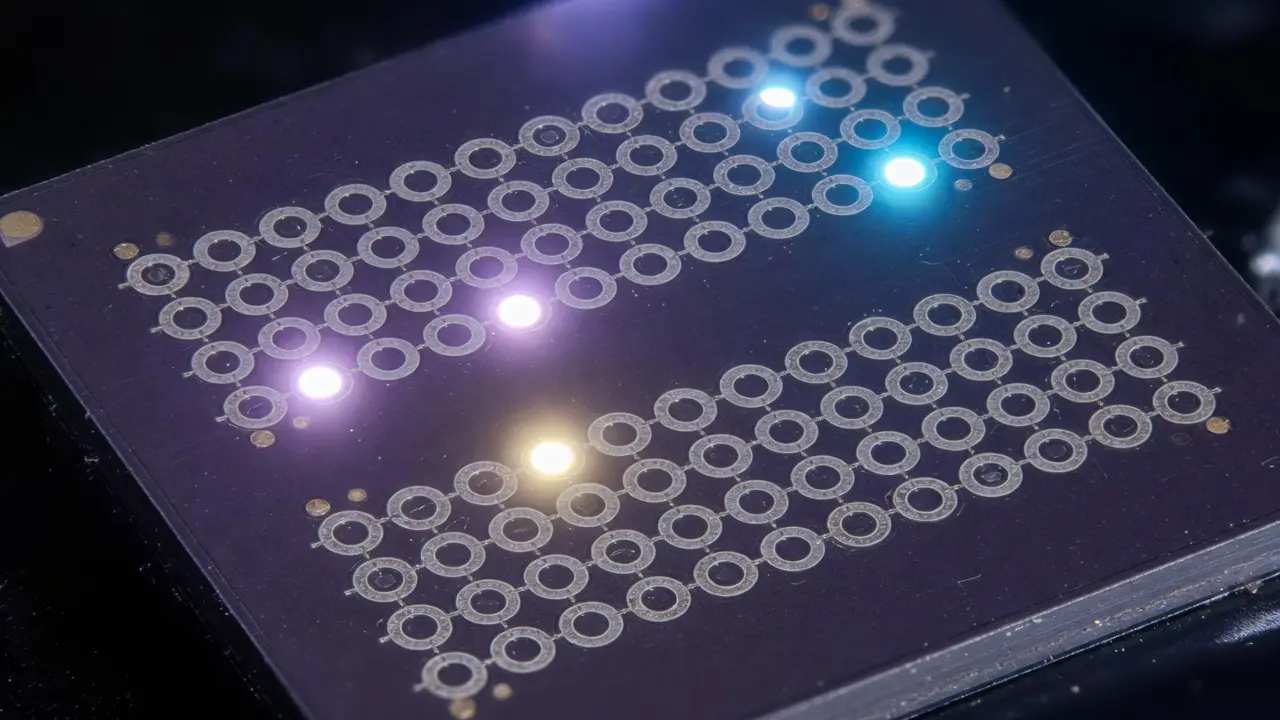
Just five superconducting qubits powered a quantum algorithm successfully classifying jets originating from beauty and charm quarks, streams of particles created in proton-proton collisions at the Large Hadron Collider. Researchers from the Istituto Nazionale di Fisica Nucleare and Politecnico di Torino demonstrated an end-to-end machine-learning workflow, completing both training and testing on real quantum hardware manufactured by IQM.
To the best of their knowledge, this is the first demonstration of a quantum algorithm for jet identification using simulated data from an LHC experiment in which all stages of the machine-learning workflow, including training and testing, are performed on real quantum hardware. The results demonstrate that the impact of hardware-induced quantum noise does not significantly degrade the performance. These findings suggest future applications on larger quantum devices are possible.
Five-Qubit Superconducting Processor Enables Jet Identification
The framework proposed by researchers allows evaluation of training time on quantum hardware and optimization of the circuit itself, a critical step for scaling up the approach. Identifying these jets requires distinguishing them from background noise, a process demanding significant computational resources, and the team’s work demonstrates a pathway to tackling this complexity with limited quantum resources. This complete process, encompassing both training and testing phases, was performed entirely on real quantum hardware, a departure from previous studies that often relied on classical computers for pre- or post-processing.
The team’s approach is designed as a testbed for future applications on larger quantum processors, and the paper includes a discussion on the scalability of their method. This resilience is particularly noteworthy considering the inherent fragility of quantum states and the challenges of maintaining coherence in superconducting qubits.
The ability to achieve reliable classification despite these imperfections suggests that quantum machine learning algorithms can be robust enough for practical use in high-energy physics. Researchers are now positioned to explore how this approach can be extended to more complex datasets and larger quantum systems, potentially leading to new understanding of the fundamental properties of particles and forces.
Heavy-Flavor Jet Identification Challenges at the LHCb Experiment
This work details the first demonstration of a complete quantum algorithm pipeline, from training to testing, executed on actual quantum hardware using simulated data from the LHCb experiment. The algorithm successfully classified jets originating from the fragmentation of beauty and charm quarks, a key task in analyzing data from high-energy particle collisions.
End-to-End Training of Quantum Classifiers on Real Hardware
This demonstration moves beyond simulations by performing both the training and testing phases of a variational quantum circuit (VQC) directly on a quantum processing unit, a step previously unachieved in the context of data from the Large Hadron Collider. The output of the classifier trained on the real quantum hardware showed visible differences when compared to its counterpart trained on an ideal simulator, as expected given the inherent presence of noise during hardware training and its influence on the optimization process. Despite these differences, the overall performance of both classifiers remained consistent and aligned with predictions from noise-aware analysis, suggesting the optimization process is robust enough to yield meaningful results even with realistic hardware limitations.
The training process demonstrated clear convergence, and measured execution times aligned with the proposed model for quantum processing unit (QPU) time. Observed differences between classifiers trained on hardware versus simulators stemmed from quantum noise impacting the optimization procedure, but the resulting performance levels remained comparable to those achieved in simulation.
Variational Quantum Circuits for b- and c-Jet Classification
Variational quantum circuits offer a potential path toward classifying heavy-flavor jets despite limitations in current quantum hardware. This approach addresses a key constraint of existing quantum machine learning methods, which often require more qubits than are currently available in practical devices. The team’s work focuses on a hybrid quantum-classical machine-learning algorithm where classical input features are encoded into a quantum state and processed by a trainable circuit.
Optimization of the circuit’s parameters occurs through a classical loop, with the final output interpreted as a classification score. Training continued until convergence, a metric assessed to ensure reliable performance, and the entire workflow, from training to testing, was completed on the superconducting quantum processor. The architecture adopted was specifically designed to be executable on the limited qubit count while still providing sufficient capability for the jet classification task.
A schematic representation of the variational quantum classifier shows how multiple layers of these rotations are applied to the input qubits, ultimately leading to the classification result. One potential source of this advantage may lie in the ability of quantum circuits to exploit non-classical correlations relevant to fragmentation and hadronization processes.
Impact of Quantum Noise on Machine Learning Performance
The ability to classify particle jets, streams of particles from quark fragmentation, relies on complex machine learning, yet recent work demonstrates performance is not significantly diminished when executed on a limited, 5-qubit superconducting quantum computer. This finding challenges the assumption that hardware-induced quantum noise would immediately overwhelm the benefits of a quantum approach to this high-dimensionality problem. The algorithm, designed for the LHCb experiment, successfully processed data without substantial performance loss despite the inherent fragility of quantum states.
Framework for Quantum Circuit Optimization and Training Time
This optimization wasn’t achieved through algorithmic innovation, but through careful parameter tuning of the variational quantum circuit itself, demonstrating the importance of hardware-aware design. The team’s approach focused on minimizing computational cost without sacrificing performance, a critical step toward scaling quantum machine learning algorithms. This end-to-end approach is significant because it acknowledges the inherent limitations of current quantum hardware and assesses performance under realistic conditions.
Limitations of Current Quantum Simulators for Jet Tagging
The limited number of qubits in existing quantum processors constrains the dimensionality of input features used in jet tagging, a critical task in analyzing data from the Large Hadron Collider. Classical simulation of quantum circuits becomes computationally demanding as qubit count increases, preventing realistic jet tagging problems involving hundreds of observables from being addressed by current quantum simulators. The expectation is that quantum processors with approximately 100 qubits or more will be necessary to fully represent jet feature spaces and enable comprehensive comparisons with classical methods.
While prior studies have explored variational quantum circuits for jet identification, this work distinguishes itself by performing the complete machine-learning workflow, including both training and testing, on actual quantum hardware. The researchers successfully executed all quantum stages of the training and testing process on the IQM Lagrange quantum processor, demonstrating reliable convergence during the training phase.
The bulk of the training time is currently consumed by evaluating gradients through circuit executions using the parameter-shift rule, suggesting potential for optimization. Adopting more efficient gradient-estimation techniques, such as Simultaneous Perturbation Stochastic Approximation, or employing classical neural networks as surrogate models to approximate circuit outputs, could significantly reduce training costs. The work represents a step toward determining if quantum computers can offer a computational benefit over classical methods for particle physics classification.
👉 More information
🗞 Beauty and charm jet identification with end-to-end training on a superconducting quantum processor
✍️ Lucio Anderlini, Giovanni Passaleva, Lorenzo Sestini and Michele Veltri (Istituto Nazionale di Fisica Nucleare (INFN), Sezione di Firenze, Florence, Italy); Pietro Asinari and Matteo Maria Piredda (Dipartimento Energia, Politecnico di Torino, Turin, Italy); Gianluca Bertaina, Davide Calonico and Marco Coïsson (Istituto Nazionale di Ricerca Metrologica (INRiM), Turin, Italy); Alessio Gianelle, Donatella Lucchesi and Davide Zuliani (Istituto Nazionale di Fisica Nucleare (INFN), Sezione di Padova, Padua, Italy)
🧠 ArXiv: https://arxiv.org/html/2611.16607v1




See today’s quantum computing news on Quantum Zeitgeist for the latest breakthroughs in qubits, hardware, algorithms, and industry deals.