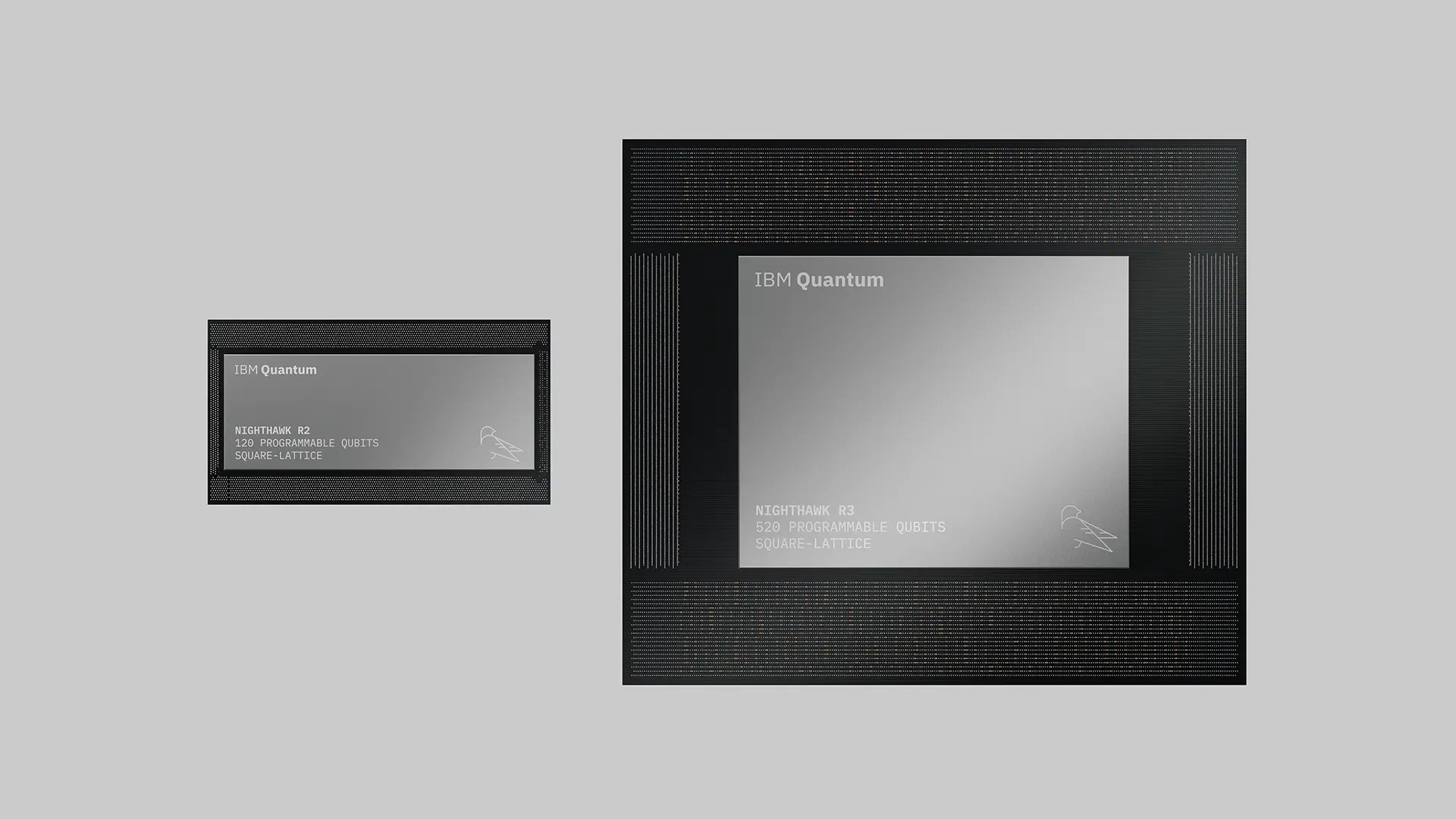
IBM Quantum plans to link two Nighthawk r3 processors in 2027, creating a system exceeding 1,000 qubits and demonstrating a scaling strategy beyond simply increasing qubit counts on a single chip, the company says. The forthcoming Nighthawk r3 processor will be built to accurately execute 10,000 quantum operations across 520 qubits, enabling larger and more complex computations.
“Useful quantum computing depends on delivering results with accuracy and speed, both are fundamental,” said Jay Gambetta, Director of IBM Research and IBM Fellow. Clients and partners have already run over 34 billion circuits on the current Nighthawk r2, reporting speedups of up to 19x compared to previous IBM quantum processors.
Nighthawk r2 Achieves Up to 19x Speedup for Complex Workloads
E.ON experienced a 15-fold increase in speed when using the Nighthawk r2 processor for quantum machine learning applications focused on optimizing energy grids, demonstrating practical gains from the new hardware. This improvement, achieved over previous IBM Quantum Heron processors, highlights the platform’s ability to accelerate complex calculations important for modern infrastructure management, according to the company. These speedups are not merely theoretical; they translate directly into faster results for pressing industrial challenges.
The Nighthawk r2’s high-speed qubit reset technology is central to its performance gains, significantly reducing the time required between successive circuit executions. This capability allows applications to gather the millions or billions of samples needed for complex computations with greater efficiency. IBM also used the Nighthawk r2 to achieve a 12x speedup in a simulation conducted earlier this year with Oak Ridge National Laboratory, accurately modeling real magnetic materials and corroborating findings from neutron scattering experiments.
Quantum Elements and ParityQC are among other collaborators reporting substantial performance improvements on their respective Nighthawk r2 workloads, further solidifying the processor’s impact across various research areas. The Nighthawk r2 supports accurate computations with over 7,500 quantum operations on 120 qubits while delivering up to 100,000 samples per second.
This combination of scale and speed is critical for tackling increasingly complex problems that demand substantial computational resources. The platform’s enhanced integration of quantum and classical computing is designed to address the growing need for both types of processing power, allowing researchers and developers to use the strengths of each approach.
IBM’s strategy recognizes that advancing quantum computers requires continuous progress in how they interact with classical systems to mitigate errors and manage the increasing demands of complex workloads. This architectural approach demonstrates a commitment to scaling quantum computing beyond simply increasing the number of qubits on a single chip.
The company is also involved in “Project for Research and Development of Enhanced Infrastructures for Post 5G Information and Communications Systems (JPNP20017)” and “Research and Development of Quantum-Supercomputers Hybrid Platform for Exploration of Uncharted Computable Capabilities”, further illustrating its dedication to advancing the field. The company believes this integrated approach will be essential for realizing the potential of quantum computation and delivering practical solutions to real-world problems.
Useful quantum computing hinges on whether results can be delivered with accuracy and speed, both are fundamental.
Jay Gambetta, Director of IBM Research and IBM Fellow
Nighthawk r3 Design: 520 Qubits and Modular Interconnects
The forthcoming Nighthawk r3 processor will use ten chip-to-chip interconnects, designated l-couplers, to facilitate the connection of processors into larger, more powerful systems. These l-couplers represent a key architectural element in IBM Quantum’s strategy to scale beyond single-chip designs, enabling the creation of a system exceeding 1,000 qubits in 2027, the firm reports. IBM has already demonstrated the viability of this strategy by connecting Nighthawk r1 processors with four l-couplers, achieving 99.3 percent quantum state transfer fidelity.
The Nighthawk r3 is designed to execute 10,000 quantum operations across 520 programmable qubits, supported by a total of 2,034 physical qubits. The new processor will retain the square-lattice connectivity and fast operation speeds of its predecessor, while incorporating the l-couplers to enable modular scaling. This focus on maintaining performance characteristics alongside increased qubit counts emphasises IBM’s commitment to delivering both scale and quality in its quantum processors.
This year, IBM successfully connected two cryogenic modules into a single system, reaching operating temperature in under five days and cooling below 15 millikelvin. This achievement demonstrates critical progress in the infrastructure required to support modular quantum computing. Maintaining extremely low temperatures is essential for qubit coherence, and the ability to rapidly cool and integrate multiple modules is a significant step towards building larger, more complex quantum computers.
The successful connection of Nighthawk r1 processors using four l-couplers provided valuable data and insights into the challenges of maintaining high fidelity during inter-chip communication. IBM is now targeting 99.9 percent quantum state transfer fidelity, an important threshold for reliable operation of a modular quantum computer. The company’s progress in both modular interconnects and cryogenic integration suggests a clear path toward achieving this goal and scaling Nighthawk beyond the 1,000-qubit mark.
The design of Nighthawk r3 reflects a broader trend in quantum computing towards hybrid architectures that combine the strengths of quantum and classical processing, IBM reports. This approach allows for the distribution of workloads across multiple quantum processing units, potentially accelerating computation times and improving overall performance. Coupled with the modular interconnects, Nighthawk r3 positions itself as a significant step towards realizing the potential of quantum computation.



See today’s quantum computing news on Quantum Zeitgeist for the latest breakthroughs in qubits, hardware, algorithms, and industry deals.