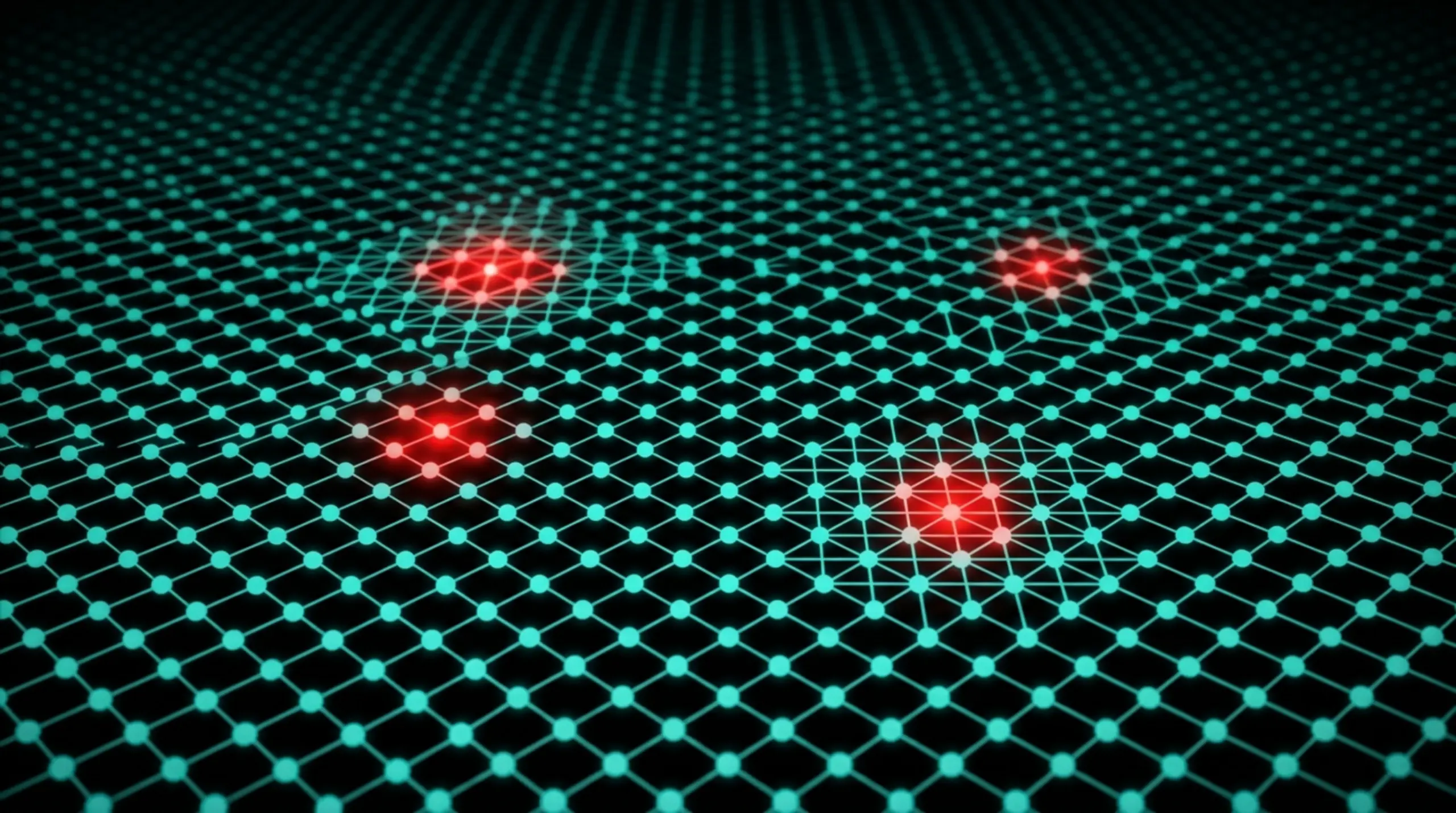
This counterintuitive maneuver uses regions of low valley splitting to temporarily occupy excited valley states, enriching electron mobility and opening new routing paths. The work demonstrates the feasibility of this operation and proposes a way to implement an entangling SWAP γ two-qubit gate during electron shuttling, potentially expanding the operational toolkit for silicon spin qubit devices.
Valley Splitting Challenges in Silicon Spin Qubit Shuttling
Regions of intentionally low valley splitting in silicon, previously considered problematic for building stable quantum processors, can now be used to facilitate a novel method of shuttling electron spin qubits, according to work from the University of Konstanz in Germany. The research details how a mobile qubit can effectively “leapfrog” over a stationary electron occupying a quantum dot, a counterintuitive maneuver enabled by exploiting the valley degree of freedom within the silicon material.
Simulations demonstrate that this technique is viable even with variations in device parameters, offering a solution to a long-standing challenge in spin shuttling architectures. The team modeled the interaction as a triple quantum dot system, where a central dot is consistently occupied by an electron in its ground valley state, representing a scenario akin to bucket-brigade shuttling through an occupied dot or a fixed obstacle in a conveyor-belt system.
By carefully controlling the detuning sequence, the precise manipulation of energy levels, researchers load the mobile qubit into the occupied dot and subsequently unload it into an empty dot on the opposite side. The Pauli exclusion principle dictates that for two electrons to occupy the same space, one must transition into an excited valley state, accumulating a relative phase shift and enabling the implementation of an entangling SWAP γ gate. This gate’s exponent, γ, is tunable by adjusting the duration the qubits remain in this doubly-occupied configuration, providing a degree of control over the interaction.
The process relies on the temporary occupation of these excited valley states, a strategy that flips the conventional approach of avoiding such excitations to maintain qubit coherence. “Although it is challenging to predict the phase collected during the detuning processes because it strongly depends on the chosen parameters, the phase is resilient enough against typical levels of quasistatic noise in the case where the valley splitting in the middle dot is small,” the researchers write.
The ability to use low valley splitting regions is particularly significant because it expands the design possibilities for future quantum processors. Existing methods often focus on either avoiding these areas or increasing the overall valley splitting, both of which present limitations.
The current work proposes a unique use case for otherwise precarious regions of a quantum processor chip and a possible extension to the set of possible operations for silicon spin qubit devices. Integrating the SWAP γ gate operation directly into the shuttling process streamlines quantum computations, reducing the need for additional gate operations and control lines.
The simulations, conducted using two distinct sets of realistic device parameters, confirm both the reliable transfer of spin through the occupied dot and the high fidelity of the resulting SWAP γ gate. Maintaining qubit coherence and ensuring the accuracy of quantum computations depends on this resilience.
This approach contrasts with conventional spin shuttling methods like bucket-brigade and conveyor-belt systems, which typically rely on empty quantum dots or traveling-wave potentials to move qubits. While these methods have achieved high fidelities, they often require precise control over numerous independent control lines. The leapfrogging technique, by integrating gate operations into the shuttling process, potentially reduces this complexity. The findings open avenues for further exploration of valley-based control mechanisms in silicon spin qubits and could contribute to the development of more scalable and efficient quantum computing architectures.
Conveyor-Belt and Bucket-Brigade Approaches to Spin Shuttling
This integration streamlines quantum computation by performing a necessary gate operation as an inherent part of the shuttling process, potentially reducing the need for separate, dedicated gate control lines. This configuration mirrors both a bucket-brigade system passing through an occupied dot and a solitary occupied dot positioned within a conveyor-belt shuttling lane.
Simulating this process for different sets of parameters, researchers demonstrate the feasibility of such an operation and offer a unique use case for otherwise precarious regions of a quantum processor chip and propose a possible extension to the set of possible operations for silicon spin qubit devices. Traditionally, these areas were avoided or actively suppressed due to their susceptibility to decoherence. The team proposes that this approach could enable more efficient use of established spin shuttling methods, offering a more practicable path to reordering qubits.
Researchers found that operating with intentionally low valley splitting mitigates dephasing caused by quasistatic charge noise, a common source of error in semiconductor qubits. This counterintuitive approach uses regions previously considered problematic for quantum processing, turning a potential weakness into an operational advantage.
Triple Quantum Dot Model for Qubit Leapfrogging
Simulations reveal that silicon spin qubits can bypass occupied quantum dots during shuttling, a process termed without significant fidelity loss. By carefully controlling the parameters of the triple quantum dot (TQD), specifically the valley splittings of each dot and the tunneling rates between them, researchers found that the system can maintain high fidelity even when shuttling an electron over an existing charge. This is achieved by projecting out certain charge states during the simulation, simplifying the model while preserving key dynamics.
The work suggests that low valley splitting in the central dot, around 2 microelectronvolts, is not necessarily detrimental. In fact, this parameter range appears to offer sufficient resilience against noise, leading to expected infidelities of 1-F≈ 4. 5× for SWAPγ gates. Further optimization of the control pulses used to drive the leapfrogging process is anticipated to improve these figures still further.
The simulations employed a Schrieffer-Wolff transformation to streamline calculations, focusing on the most relevant charge states within the TQD. A key aspect of this approach is the ability to compensate for deterministic detuning phases that arise during the leapfrogging process. Researchers propose that these phases can be mapped for a given set of TQD parameters by preparing the qubits in a specific state and measuring the mobile qubit’s orientation after the operation.
This allows for the leapfrogging operation to be used as a building block for more complex operations. The potential implications extend beyond simply overcoming a technical hurdle. This could simplify the scheduling of, allowing for more efficient qubit reordering within a conveyor belt network. “Leapfrogging could allow for an easier and more practicable path to reordering qubits running in the same conveyor belt network, thereby simplifying the scheduling problem in the implementation of,” the paper notes.
The researchers acknowledge that fabricating a semiconductor device capable of verifying these findings is achievable with current technology. This opens the door for near-future experimental tests and implementations, potentially clearing the way for more robust and versatile quantum processors. By demonstrating that these regions can be exploited for functional purposes, the research expands the design space for silicon-based quantum chips. The findings suggest that the process provides “a practical way to isolate and exploit otherwise dangerous low-valley-splitting regions of a silicon qubit device”.
👉 More information
🗞 Spin-qubit leapfrogging: Dynamics of shuttling electrons on top of another
✍️ Nicklas Meineke and Guido Burkard
🧠 DOI: http://link.aps.org/doi/10.1103/l1vq-9zhr

See today’s quantum computing news on Quantum Zeitgeist for the latest breakthroughs in qubits, hardware, algorithms, and industry deals.