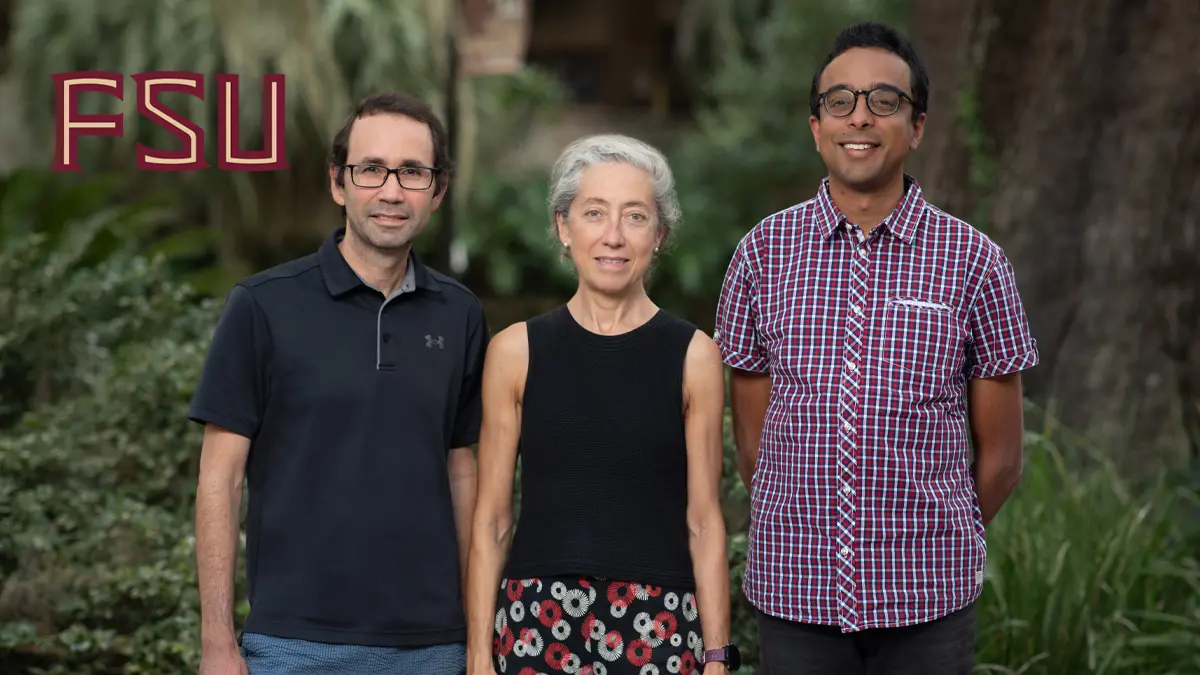
Florida State University physicists Laura Reina, Fernando Febres Cordero, and Herschel Chawdhry will lead a $755,000 project investigating high-energy QCD, funded as part of a larger $7.3 million Department of Energy initiative supporting quantum research. The team aims to determine if quantum computing can refine theoretical predictions used in particle physics collider experiments like those at CERN’s Large Hadron Collider.
“Our work helps make the most of data collected in LHC experiments,” explains Febres Cordero, the study’s principal investigator, “and we’re always seeking to use the best technologies and algorithms.” Department chair Paul Cottle describes the three physicists as a collaborative group whose work will amplify their potential for discovery.
Seeking Quantum Advantage in High-Energy QCD
The $755,000 awarded to Florida State University physicists will focus on quantum chromodynamics, or QCD, the theory governing the interactions of quarks and gluons within protons and other particles. The Large Hadron Collider, a proton-proton collider, relies heavily on understanding the strong force described by QCD to interpret experimental measurements. Herschel Chawdhry’s prior research indicated quantum computers could surpass classical systems in precision and complexity for certain calculations, exploiting quantum rules to solve problems faster.
“The idea is that we’ll be able to do the same calculation faster, extend the reach of calculations, and hopefully even open up a whole new class of processes for us to study,” Chawdhry said. This potential for increased computational power is particularly relevant given the scale of calculations currently performed by the team, which often push the limits of existing computing infrastructure.
Laura Reina explained that the size of these computations motivates the exploration of quantum solutions, asking if quantum computing can make theoretical predictions and calculations more efficient and precise. The team’s approach aligns with broader national initiatives, including the FSU Initiative in Quantum Science and Engineering and the Quantum Genesis Initiative, which aims to deliver scientifically relevant quantum computing capabilities by 2028.
This funding not only advances fundamental physics research but also contributes to the development of a skilled workforce in quantum information science, a field where Florida State University has established decades of expertise. The application of quantum computing extends beyond QCD, potentially impacting other quantum field theories as well.
The team is building on Chawdhry’s previous findings, investigating how quantum computers can enhance existing classical computational methods. Improving the sensitivity to new physics is a primary goal, with the team hoping to detect subtle discrepancies that could point to phenomena beyond the Standard Model. Chawdhry stated that achieving this will increase their ability to detect small discrepancies, maximizing the chance of discovering new physics. The project’s success could unlock new avenues for theoretical exploration and deepen our understanding of the universe’s fundamental building blocks.
Our work helps make the most of data collected in LHC experiments, and we’re always seeking to use the best technologies and algorithms to extract the information we need to probe the Standard Model and possibly identify signals of new physics beyond it.
Fernando Febres Cordero, Professor of Physics, Florida State University




See today’s quantum computing news on Quantum Zeitgeist for the latest breakthroughs in qubits, hardware, algorithms, and industry deals.