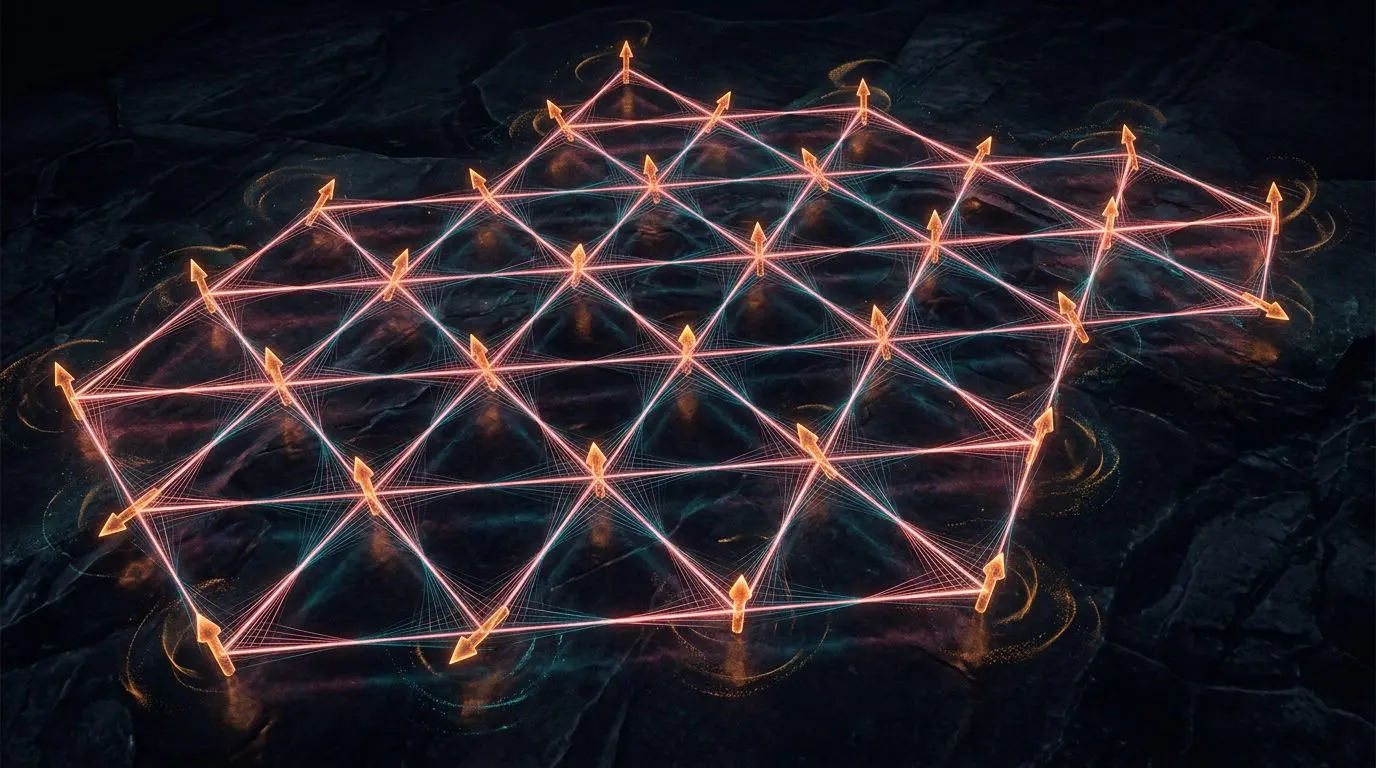
A new quantum algorithm simulates complex dynamics within disordered all-to-all spin systems using polynomial time and logarithmic space; these are models such as those found in neural networks or disordered magnets. The work addresses an open question regarding whether algorithms can simultaneously achieve both efficient computation time and minimal memory usage. A new computational method efficiently simulates complex physical systems known as all-to-all spin models characterised by every component interacting with every other part simultaneously.
The approach offers potential advantages for quantum computers in simulating such systems because it requires less memory and processing time than current methods allow. Researchers at the Max-Planck-Institut für Quantenoptik have devised a new quantum algorithm that efficiently simulates complex physical systems, specifically all-to-all spin models where every component interacts with every other simultaneously. These disordered systems, found in areas like neural networks and magnetism, present key computational challenges due to their interconnected nature, requiring substantial memory and processing power for accurate simulation.
The team’s approach uses ‘permutation invariance’, which can be understood as rearranging identical components without changing the overall result, much like shuffling a deck of cards containing multiple copies of each card. By exploiting this symmetry, they demonstrate how states can theoretically be stored using only logarithmic amounts of computing space, akin to storing information very compactly.
A quantum algorithm developed by researchers at the Max-Planck-Institut für Quantenoptik and Munich Centre for Quantum Science and Technology (MCQST) can simulate all-to-all spin dynamics using only O(log N) space. Previously, such simulations required substantially more memory scaling with system size. This logarithmic storage represents a sharp reduction from conventional methods which needed resources growing polynomially with the number of spins, N, enabling efficient representation of averaged states within disordered systems.
Proving that bounded-error polynomial query language is contained within scalable computation (BQLsubseteq SC) would be necessary to match this performance classically. The algorithm extends to encompass dynamics involving up to k local interactions between spins, allowing simulation of more complex quantum systems like those found in materials science or modelling neural networks. It successfully simulated short-time behaviour of the Sherrington, Kirkpatrick model, a notoriously difficult disordered spin glass.
Logarithmic scaling via permutation invariance for efficient many-body simulation
The technique centres around ‘permutation invariance’, where order doesn’t alter overall composition and tackled the computational challenge posed by simulating complex quantum systems. When averaging over numerous disordered configurations and focusing on typical behaviour rather than specific instances, the system’s state becomes insensitive to labelling and rearrangement; this simplifies calculations considerably. This means memory requirements grow very slowly as the size of the simulated system increases which is vital towards practical simulations on near-term quantum computers with limited resources.
Logarithmic scaling offers promise, but challenges remain for long timescale quantum simulations
Simulating complex systems demands ever more computational power, yet this work provides a potential route to overcome those limitations by utilising quantum mechanics. While demonstrating resource usage matching short simulations, extending this advantage over longer timescales remains elusive according to their findings. The breakthrough demonstrates a pathway toward efficient modelling and could unlock new possibilities in fields reliant on complex systems such as materials discovery or advanced artificial intelligence design; even incremental improvements to simulation techniques are valuable given current constraints.
The algorithm simulates disordered all-to-all spin systems with polynomial time and logarithmic space, a compact storage method improving upon existing techniques needing substantially more memory as system size increases. Such equivalent classical performance would necessitate proving the relationship between two complexity classes, suggesting fundamental implications for computational understanding beyond immediate simulations themselves. Currently, the team is investigating methods to extend their approach towards simulating dynamics across extended periods, potentially unlocking further advantages over conventional computation.
This research demonstrated an algorithm capable of efficiently modelling averaged quantum states using only logarithmic space, meaning its memory requirements grow very slowly even as the simulated system becomes larger. This offers a potential advantage in simulating complex disordered spin systems like those found in materials science and artificial intelligence design because it reduces the resources needed compared with existing techniques.
The authors showed this method works well for short simulation times and are now exploring ways to apply it to longer timescales. Achieving such long-term simulations could reveal whether quantum computers can outperform classical ones for these specific calculations.
👉 More information
🗞 Classical and Quantum Simulation of All-to-All Quantum Dynamics in Logarithmic Space
✍️ Maximilian Lutz, Rahul Trivedi and J. Ignacio Cirac (Affiliation: Max-Planck-Institut für Quantenoptik)
🧠 ArXiv: https://arxiv.org/abs/2609.40162



See today’s quantum computing news on Quantum Zeitgeist for the latest breakthroughs in qubits, hardware, algorithms, and industry deals.