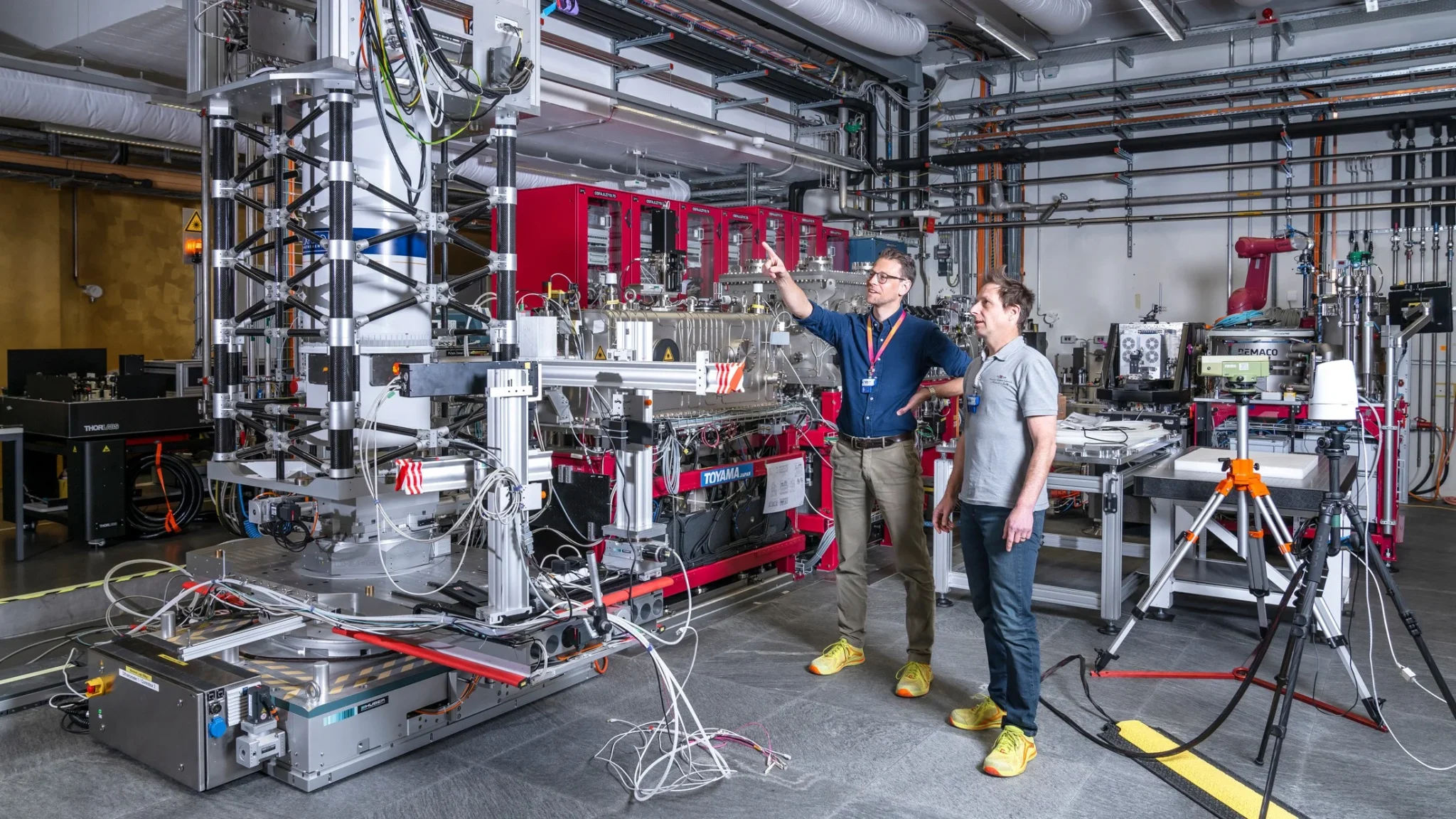
Scientists at SwissFEL recently measured a temperature of 35 millikelvin, just 35 thousandths of a degree above absolute zero, representing the coldest temperature ever achieved during X-ray scattering measurements, to their knowledge, the company says. This feat, enabled by the custom cryostat within the Cristallina experimental station at SwissFEL, allows researchers to study quantum states, as Simon Gerber of the Paul Scherrer Institute PSI explains.
The team utilizes ultra-intense X-ray pulses lasting only tens of femtoseconds to capture snapshots of these delicate states before radiation damage occurs, a technique known as diffraction before destruction. “Our vision is to use the SwissFEL to image these quantum states and their dynamics as close as possible to absolute zero,” Gerber states.
SwissFEL Achieves Record 35 Millikelvin X-ray Scattering Measurements
This extreme cooling unlocks the potential to study quantum states that are otherwise transient or undetectable, offering insight into the behavior of matter at its most fundamental level. The achievement relies on a uniquely designed cryostat integrated within the Cristallina experimental station, a custom instrument developed over several years to meet the demands of these delicate measurements. The impetus for this technological advancement stemmed from principles known as diffraction before destruction.
Researchers recognized that intense X-ray pulses, while capable of revealing atomic structures, inevitably cause radiation damage to samples. “When we do experiments with X-rays, one thing we know for sure is that the sample will heat up and suffer from radiation damage,” explained Simon Gerber, who leads the Quantum Photon Science group at PSI.
However, the ultra-short duration of the X-ray pulses at SwissFEL, lasting only tens of femtoseconds, allows scientists to capture data before significant damage occurs, a concept they adapted to preserve fragile quantum states, according to the company. Bill Pedrini, staff scientist responsible for the Cristallina station, described the process as capturing a snapshot: “An FEL acts like a super-fast camera on the atomic world.
Our idea is that the shutter of SwissFEL is closed, the sample is as cold as can be and then… ‘pschup!’: one intense light pulse and we take a snapshot of the quantum state before the X-rays suppress it by heating it up.” Developing the necessary instrumentation proved challenging, particularly designing the cryostat and incorporating windows to allow the X-rays in. “The difficult part was how to design the cryostat and incorporate windows to allow the X-rays in,” said Pedrini, who has been developing Cristallina since 2019.
The initial measurement focused on a quantum antiferromagnet, a material previously studied at PSI’s Swiss Spallation Neutron Source, providing a valuable benchmark for the new setup, which built on a foundation established with neutron scattering. “In this material, the antiferromagnetic state emerges only below a couple of hundred millikelvin,” Pedrini noted, adding that the 35 millikelvin base temperature of their cryostat provided limited headroom but confirmed the viability of the approach.
Beyond fundamental research, the team anticipates applications for this technology in future quantum devices, the company says. “We’ve designed the experimental station in such a way that we can, in principle, measure actual quantum devices,” Pedrini stated. The facility has already begun hosting external user groups, and researchers are eager to explore the possibilities offered by this unique capability.
Diffraction Before Destruction: Adapting FEL Techniques for Quantum States
This principle, known as diffraction before destruction and successfully applied to biological molecules, has now been adapted to investigate the fleeting existence of quantum states. Achieving a base temperature of 35 millikelvin with the cryostat allowed researchers to probe this state with unprecedented precision. “When you build something new, the first step is benchmarking it. This was a challenging but realistic benchmark.
Now we know that we can access this ultra-cold regime with SwissFEL,” Gerber said. Beyond simply observing these states, the team aims to dynamically control and study their evolution, studying the dynamics by coherently driving these quantum states and seeing how they evolve.
The experimental station is designed so that they can, in principle, measure actual quantum devices. The microwaves used to drive quantum states are related to synchronization, and they had to invent new ways of doing that, with potential benefits extending far beyond quantum physics. “We’re investigating fundamental physics, but we need to invent technical solutions to realise our goals,” said Gerber.
Quantum Antiferromagnet Benchmarks Cristallina Station’s Ultra-Cold Capabilities
The successful measurement utilized a custom cryostat integrated into the Cristallina station, allowing researchers to probe the behaviour of matter at a scale previously inaccessible with X-ray techniques. Researchers reasoned that this approach could be adapted to study fragile quantum states, capturing snapshots before the X-rays disrupt them. The development of the cryostat itself required significant innovation in its design and in incorporating windows to allow X-rays to penetrate while maintaining the extreme temperature, SwissFEL reports.
Pedrini highlighted the collaborative nature of the project, noting that it was “only possible when many persons with complementary expertise work towards the same goal.” The team anticipates broader applications for the technologies developed during this research, including advancements in microwave synchronization techniques and precision engineering. The team has already hosted initial user groups and anticipates further exploration of quantum states inaccessible to other measurement techniques.
Technology Development Extends Beyond Quantum Physics to Industry
The pursuit of increasingly low temperatures at the SwissFEL facility is yielding benefits extending beyond fundamental quantum research, driving innovation in precision engineering and materials science. One example is the lightweight, stiff carbon fiber stand for the cryostat, developed with a local mechanical engineering firm. The company refined techniques for accurately gluing carbon fiber and aluminum to meet the stringent specifications of the experiment, expertise now transferable to other industries requiring high-precision, lightweight designs.
Beyond materials, the need for extreme stability within the experimental setup spurred innovation in vibration control. The Cristallina station utilizes a granite floor, enabling instruments weighing several tonnes to be moved precisely on air pads. This level of precision, demanded by the quantum experiments, has benefits for a range of applications, both within and outside Switzerland.
These advancements, initially developed for driving quantum states and inventing new ways of synchronization with microwaves, have potential applications in areas beyond SwissFEL, such as telecommunications and high-frequency electronics, by the company’s account. This reciprocal relationship, fundamental research driving practical innovation, positions SwissFEL as a hub for both scientific discovery and technological progress.</p, the company claims.



See today’s quantum computing news on Quantum Zeitgeist for the latest breakthroughs in qubits, hardware, algorithms, and industry deals.