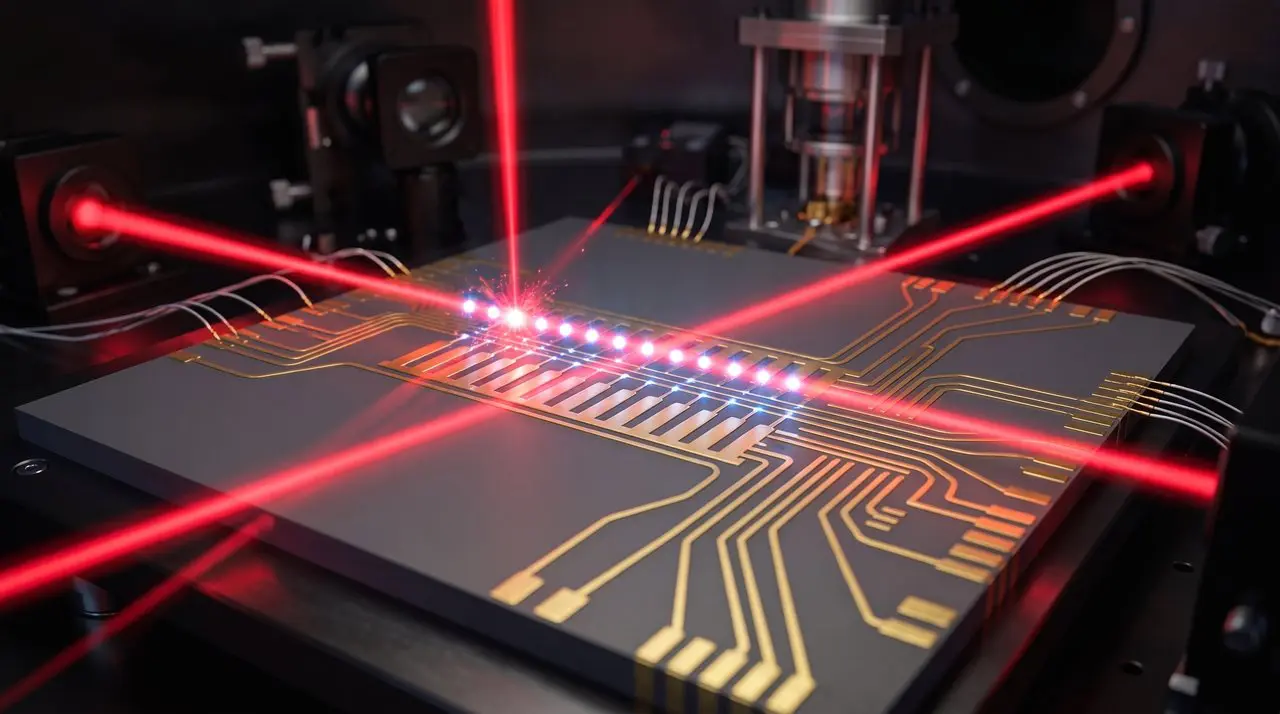
Shuang Zheng and colleagues have created the first fully tunable on-chip meta-generator capable of dynamically mapping arbitrary light states across multiple Poincaré spheres, extending to a four-dimensional Hilbert space. The device, built on an eight-channel space-multiplexed silicon photonic integrated circuit, densely integrates components for precise control of structured light. This work overcomes limitations of bulky free-space optics, enabling compact and programmable manipulation of light for applications like optical communications and quantum photonics. This research represents a significant step toward reconfigurable on-chip manipulation of multidimensional Poincaré spheres.
Multidimensional Poincaré Sphere Mapping with Structured Light
An eight-channel space-multiplexed silicon photonic integrated circuit now allows for the dynamic mapping of light across multiple Poincaré spheres, a feat previously hindered by the size and inflexibility of free-space optics. This device overcomes limitations of earlier approaches by densely integrating the necessary components, mode multiplexers, amplitude-phase modulators, and a specifically designed meta-waveguide, onto a single chip. The core of this innovation lies in the ability to convert guided modes within the chip to orbital angular momentum (OAM) modes in free space.
The multimode meta-waveguide directly maps eight on-chip guided modes to OAM, supporting broadband generation of high-purity OAM modes with diverse polarization states and topological charges. By simultaneously engineering amplitude, phase, polarization, and topological charge, the team achieved full-field control over OAM mode bases, enabling fully tunable access to arbitrary scalar and vectorial states across more than eight distinct Poincaré spheres.
This level of control is crucial for applications requiring complex light manipulation, such as high-capacity optical communications and precision metrology. The device builds upon the established framework of Poincaré spheres, geometric representations used to describe the polarization states of light. Recent advancements have extended this framework to encompass more complex light structures, including OAM modes and vector modes, mapping them onto higher-order spheres. By selecting different combinations of OAM charges for left- and right-circular polarization states at the sphere poles, more complex vector modes can be represented on modified spheres.
The inverse-designed meta-waveguide is key to bridging the gap between on-chip guided modes and free-space OAM modes, enabling mapping between space-multiplexed waveguide modes and polarization- and charge-diverse OAM mode bases. The ability to dynamically generate arbitrary structured light beams across various Poincaré spheres, including PS, OPS, HOPS, and HyOPS, had remained an unresolved challenge until now. This work represents a significant step toward reconfigurable on-chip manipulation of multidimensional Poincaré spheres.
Poincaré Sphere Evolution: From Scalar to Hybrid Orders
Researchers have expanded the established framework of Poincaré spheres to encompass more complex light structures with a space-multiplexed silicon photonic integrated circuit. The team’s innovation lies in a densely integrated system featuring mode multiplexers, amplitude-phase modulators, and an inverse-designed multimode meta-waveguide. On a higher-order Poincaré sphere, the poles correspond to opposite OAM states with orthogonal circular polarizations, while the equator represents cylindrical vector beams.
Alternatively, when circularly polarized OAM states carry different topological charges, the resulting hybrid-order Poincaré sphere can describe full Poincaré beams or C-point singularities. The system’s ability to generate arbitrary structured light fields on diverse Poincaré spheres is crucial for unlocking their full potential in various applications, a need previously unmet by existing free-space optical setups or limited metasurface– and fiber-based schemes.
On-Chip Meta-Generator: Eight-Channel Silicon Photonics
A new silicon photonic integrated circuit dynamically controls light’s properties across multiple dimensions, offering an advance for applications requiring precise beam manipulation. The device, fabricated with a space-multiplexed silicon photonic integrated circuit, overcomes limitations of traditional free-space optics by integrating key components onto a single chip. The researchers highlight the potential for mapping the angular momentum of light onto these high-order spheres, providing a powerful framework for describing structured light beams.
Previously, dynamic generation of full Poincaré sphere beams relied on bulky free-space optical setups. While metasurface and fiber-based schemes have been demonstrated, they lacked dynamic tunability and full reconfigurability. This new chip addresses those limitations by leveraging the advantages of photonic integrated circuits.
Inverse-Designed Meta-Waveguide for OAM Generation
An eight-channel space-multiplexed silicon photonic integrated circuit forms the core of a new device capable of improved control over light’s angular momentum, moving beyond the limitations of traditional free-space optics. Central to this functionality is an inverse-designed multimode meta-waveguide, a structure meticulously crafted to manipulate light at the nanoscale. This isn’t a passive component; it actively shapes the wavefront, enabling precise and programmable control. The researchers demonstrate the ability to engineer amplitude, phase, polarization, and topological charge simultaneously.
Dynamic Control of Amplitude, Phase, and Polarization
The ability to manipulate light in this way has long been hampered by the size and complexity of traditional free-space optical setups, but this integrated circuit offers a scalable and reconfigurable alternative. The design leverages an inverse-designed meta-waveguide to bridge the gap between guided modes within the chip and the free-space OAM modes, a critical step in realizing efficient beam formation. Previously, achieving this level of control required bulky free-space optical setups, or relied on metasurface and fiber-based approaches with limited tunability.
Limitations of Existing Structured Light Generation Methods
Existing methods for generating structured light, while increasingly sophisticated, have historically relied on bulky optical setups that hinder widespread adoption and integration into practical devices. Until recently, dynamic control over the complex properties of light, specifically its polarization, phase, and orbital angular momentum, demanded extensive free-space components, limiting scalability and portability. These systems often struggle to simultaneously manipulate multiple parameters, restricting the range of accessible light states and hindering applications requiring rapid reconfiguration.
Alternative approaches utilizing metasurfaces or optical fibers, though offering some degree of miniaturization, have generally lacked the full tunability needed to generate arbitrary vectorial states across diverse optical landscapes. The limitations extend to the very framework used to describe these complex light fields. The fundamental Poincaré sphere, traditionally employed to visualize polarization states, has been expanded to represent orbital angular momentum and vector modes through higher-order spheres.
However, translating this theoretical mapping into a practical, dynamically controllable device presented a significant hurdle. Previous attempts to generate beams mapped onto these higher-order spheres, such as the hybrid-order Poincaré sphere, were constrained by fixed polarization distributions and narrow bandwidths, preventing versatile application.
The ability to access and manipulate light across multiple, interconnected Poincaré spheres, and extend to higher-dimensional Poincaré spheres, remained elusive, demanding a platform capable of simultaneously controlling numerous degrees of freedom. Existing photonic integrated circuits often focused on generating linearly polarized OAM states using fundamental waveguide modes, inherently limiting the diversity of accessible modal regimes.
While programmable photonic meshes offered some flexibility, they lacked the capacity to dynamically generate arbitrary structured light across a range of Poincaré spheres, including the fundamental, orbital, higher-order, and hybrid varieties. The development of an ultracompact and fully tunable Poincaré sphere beam generator on a photonic integrated platform, therefore, represents a crucial advancement in the field, enabling the creation of complex light fields with unprecedented control and versatility.
PICs Enable Compact, Tunable Structured Light Control
This architecture densely integrates the necessary components for manipulating structured light, moving beyond the limitations of bulky free-space optics previously required for similar tasks. This direct mapping represents a significant advancement in the efficiency of translating guided light into usable free-space beams. This level of control surpasses previous attempts, which were often limited to generating a narrow range of structured beams without dynamic tunability.
To date, a fully tunable solution implemented on a single photonic chip for dynamic control of arbitrary light states hadn’t been realized. The team’s device promises to unlock new possibilities in fields requiring precise control of light’s properties, offering a compact and programmable alternative to traditional optical systems.


See today’s quantum computing news on Quantum Zeitgeist for the latest breakthroughs in qubits, hardware, algorithms, and industry deals.