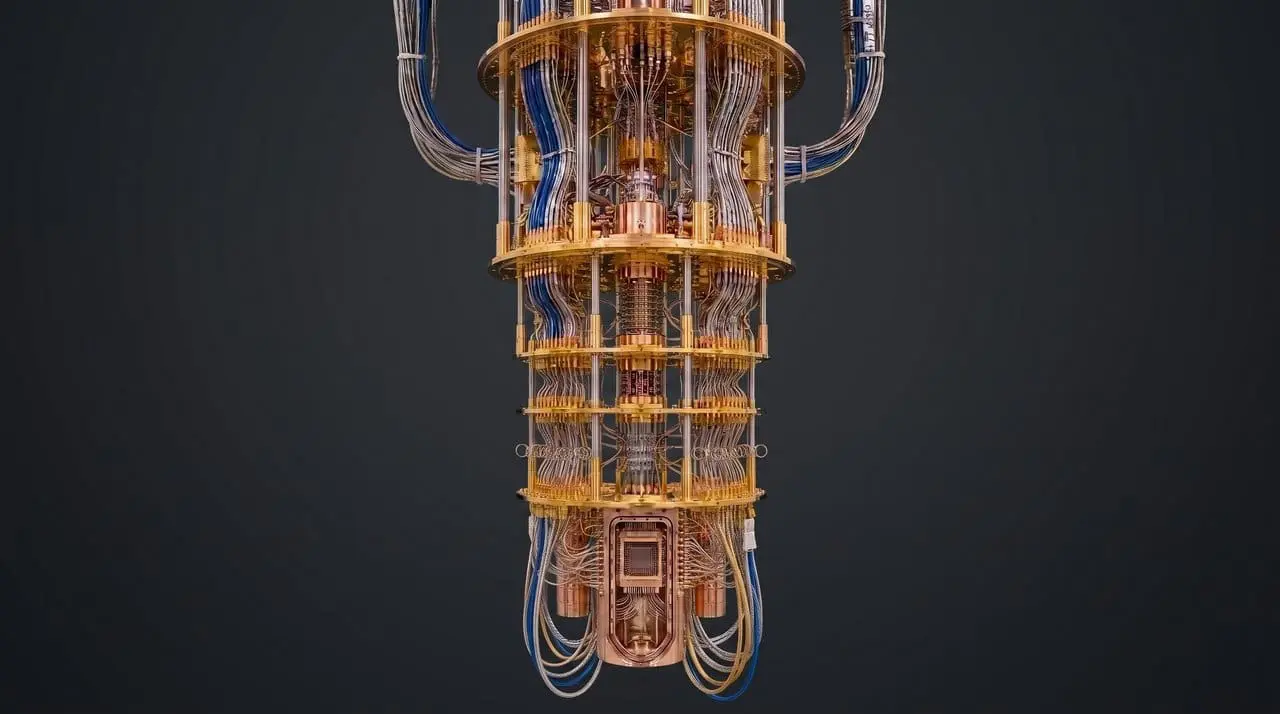
NVIDIA has released Ising Calibration 1.5, an open source vision language model that automates quantum computer calibration by interpreting diagnostic outputs and recommending tuning adjustments without requiring prior training examples. The new model is 11.4% smaller at BF16 precision, easing deployment of calibration workflows directly in local lab environments. Ising Calibration 1.5 also introduces an NVFP4-quantized version, allowing operation on a single GPU or NVIDIA DGX Spark, a level of accessibility comparable to closed models like Fable 5 and GPT 5.6 Sol. According to NVIDIA, the model is now 86.68% better than its predecessor when using examples from related experiments, and is trained on data from six distinct qubit modalities including superconducting qubits, ions, and quantum dots.
Vision Language Model for Automated Quantum Calibration
The automation of quantum computer calibration has taken a significant step forward with the release of NVIDIA Ising Calibration 1.5. This latest iteration marks a departure from earlier approaches by demonstrating proficiency in analyzing unfamiliar data, leveraging examples from related experiments to refine its assessments. NVIDIA states that Ising Calibration 1.5 broadens deployment options, bringing capabilities previously limited to larger systems within reach of smaller laboratories and research groups. The 31-billion-parameter VLM is also suited for data center GPUs such as NVIDIA Grace Blackwell and NVIDIA Vera Rubin. The model’s training regimen involved data from six distinct qubit modalities, including superconducting qubits, quantum dots, ions, neutral atoms, electrons on Helium, and others, demonstrating a versatility uncommon in specialized quantum tools.
Performance is rigorously evaluated using the QCalEval benchmark, which assesses a model’s ability to interpret experimental results and recommend next steps. The company reports that “For zero-shot, Ising Calibration 1.5 scores 10% better on average than the next best open model at comparable size,” highlighting its out-of-the-box capabilities. Full-parameter checkpoints are available on Hugging Face, alongside support through NVIDIA NIM and the OpenMDW License, offering flexibility for customization and deployment.
Deployment Options: NVFP4 Quantization and DGX Spark Optimization
NVIDIA is expanding access to advanced quantum processor calibration through strategic deployment options for its Ising Calibration 1.5 vision language model. Tom Lubowe and Shuxiang Cao are the authors of the post, emphasizing a move toward wider accessibility without sacrificing performance. Previously limited by computational demands, the model now benefits from both BF16 precision reduction and, crucially, NVFP4 quantization. The shift to NVFP4 is particularly significant, as it addresses a key barrier to entry for researchers lacking access to extensive data center resources. While the full-parameter, 31-billion-parameter VLM remains suited for data center GPUs such as NVIDIA Grace Blackwell and NVIDIA Vera Rubin, the quantized version enables deployment even on consumer gaming cards.
This broadened compatibility is coupled with optimizations for DGX Spark, resulting in improved throughput and cost-effectiveness for local workflows. The company reports that “Ising Calibration 1.5 provides better performance on DGX Spark,” highlighting the benefits of batching for parallelizing agent operations across multiple experiments. The availability of full-parameter checkpoints on Hugging Face, including both BF16 and NVFP4 versions, underscores this commitment to open access and customization. The model is accessible as an NVIDIA NIM and through NVIDIA Build, leveraging the OpenMDW License from the Linux Foundation to provide data control and deployment flexibility for quantum processor builders and operators. The release of a quantum calibration agent blueprint, utilizing the NVIDIA Nemo Agent Toolkit, provides a ready-to-use framework for automating experiments with Ising Calibration 1.5, streamlining the calibration process for a wider range of users.
See today’s quantum computing news on Quantum Zeitgeist for the latest breakthroughs in qubits, hardware, algorithms, and industry deals.