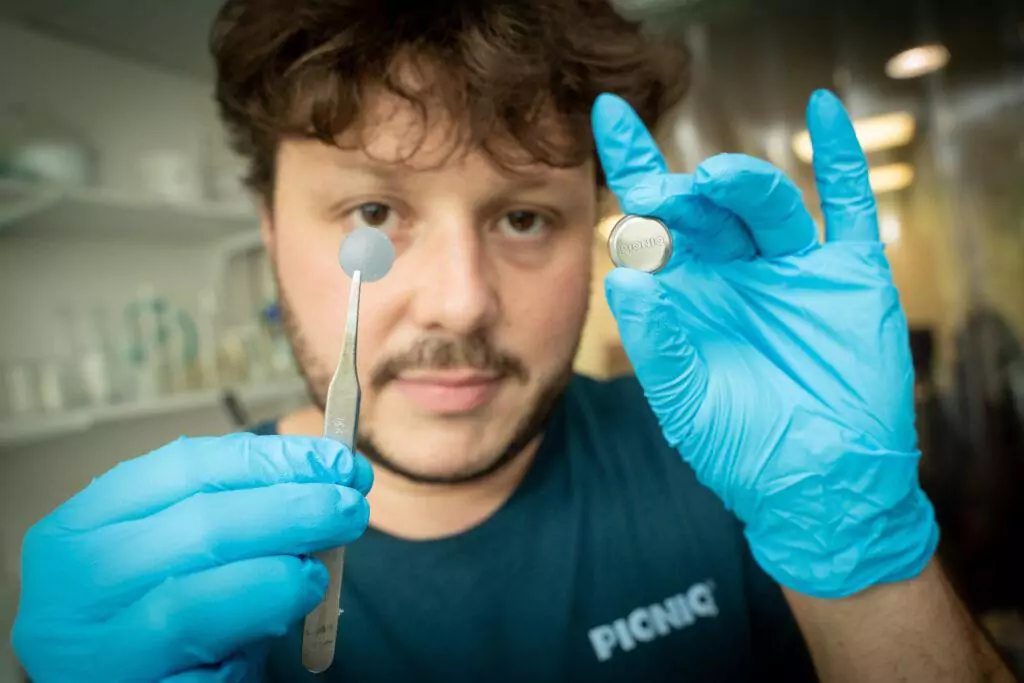
A recent National Institute of Standards and Technology (NIST) study estimates 198,000 battery fires have occurred in the US since 2011, a figure significantly higher than officially reported incidents. Electric vehicle fires are increasing at a rate of roughly 45% annually, exceeding the approximately 10% yearly increase in consumer fires. Researchers state that the root causes, thermal runaway, dendrite-induced short circuits, and flammable liquid electrolytes, are not simply engineering flaws, but inherent to lithium-ion battery technology since its inception.
Pioniq, a portfolio company of Quantonation, is attempting to address these fundamental issues with a new battery platform built on quantum materials.
Pioniq’s Quantum Electrolytes Enable Solid-State Proton Conduction
The pursuit of safer battery technology has largely focused on mitigating risks inherent in lithium-ion designs, rather than eliminating them at the source. Pioniq’s innovation centers on solid-state crystalline proton conductors derived from the perovskite family. Unlike conventional batteries relying on flammable liquids, Pioniq’s design utilizes solid materials synthesized from abundant oxide precursors, eliminating the risk of leakage, ignition, and thermal runaway. This process leverages quantum-tunneling effects between sites, enabling proton conduction without the hazards associated with liquid electrolytes. Recent atomistic and quantum-mechanical modeling supports the idea that proton conductivity arises from dynamically reconfiguring hydrogen-bond networks, lowering proton hopping barriers and favoring Grotthuss-type transport. This shift in fundamental chemistry also simplifies manufacturing processes. Pioniq’s quantum electrolytes share similarities with ceramics already produced at industrial scale, allowing for processing under ambient conditions and shaping using conventional routes.
This eliminates the need for expensive dry rooms and hazardous precursors, reducing costs and improving scalability. The company’s current prototypes demonstrate a volumetric energy density of 600 Wh/L, with a roadmap to 1,200 Wh/L, alongside an estimated lifetime exceeding 3,000 cycles and operation across a wide temperature range (-30°C to +80°C). The simpler manufacturing process allows for rapid iteration and validation, a key factor in Pioniq’s accelerated development timeline. Quantonation notes that “simplifying the chemistry simplified the engineering,” highlighting the company’s progress from discovery to functional prototypes in roughly two to three years. Pioniq is initially targeting applications where safety is paramount, including micro-batteries for electronics and large-format cells for data centers, autonomous defense systems, aviation, and medical devices.
The company’s founders, Brigitte Leridon, Rémi Federicci and Clément Barraud, built upon years of research into quantum materials, discovering a new class of solid-state electrolytes where charge transport is a quantum-mechanical phenomenon. Pioniq describes these materials and positions them as the foundation for what it claims is the world’s first battery built on this principle. This isn’t simply about incremental improvement; the company believes the answer isn’t a safer version of lithium chemistry, but a different chemistry altogether, where safety is intrinsic rather than an engineered afterthought.
Quantonation’s Early Involvement Accelerated Pioniq’s Tech Transfer
Quantonation’s proactive engagement proved instrumental in rapidly translating Pioniq’s foundational research into viable battery technology, demonstrating a model for accelerating deep-tech commercialization. The venture capital firm’s partnership with Brigitte Leridon began prior to the formal incorporation of Pioniq, allowing for strategic input into the company’s structure, market prioritization, and the crucial transition from academic investigation to a functioning industrial team. This early involvement, according to Quantonation, wasn’t merely financial; it was a collaborative effort focused on overcoming the typical decade-long lag between scientific breakthrough and practical application. Pioniq successfully developed functional prototypes and secured initial industrial partnerships within approximately two to three years, a pace Quantonation attributes to this hands-on, early-stage support coupled with a strong scientific foundation. The urgency behind this accelerated development stems from a growing crisis in battery safety.
Battery fires are more common than you think, and the lithium-ion fire problem is larger than the record shows, and growing fast. A March 2026 NIST study pieced together eight fragmented datasets and estimated that 198,000 battery fires have occurred in the US since 2011, with consumer fires up about 10% a year and EV fires roughly 45%. (Link) These incidents aren’t isolated failures, but rather consequences of inherent vulnerabilities in lithium-ion technology since its inception. Pioniq’s approach diverges sharply from attempts to incrementally improve lithium-ion safety, instead focusing on a fundamentally different chemistry. Unlike conventional batteries reliant on flammable liquid electrolytes and susceptible to thermal runaway, Pioniq’s design utilizes solid-state conduction via quantum-assisted proton transport.
Water molecules are structurally incorporated into the crystalline material, forming one-dimensional chains that facilitate proton movement through quantum tunneling. The company asserts that “simplifying the chemistry simplified the engineering,” highlighting the potential for reduced costs and faster scaling.
Unlike traditional batteries where ions migrate through a liquid medium prone to leakage and thermal runaway, Pioniq’s design utilizes nearly-free protons moving through a crystalline lattice via quantum-assisted transport. Water molecules are structurally incorporated into the material, forming one-dimensional chains conducive to proton conduction through quantum-tunneling effects. This fundamentally alters the battery’s safety profile, as the charge carrier is a proton moving through a solid oxide framework, removing the risks associated with liquid flammability and runaway reactions. Beyond safety, Pioniq’s prototypes demonstrate promising performance characteristics. Importantly, the manufacturing process leverages the similarities between these quantum electrolytes and existing industrial ceramic production methods.
See today’s quantum computing news on Quantum Zeitgeist for the latest breakthroughs in qubits, hardware, algorithms, and industry deals.