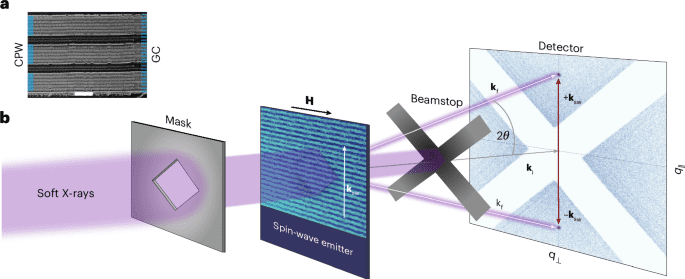
Researchers have, for the first time, directly imaged magnon populations across two-dimensional momentum space using a new technique called magnon momentum microscopy. This resonant magnetic soft-X-ray scattering method overcomes a key experimental challenge in the field: detecting magnons at nanometre wavelengths, where exchange interactions govern their dynamics. Applying the technique to yttrium iron garnet, the team revealed a rich variety of previously unobserved nonlinear magnon interactions. With its ability to capture these interactions over large regions of the dispersion plane, magnon momentum microscopy establishes a versatile platform for exploring short-wavelength and nonlinear magnonics, potentially advancing wave-based information processing beyond conventional electronics.
Soft-X-ray Momentum Microscopy for Magnon Imaging
The ability to directly visualize the behaviour of magnons, quantum units of spin wave energy, at the nanometre scale has long presented a significant hurdle for materials scientists. Researchers publishing in Nature Physics report that this quasi-elastic, resonant magnetic soft-X-ray scattering technique directly images magnon populations across two-dimensional momentum space, revealing previously hidden dynamics. Central to this advancement is the use of soft X-rays, essential for probing wavelengths below 100 nanometres where exchange interactions dominate magnon behaviour in materials like yttrium iron garnet (YIG). Unlike electronic detection methods, MMM doesn’t rely on patterned antennas or contacts, allowing for flexible experimental geometries. The technique hinges on a principle akin to X-ray scattering of phonons; researchers effectively treat the spin waves as a quasi-static modulation. This modulation creates an absorption grating when tuned to electronic resonances exhibiting X-ray magnetic circular dichroism. The researchers explain that “This concept of MMM is sketched… for probing propagating spin waves via soft-X-ray scattering.”
Yttrium Iron Garnet as a Prototypical Magnonic Material
Following advances in detecting magnons at nanometre wavelengths, yttrium iron garnet (YIG) has emerged as a crucial material for exploring the dynamics of short-wavelength spin waves. Researchers used YIG to demonstrate magnon momentum microscopy (MMM), a new imaging technique capable of revealing previously unseen interactions between magnons. This choice stems from YIG’s properties, which allow a crossover to exchange-dominated regimes at wavelengths below 100 nanometres, a region where short-range interactions govern magnon behaviour. A major challenge in accessing this largely unexplored regime is the ability to reliably excite and detect such short-wavelength modes. While techniques like spin-torque architectures and microwave excitation have demonstrated the generation of such short-wavelength magnons, accessing such high magnon frequencies or wave vectors remained challenging.
Challenges in Detecting Sub-100-nm Magnon Wavelengths
The pursuit of understanding spin-wave dynamics at the nanoscale has long been hampered by limitations in detection technology, but researchers at several institutions are now pushing the boundaries of what’s observable. While existing methods like resonant inelastic X-ray scattering and scanning transmission X-ray microscopy have provided valuable insights, directly imaging nonlinear interactions of magnons with wavelengths below 100 nanometers across a broad momentum range remained a significant hurdle. Wittrock and colleagues explain this in their recent publication. Accessing such high magnon frequencies or wave vectors remains challenging and is a relevant and topical area of research. Electronic techniques, while useful in the gigahertz regime, lack the flexibility needed for unconstrained sample conditions. Light-based methods offer a potential solution, but conventional Brillouin light scattering is limited to a few gigahertz, falling short of the frequencies needed to probe these magnons.
The team addressed this by developing magnon momentum microscopy (MMM), a resonant magnetic soft-X-ray scattering technique. This approach leverages the principle that “a simple scattering relation forms the basis of our momentum microscopy image,” allowing direct visualization of magnon populations in two-dimensional momentum space.
Nonlinear Magnon Interactions and Wave-Based Computing
The potential for harnessing magnons, quantized spin waves, as information carriers is rapidly gaining traction as an alternative to conventional electronics, promising wave-based computing architectures beyond the limitations of CMOS technology. Recent advances have focused on exploiting the inherent nonlinearity of magnon interactions to create novel computational schemes, but reliably exciting and detecting these short-wavelength modes has proven challenging. While techniques like spin-torque architectures and microwave excitation have demonstrated the generation of such short-wavelength magnons, a corresponding method for their detection remained a key experimental challenge.
Magnon Momentum Microscopy: Principles of Quasi-Elastic Scattering
The conventional understanding of probing magnetic waves often centers on electronic detection, but a new approach bypasses limitations inherent in those methods by leveraging the power of X-rays. Magnon momentum microscopy (MMM) directly images magnon populations in two-dimensional momentum space, a feat previously hampered by challenges in detecting short-wavelength spin waves. Wittrock and colleagues explain that “Although this absorption contrast relies on a circular dichroism, the magnetic scattering does not require a defined X-ray polarization.” A moderate beam focus, approximately tens of micrometres, is sufficient, and the technique’s sensitivity allows for the detection of magnetic diffraction peaks, revealing information about the magnon wave vector in momentum space. The experimental setup is surprisingly straightforward; a beamstop and proximity mask minimize background scattering, enabling a clear signal.
XMCD and Absorption Grating for Momentum Contrast
The technique leverages resonant magnetic soft-X-ray scattering, exploiting a principle analogous to X-ray scattering of phonons, but applied to magnons, quantized collective excitations of spins. This grating allows for the direct determination of magnon wave vectors, as “magnetic diffraction peaks of first order emerge in the scattering pattern at q = ± k SW,” where ‘q’ is the scattering vector and ‘k SW’ represents the magnon wave vector. A moderate beam focus of tens of micrometres proves sufficient, and the technique’s sensitivity allows for the detection of magnetic diffraction peaks, revealing the magnon wave vector in momentum space.
Magnetic Diffraction Peaks Define Wave Vector Mapping
Existing techniques, while effective in certain regimes, often struggle with sensitivity, efficiency, or the accessible range of momentum space, leaving a gap in understanding dynamic processes at these diminutive scales. Central to MMM is the principle that magnons, when interacting with soft X-rays, create a periodic magnetic modulation akin to an absorption grating. This phenomenon allows researchers to observe indicators of magnon wave vectors directly in the scattering pattern. This simple relationship forms the basis of the momentum microscopy image. Researchers demonstrated the technique using yttrium iron garnet (YIG) and a specially designed spin-wave emitter. By coupling a microwave-generated magnetic field to a grating coupler structure on the YIG film, they were able to excite magnons down to wavelengths below 100 nanometres.
Steffen Wittrock and colleagues at multiple institutions, including the Helmholtz-Zentrum Berlin, are developing a new method for visualizing spin waves at the nanoscale, addressing a longstanding challenge in the field of magnonics. Existing techniques struggled to reliably detect magnons with wavelengths below 100 nanometres, hindering exploration of the exchange-dominated regime where short-range interactions govern their behaviour. Crucially, the technique achieves this with a relatively modest experimental setup; a beam focus of tens of micrometres is sufficient.
See today’s quantum computing news on Quantum Zeitgeist for the latest breakthroughs in qubits, hardware, algorithms, and industry deals.