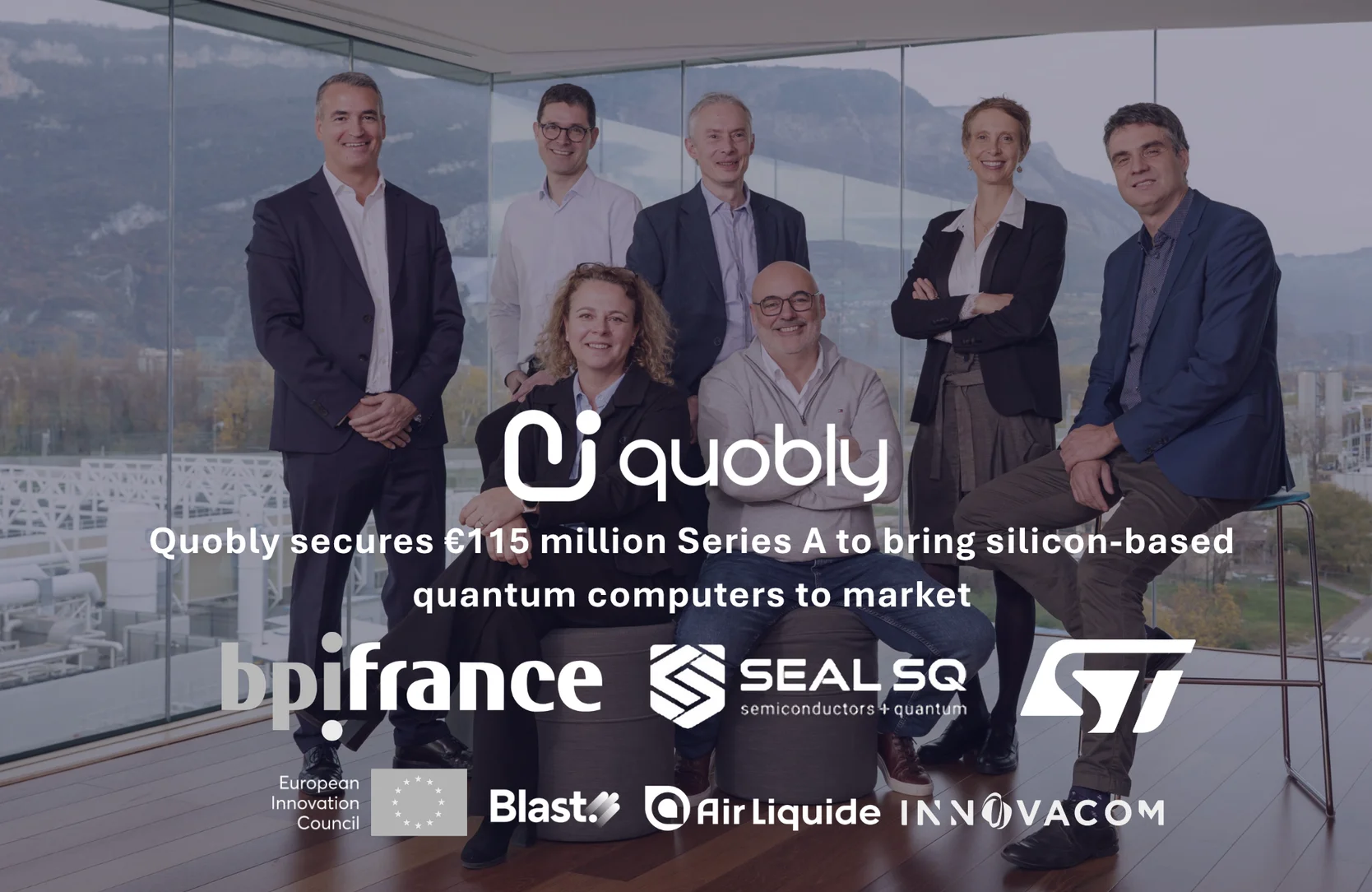
A €115 million Series A funding round has positioned Quobly, a French quantum computing company, to rapidly advance the industrialization of its silicon-based quantum computers and deliver its first commercial product by year’s end. Led by Bpifrance, SEALSQ and STMicroelectronics, the investment will fuel continued research and development, as well as international commercial expansion for the company’s approach to scalable quantum processing. Quobly plans to deploy its initial system, Alloy Pioneer, via the cloud, targeting early adopters in high-performance computing and research environments. This financing marks a key step in transitioning from validation to production, leveraging semiconductor manufacturing to address challenges in yield and reproducibility, and is supported by the French government’s France initiative through Bpifrance’s Deep Tech fund.
€115 Million Series A Fuels Silicon Quantum Computer Industrialization
Quobly, a French company developing silicon-based quantum computing, has secured €115 million in a Series A funding round, indicating a significant increase in efforts to translate quantum research into commercially viable systems. This substantial capital injection highlights Quobly’s approach, which centers on leveraging existing semiconductor manufacturing techniques, specifically FD-SOI technology on 300 mm wafers, to address critical challenges in scaling quantum systems. Quobly’s strategy prioritizes compatibility; its systems are designed to align with standard data center footprints, power requirements, and utility needs, streamlining deployment for potential clients. Alloy Pioneer will also be accessible through Alloy Forge, Quobly’s application development environment, allowing users to test applications under realistic hardware conditions.
This Series A builds upon a previously completed €19 million seed phase, during which Quobly successfully demonstrated the feasibility of fabricating silicon qubits within established semiconductor processes and established a foundational system-level architecture. “This financing marks a transition from technology validation to industrial execution,” explains Maud Vinet, CEO and co-founder of Quobly. “Over the past two years, we have demonstrated that silicon qubits can be developed within semiconductor manufacturing processes and integrated into a system architecture.” Strategic partnerships with companies like STMicroelectronics, Air Liquide, Soitec, and Orano are central to Quobly’s industrial approach, accelerating the integration of process control and materials engineering from the outset.
Alloy Product Line: Pioneer System and Cloud Deployment
Quobly is establishing a clear pathway from research to practical application with its Alloy product line, designed to integrate seamlessly into existing high-performance computing ecosystems. Beyond securing €115 million in Series A funding, the company is focused on delivering tangible hardware, beginning with the Alloy Pioneer system slated for cloud deployment by year-end, and subsequent installation within HPC infrastructures. This approach distinguishes Quobly by prioritizing compatibility with current data center infrastructure, addressing concerns about footprint, power requirements, and overall ease of integration, critical factors for early adoption. Quobly intends to increase the performance and scalability of its quantum computer product line and accelerate the industrialization of its silicon quantum processors, a process supported by expansion of its hardware, control electronics, and software stack.
SEALSQ is proud to participate as a lead investor in Quobly’s Series A financing.
Carlos Moreira, CEO, SEALSQ
FD-SOI Technology Enables Scalable Quantum Processor Development
Quobly’s approach to building scalable quantum processors centers on fully depleted silicon-on-insulator (FD-SOI) technology fabricated on 300mm wafers, a deliberate strategy to leverage existing semiconductor manufacturing infrastructure. This contrasts with many quantum computing efforts reliant on exotic materials or unproven fabrication techniques; by utilizing established processes, Quobly aims to address critical hurdles in scalability, yield, and reproducibility. The company isn’t simply adapting existing chipmaking; they are developing silicon qubits specifically designed for dense integration and compatibility with current industrial fabrication standards. These collaborations are not merely supply agreements, but are intended to accelerate the transfer of Quobly’s quantum technologies into advanced manufacturing environments, integrating process control, materials engineering, cryogenics, and yield optimization from the earliest stages.
Laurent Malier, Executive Vice President, Global Technology R&D at STMicroelectronics, explains that “Quantum computing will achieve the scale needed by HPC customers only if breakthrough quantum systems can be industrialized and integrated with semiconductor-grade rigor and backed by a robust ecosystem.” The choice of FD-SOI isn’t arbitrary; it allows for greater control over the quantum properties of the silicon qubits, potentially leading to improved coherence times and reduced error rates. Quobly’s system-level co-design approach further emphasizes this integration, simultaneously optimizing hardware, control electronics, and software. This industrial approach, prioritizing manufacturability and co-development, distinguishes Quobly and positions them to deliver quantum computing systems that can be realistically deployed and scaled within existing high-performance computing infrastructures.
Quantum computing will achieve the scale needed by HPC customers only if breakthrough quantum systems can be industrialized and integrated with semiconductor-grade rigor and backed by a robust ecosystem.
Laurent Malier, Executive Vice President, Global Technology R&D, STMicroelectronics
Strategic Partnerships Drive Semiconductor Manufacturing Integration
Quobly’s rapid advancement toward commercial quantum computing is occurring with strategic alliances demonstrably central to its industrialization strategy. A recently secured €115 million Series A funding round, led by Bpifrance, SEALSQ, and STMicroelectronics, underscores confidence in the company’s silicon-based approach and its ability to scale production. Beyond capital, these partnerships provide critical access to established semiconductor infrastructure and expertise, accelerating a notoriously complex process. This emphasis on manufacturability distinguishes Quobly, prioritizing technology-system co-development from the outset. Gwenaël Hamon, Senior Investment Director at Bpifrance, affirms this approach, stating, “By choosing a quantum architecture compatible with established microelectronics industry standards, Quobly paves the way for the rapid and controlled industrialization of breakthrough technologies, an essential condition to ensure Europe’s strategic autonomy in quantum computing.” Quobly’s system-level co-design approach, coupled with these partnerships, aims to deliver quantum computing solutions deployable within existing computing infrastructures, rather than requiring entirely new facilities or expertise.
By choosing a quantum architecture compatible with established microelectronics industry standards, Quobly paves the way for the rapid and controlled industrialization of breakthrough technologies, an essential condition to ensure Europe’s strategic autonomy in quantum computing.
Gwenaël Hamon, Senior Investment Director, Bpifrance
See today’s quantum computing news on Quantum Zeitgeist for the latest breakthroughs in qubits, hardware, algorithms, and industry deals.