
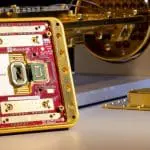
Microsoft Quantum has achieved a substantial leap in quantum computing stability with its new Majorana 2 processor, creating qubits that are 1,000 times more reliable than its previous unit. This improvement stems from a key materials science innovation: replacing aluminum with lead in the processor’s construction, effectively doubling the topological gap and bolstering qubit robustness. The resulting qubits now maintain quantum information for an average of 20 seconds, with some lasting over a minute, a critical advancement for performing complex calculations. “Majorana 2 contains qubits that are 1,000 times more reliable than those in our previous quantum processing unit,” explains Chetan Nayak, Technical Fellow and Corporate Vice President of Quantum Hardware, highlighting the progress enabled by artificial intelligence and accelerating the timeline for a scalable quantum computer.
Lead-Based Material Stack Enhances Topological Qubit Lifetimes
A shift in materials has yielded a thousandfold increase in the reliability of qubits, the fundamental building blocks of quantum computers, according to researchers at Microsoft Quantum. The leap forward, detailed in a recent technical paper, centers on a redesigned material stack for the company’s Majorana 2 processor, replacing aluminum with lead in a critical component. This substitution has dramatically enhanced the stability of topological qubits, extending their ability to maintain quantum information, a persistent challenge in the field. The core innovation addresses a protective barrier against environmental noise that corrupts quantum states. The team explains that the improvement is directly attributable to the lead-based material. This extended coherence is crucial for performing complex calculations, as it allows more operations to be completed before the quantum information is lost. This achievement has also garnered recognition from the Defense Advanced Research Projects Agency (DARPA), which previously identified Microsoft as a leader in the development of utility-scale quantum computing.
Tetron Architecture and Measurement-Based Operations in Majorana 2
The current pursuit of stable quantum computation increasingly focuses on topological qubits, leveraging their inherent resistance to environmental disruption; Microsoft’s Majorana 2 processor exemplifies this approach with a novel architecture centered around tetrons. These tetrons, described as a type of topological qubit, are constructed from two superconducting nanowires hosting Majorana Zero Modes (MZMs) at their ends, which function as the fundamental building blocks storing quantum information via electron parity, the evenness or oddness of electron count within the wire. Unlike many qubit designs relying on direct manipulation, Majorana 2 utilizes a measurement-based operational paradigm, executing calculations through parity determination of these topoconductor wires. “Each parity measurement yields a 0 or a 1, corresponding to an even or odd number of electrons in the topoconductor wire,” explains the team, highlighting the direct readout capability inherent in this design.
This measurement-based approach is integral to performing calculations and enabling quantum error correction. Digital pulses are employed to selectively connect or disconnect quantum dots from the nanowires, allowing for control and readout, and crucially, the measurement of joint parity across multiple qubits. These measurements, combined with “magic state” preparation, form the basis of complex computations. The scalability of this architecture is a key focus, with Majorana 2 being a multi-tetron device designed for expansion. Improvements in material science have directly translated to enhanced qubit performance; the switch to lead from aluminum in the material stack has more than doubled the topological gap, a protective barrier against noise. This has resulted in a dramatic increase in qubit lifetimes, extending from one to twelve milliseconds in the previous generation to exceeding 20 seconds in Majorana 2, with some qubits lasting over a minute, a more than 1,000-fold improvement in stability. The team confirms that this extension of lifespans is due to the larger topological gap made possible by using lead in the material stack, underscoring the direct link between materials and qubit coherence.
Majorana 2 contains qubits that are 1,000x more reliable than those in our previous quantum processing unit.
Chetan Nayak, Technical Fellow and Corporate Vice President of Quantum Hardware
DARPA US2QC Validates Microsoft’s Scalable Quantum Progress
This partnership signifies a crucial step toward realizing practical quantum computation, building on an earlier DARPA assessment that Microsoft “could plausibly build a utility-scale quantum computer in a reasonable timeframe.” The US2QC program, part of DARPA’s larger Quantum Benchmarking Initiative (QBI), brings together experts from institutions including Johns Hopkins University Applied Physics Laboratory and Los Alamos National Laboratory to verify quantum systems capable of tackling classically intractable problems. This enhancement directly contributes to the increased robustness of the qubits, shielding them from environmental noise and errors, as explained in their recently published technical paper detailing the fabrication of Majorana 2. This extended coherence is vital for complex calculations, and has allowed Microsoft to accelerate its roadmap, according to Nayak, a significant shift from previous projections. DARPA’s continued support through US2QC underscores the potential of this topological qubit approach to deliver a fault-tolerant prototype “in years, not decades,” bringing utility-scale quantum computing closer to reality.


See today’s quantum computing news on Quantum Zeitgeist for the latest breakthroughs in qubits, hardware, algorithms, and industry deals.