Researchers at Quandela and C2N have achieved 88 ± 1% indistinguishability between photons originating from independent quantum dot sources without relying on spectral filtering, a critical advancement for building scalable photonic quantum computers. This breakthrough addresses a longstanding technical hurdle in the field, where ensuring photons from multiple sources behave identically has proven exceptionally difficult. The work focuses on enabling the Spin-Optical Quantum Computing (SPOQC) architecture, where embedded spin qubits leverage indistinguishable photon interference to communicate, paving the way for scalable quantum computation. High-fidelity entangling operations require photons from these spin-based sources to interfere indistinguishably, highlighting the importance of this level of control for future quantum processors that can grow in power. This demonstration moves beyond limitations of single-source demultiplexing, establishing a strategy for generating indistinguishable photons from multiple independent sources.
InGaAs Quantum Dot, Cavity Sources for Scalable Photon Emission
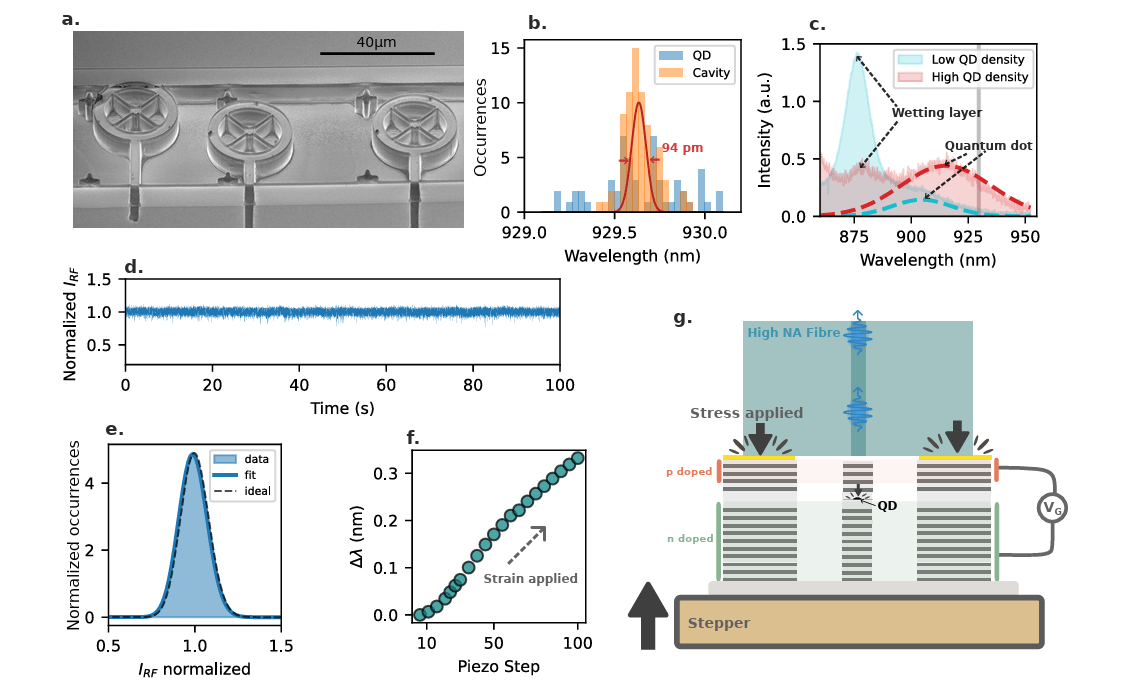
Researchers at C2N and Quandela’s Device R&D teams collaborated to engineer a system where photons emitted from independent sources behave as a unified quantum resource, overcoming a longstanding obstacle in the field. The advance centers on InGaAs quantum dots embedded within micropillar cavities, functioning as deterministic single-photon emitters, and fabricated using a low-density growth recipe via high-precision molecular beam epitaxy. This meticulous process minimizes environmental charge fluctuations, a key factor in achieving uniformity across multiple devices. The team addressed the inherent challenge of solid-state emitters, their natural variations that hinder the production of identical photons, through a combination of fabrication precision and post-fabrication tuning. Following growth, quantum dots underwent in-situ lithography based on emission wavelengths, resulting in tightly controlled wavelength dispersion of approximately 94 picometers. Further refinement employed both strain tuning for coarse wavelength correction and electric-field tuning for fine spectral alignment, enabling deterministic spectral overlap between independent emitters.
This dual-control approach is critical because historically, achieving indistinguishability required spectral filtering or post-selection, both of which limit scalability. Measurements using Hong, Ou, Mandel experiments demonstrated a mutual indistinguishability of 88 ± 1%, signifying strong quantum interference between independent devices. The researchers note that this performance is achieved without spectral filtering, without post-selection, at high emission rates, and that the result is primarily constrained by phonon-induced pure dephasing, a fundamental solid-state interaction, rather than fabrication imperfections.
Dual-Control Tuning for Deterministic Spectral Alignment
The pursuit of scalable photonic quantum computing hinges on the ability to generate and manipulate numerous identical photons, a challenge historically complicated by inherent variations in solid-state light sources. Current quantum photonic units rely on a single photon source that is demultiplexed to create multiple photons simultaneously, a technique that diminishes processing speed and introduces optical losses; however, a collaboration between the C2N and Quandela’s Device R&D teams has yielded a new approach to overcome this limitation. This level of control stems from a meticulous fabrication process beginning with low-density quantum dot growth via molecular beam epitaxy, which minimizes environmental charge noise. By removing the need for demultiplexing, this multi-source approach promises to improve throughput, simplify photonic circuits, and ultimately, advance the development of fault-tolerant quantum computing.
By enabling photons emitted from different spin-based sources to interfere, it allows the embedded spins to “talk to one another” through high-fidelity photon interference.
88% Indistinguishability Achieved via High-Fidelity Hong, Ou, Mandel Interference
This level of performance, attained without relying on spectral filtering, a technique that typically limits system scalability, represents a departure from previous limitations centered on single-source demultiplexing strategies. The team’s approach centers on engineering uniformity during fabrication and employing post-fabrication wavelength tuning to overcome inherent variations in solid-state emitters. Complementary strain and electric-field tuning mechanisms then allow for precise spectral alignment between independent emitters. Measurements utilizing Hong, Ou, Mandel experiments confirmed the high-fidelity interference, demonstrating that device-level variability is no longer the primary obstacle to scalability. The ability to generate indistinguishable photons from multiple independent sources eliminates the need for demultiplexing, improving throughput and reducing system complexity, and ultimately supporting the development of modular, large-scale photonic quantum computing systems.




See today’s quantum computing news on Quantum Zeitgeist for the latest breakthroughs in qubits, hardware, algorithms, and industry deals.