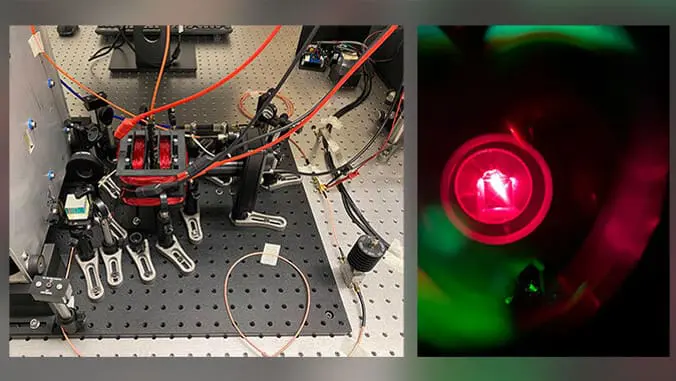
A $600,000 grant from the National Science Foundation will fund a three-year project at Mānoa focused on building interconnected networks of quantum sensors, rather than developing a single device. Led by Assistant Professor Bo-Han Wu’s Department of Electrical and Computer Engineering, the research aims to integrate these highly sensitive sensors with artificial intelligence and machine learning to improve data analysis and adaptability. These advancements could significantly enhance the precision of detecting subtle changes in signals like temperature, light, and electromagnetic activity, surpassing the capabilities of many existing technologies. Wu said this project is about helping quantum technologies move from theory into tools that can solve real-world problems, and the unique Hawaiian environment is a key testing ground for applications ranging from ocean monitoring to disaster preparedness.
Quantum Sensors Enhance Signal Detection and Measurement
These sensors, capable of detecting minute shifts in variables like temperature, light, and electromagnetic fields, promise a level of precision exceeding that of conventional technologies. The NSF funding will support research beginning June 1 and continuing through May. The project’s core innovation lies in integrating quantum science with artificial intelligence and machine learning, allowing the sensor networks to dynamically adjust to environmental changes and refine data analysis in real-time, a crucial step toward practical application. Hawaiʻi’s distinctive geographical and environmental conditions are central to the project’s design, explicitly positioning the islands as a key location for testing and refining these advanced sensors. Researchers anticipate the technology will address pressing local concerns, including enhanced ocean monitoring, improved disaster preparedness, and more robust communication infrastructure.
More accurate sensors could facilitate earlier detection of environmental shifts, enhance medical imaging, and fortify wireless and satellite networks, impacting daily life for Hawaiʻi residents. A significant hurdle in quantum technology is the inherent fragility of quantum signals, susceptible to disruption from even minor noise or interference; Wu’s team will concentrate on bolstering the stability and reliability of these systems for practical deployment. The grant extends beyond research, encompassing educational initiatives such as new courses, open-source software development, and outreach programs designed to cultivate a skilled workforce in quantum science and engineering, ultimately strengthening Hawaiʻi’s position within the growing quantum technology sector.
AI/Machine Learning Improves Quantum Network Efficiency
This emphasis on networking is crucial, as collaborative operation dramatically enhances the ability to detect faint signals with greater accuracy. The team will investigate how these sensors can function cohesively to amplify signal detection. This represents a shift from passive detection to active, intelligent data analysis, promising more nuanced and reliable measurements. The National Science Foundation’s Foundations of Emerging Technologies program recognizes the long-term national importance of this work, anticipating that quantum technology will become a cornerstone of future scientific and industrial innovation. For Hawaiʻi residents, the potential benefits range from improved disaster preparedness to more accurate medical diagnostics and strengthened communication networks.
Hawaiʻi offers a unique real-world setting for quantum sensor research, where advanced sensors could help address island challenges in ocean monitoring, disaster preparedness and resilient communications.
See today’s quantum computing news on Quantum Zeitgeist for the latest breakthroughs in qubits, hardware, algorithms, and industry deals.