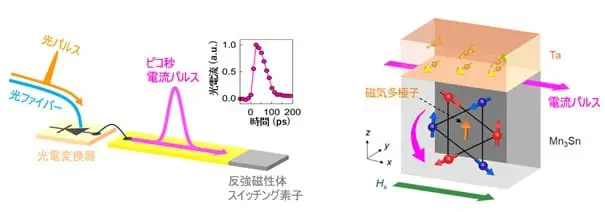
Researchers at RIKEN and the University of Tokyo have achieved a 40 picosecond switching speed in the antiferromagnetic material Mn₃Sn, demonstrating a rewriting of magnetic state with an electric pulse one thousand times faster than the current nanosecond limit of conventional CPUs and GPUs. This breakthrough addresses a critical barrier to increasing processing speeds; current systems struggle with increased energy consumption when operating below a nanosecond. The team, led by Project Professor Tsai Hanshen and Professor Satoshi Nakatsuji of the University of Tokyo, alongside Professor Ryotaro Arita of RIKEN, showed this picosecond operation is possible with reduced heat generation and high durability through a spin-orbit torque mechanism. This research, published in Science, also demonstrated similar switching using 60 picosecond photocurrent pulses, representing a demonstration of optical-to-electrical signal conversion.
Mn₃Sn Antiferromagnet Enables 40 Picosecond, Ultra-Low Power Switching
A newly demonstrated electrical switching mechanism utilizing the antiferromagnetic material Mn₃Sn achieves rewriting speeds of just 40 picoseconds, potentially exceeding the speed limits of modern computing. Previous attempts at picosecond switching often resulted in excessive heat generation and compromised device durability, hindering practical application. The researchers state that their approach is distinct from previously examined picosecond switching mechanisms. Beyond electrical pulses, the group also demonstrated successful switching using 60 picosecond photocurrent pulses generated by a laser and photoelectric converter, showcasing a pathway toward directly linking optical signals to nonvolatile memory writing. This demonstration of optical-to-electrical signal conversion opens possibilities for new architectures in data storage and processing. The research published in Science on May 15 details how Mn₃Sn’s properties allow for picosecond operation with significantly reduced heat generation and improved durability, crucial factors for building energy-efficient and reliable computing systems; the team included researchers Ryotaro Arita, Professor Mitsuru Takenaka, and Associate Professor Shinji Miwa for Solid State Physics.
Spintronics Photoelectric Conversion Demonstrates Nonvolatile Memory Writing
Current approaches to increasing computational speed in central processing units and graphics processing units are reaching fundamental limits; achieving operation speeds below a nanosecond has proven difficult due to a corresponding surge in energy consumption, hindering further performance gains. This achievement bypasses the energy consumption issues plaguing conventional high-speed switching mechanisms, as the team observed significant reduction in heat generation alongside high durability. The team extended this capability by demonstrating that similar magnetic switching could be triggered by 60 picosecond pulses of light, generated through a combination of a telecommunication wavelength laser and a photoelectric converter. This directly links an optical signal to the writing process in nonvolatile memory, potentially streamlining data storage and retrieval. Unlike previous picosecond switching attempts that required temperatures of several hundred degrees Celsius, this method operates with minimal heat production, suggesting a pathway toward practical applications in future computing architectures. The research group, led by Project Professor Tsai Hanshen, successfully showed that Mn₃Sn can be utilized to rewrite binary values with this ultra-fast, low-power technique, enabling more efficient and powerful computing systems.
In current CPUs and GPUs, it has been difficult to achieve operation speeds of less than a nanosecond (a nanosecond is one billionth of a second) because energy consumption usually increases dramatically at high processing speeds.
See today’s quantum computing news on Quantum Zeitgeist for the latest breakthroughs in qubits, hardware, algorithms, and industry deals.