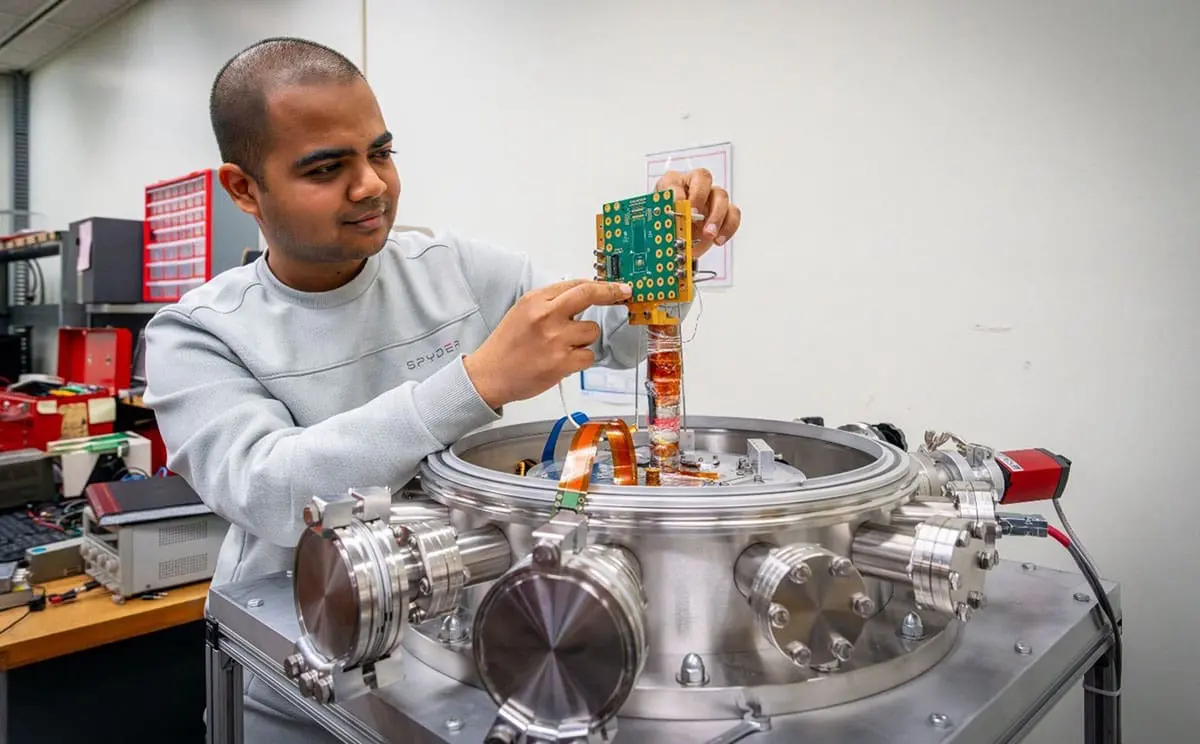
Fermilab leads a multi-laboratory initiative, including Oak Ridge, Lawrence Berkeley, SLAC, and Sandia National Laboratories, to accelerate the design of specialized computer chips for use in some of the world’s most challenging environments. The Accelerating eXtreme Environment Specs-to-Silicon, or AXESS, project aims to reduce chip development timelines from months to weeks by integrating artificial intelligence across all stages of the design process, directly supporting the goals of DOE’s Genesis Mission. These custom-designed chips are critical for advancements in quantum computing, fusion energy, and particle physics, where functionality in extreme temperatures, high radiation, and at ultra-fast speeds is paramount. “All of this coming together within the Genesis Mission is a great opportunity for Fermilab to team up with others and use AI to significantly accelerate chip design,” said Nhan Tran, head of Fermilab’s AI Program.
AXESS Project: Accelerating Chip Design for Extreme Environments
A national initiative is significantly reducing the timeline for designing specialized computer chips, essential for advancements in fields ranging from quantum computing to fusion energy. This collaborative effort directly supports the Department of Energy’s Genesis Mission, a program focused on accelerating scientific discovery through AI implementation. Traditionally, custom-designing chips for research has been a lengthy process, often taking months or even years; however, the AXESS team is building an AI framework intended to reduce this timeframe to weeks. Giuseppe Di Guglielmo, a principal engineer at Fermilab co-leading the project, explained that the goal of this framework is to create AI systems that help designers make informed decisions at each step of the design process, providing feedback for subsequent designers along the pipeline.
The team is integrating all design stages, using large language models to automate manual steps and smaller surrogate models to rapidly predict chip performance across millions of design options. This approach has already yielded significant results, with the team achieving an approximately 500-times speedup for the design phase of qubit readout algorithms and developing more accurate transistor modeling at 4 kelvin, crucial for quantum computing environments. David Burnette, engineering director at Siemens, added, “By uniting Siemens’ proven technologies with the science at Fermilab and across the DOE labs, we’re accelerating a new class of chips for quantum, fusion and high-radiation environments at a speed and scale the nation has not previously experienced.”
AI Integration Streamlines Microelectronics Design Stages
The demand for increasingly specialized microchips is driving a shift in design methodologies, moving away from traditional, sequential processes toward integrated, AI-driven workflows. Currently, custom chip creation for fields like quantum computing and fusion energy remains a lengthy, iterative process, often spanning months or even years from initial specification to fabricated silicon. Researchers are not simply automating existing steps; they are fundamentally restructuring the design pipeline. Decisions made during materials selection or transistor design could previously create unforeseen complications in later stages, necessitating costly revisions. The AXESS project, directly supporting the Department of Energy’s Genesis Mission, is building a framework that leverages artificial intelligence to ensure holistic optimization throughout the entire process. This advancement is enabled by a combination of large language models, used for high-level decision-making, and smaller surrogate AI models that rapidly predict chip performance characteristics, allowing for the evaluation of millions of design options within minutes and isolating the most promising candidates before full-scale fabrication.
All of this coming together within the Genesis Mission is a great opportunity for Fermilab to team up with others and use AI to significantly accelerate chip design.
Nhan Tran, head of Fermilab’s AI Program
See today’s quantum computing news on Quantum Zeitgeist for the latest breakthroughs in qubits, hardware, algorithms, and industry deals.