

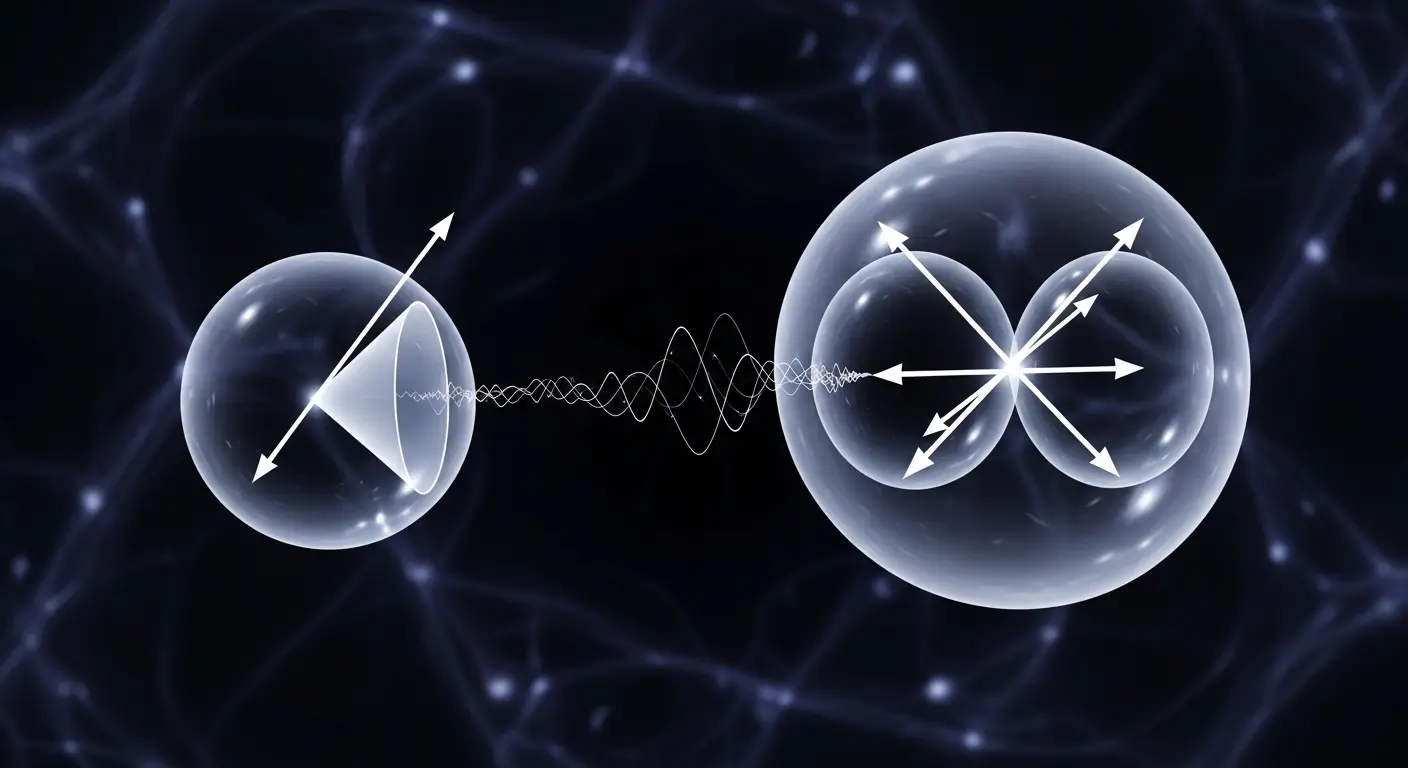
Physical loss, typically detrimental to quantum systems, can be harnessed as a resource for creating nonreciprocal interactions and entanglement in superconducting qubits. Yu-Meng Ren and Peng-Bo Li at Xi’an Jiaotong Universit detail a scheme utilising lossy auxiliary cavities to connect two transmon qubits, achieving nonreciprocity through interference between multiple coupling paths. The scheme establishes a key connection between engineered loss and nonreciprocal entanglement, potentially enabling advancements in scalable quantum networks by offering a new method to tailor quantum behaviours.
Controlled loss enables scalable nonreciprocal entanglement in superconducting qubits
Engineered loss demonstrably generates nonreciprocal entanglement, exceeding limitations of previous methods reliant on bulky magneto-optical components. Controlled loss is now directly linked to this quantum effect, unlike prior methods which demanded strong magnetic fields and were unsuitable for on-chip integration. Utilising interference between multiple lossy coupling paths in a superconducting platform created unequal effective couplings between remote qubits, enabling a one-way flow of quantum information. This represents a significant departure from traditional approaches to nonreciprocity, which often rely on time-reversal symmetry breaking via external magnetic fields or complex material designs. The ability to achieve nonreciprocity without these constraints is crucial for developing compact and scalable quantum devices.
The tunability of nonreciprocity allows precise control over quantum behaviours, opening new possibilities for advanced quantum technologies. This loss-induced scheme offers a pathway towards scalable quantum networks by tailoring both reciprocal and nonreciprocal behaviours, representing a major advance in quantum information processing. Currently, the demonstration involves only two qubits, and scaling to larger, more complex networks will require overcoming challenges related to maintaining coherence and controlling loss in increasingly intricate circuits. Specifically, minimising unwanted interactions and decoherence effects as the number of qubits increases will be paramount. Furthermore, precise calibration and control of the loss rates in each cavity will be essential for maintaining the desired nonreciprocal behaviour across the network.
The system’s design circumvents the need for bulky magneto-optical components and strong magnetic fields previously essential for achieving nonreciprocity, marking a key step towards on-chip integration and scalable quantum networks. Entanglement arises from interference between multiple lossy coupling paths, where coherent phases reverse with propagation direction, while loss-induced phases remain constant, creating unequal effective couplings. Manipulating the relative phase induced by loss allows tailoring of both reciprocal and nonreciprocal behaviours, offering precise control over quantum interactions. The strength of this control is determined by the precise engineering of the cavity losses and the qubit-resonator coupling strengths, allowing for fine-tuning of the quantum interactions.
Lossy Cavity Interconnections Enable Directed Qubit Coupling
This work centres on a carefully organised interference technique utilising lossy cavities, spaces designed to allow some energy to escape, similar to a leaky bucket, but intentionally used here to control the flow of quantum information. Connecting two superconducting transmon qubits with these lossy cavities created multiple pathways for quantum information to travel. The loss-induced phases within these cavities remain direction independent, meaning energy loss doesn’t favour one direction; however, the phases associated with the qubit-resonator couplings do change direction. The cavities are designed to have a specific quality factor, characterising the rate of energy loss, which is crucial for achieving the desired level of nonreciprocity. A lower quality factor implies a higher loss rate, and careful selection of this parameter is vital.
This combination generates differing interference conditions depending on the direction of signal transmission, effectively creating unequal effective couplings between the qubits. The approach avoids bulky components and strong magnetic fields often required by conventional methods of achieving similar directional control. The experiment focused on utilising loss as a resource rather than eliminating it, and the superconducting platform offers enhanced coherence and controllable qubit couplings, making it suitable for scalable quantum networks. Superconducting transmon qubits are favoured due to their relatively long coherence times and ease of fabrication using established microfabrication techniques. The choice of materials and fabrication processes significantly impacts qubit performance and scalability.
Harnessing dissipation to generate entanglement in superconducting qubits
Researchers are increasingly focused on building larger and more stable quantum systems, but maintaining the delicate quantum states of qubits remains a formidable challenge. This offers a potentially major approach by reframing energy loss, typically considered an obstacle, as a tool for engineering entanglement. Energy loss is typically viewed as detrimental to maintaining qubit stability, but this group demonstrates its potential as a resource for creating entanglement, a vital component of quantum computing. The ability to create and manipulate entanglement is fundamental to many quantum algorithms and quantum communication protocols.
Deliberately introducing dissipation, or energy loss, into a superconducting circuit can generate nonreciprocal entanglement, a quantum phenomenon where information preferentially travels in one direction. Superconducting transmon qubits, tiny electronic circuits, were connected with lossy cavities, creating differing interference conditions for signals travelling in either direction. Scaling this scheme to a practical quantum network necessitates overcoming significant hurdles in coherence and control, as detailed in work by Krinner and colleagues, who highlight the complexities of building 100-qubit systems. These challenges include minimising crosstalk between qubits, improving the fidelity of quantum gates, and developing efficient error correction schemes. The long-term viability of superconducting quantum computing hinges on addressing these issues. Furthermore, the precise characterisation of the loss mechanisms within the cavities and their impact on qubit coherence is crucial for optimising the performance of these systems. The research opens avenues for exploring novel quantum architectures where dissipation plays a constructive role, potentially leading to more robust and scalable quantum technologies.
Researchers demonstrated that engineered energy loss can be utilised as a resource to generate nonreciprocal entanglement in superconducting transmon qubits connected via lossy cavities. This is significant because loss is usually considered a hindrance in quantum information processing, but this work shows it can be harnessed to create a key quantum phenomenon. The differing interference conditions created by loss allow for a form of entanglement where information travels preferentially in one direction. The authors suggest further work is needed to address challenges in coherence and control when scaling this scheme to larger systems.
👉 More information
🗞 Loss-induced quantum nonreciprocity and entanglement in superconducting qubits
🧠 ArXiv: https://arxiv.org/abs/2605.11457


See today’s quantum computing news on Quantum Zeitgeist for the latest breakthroughs in qubits, hardware, algorithms, and industry deals.



