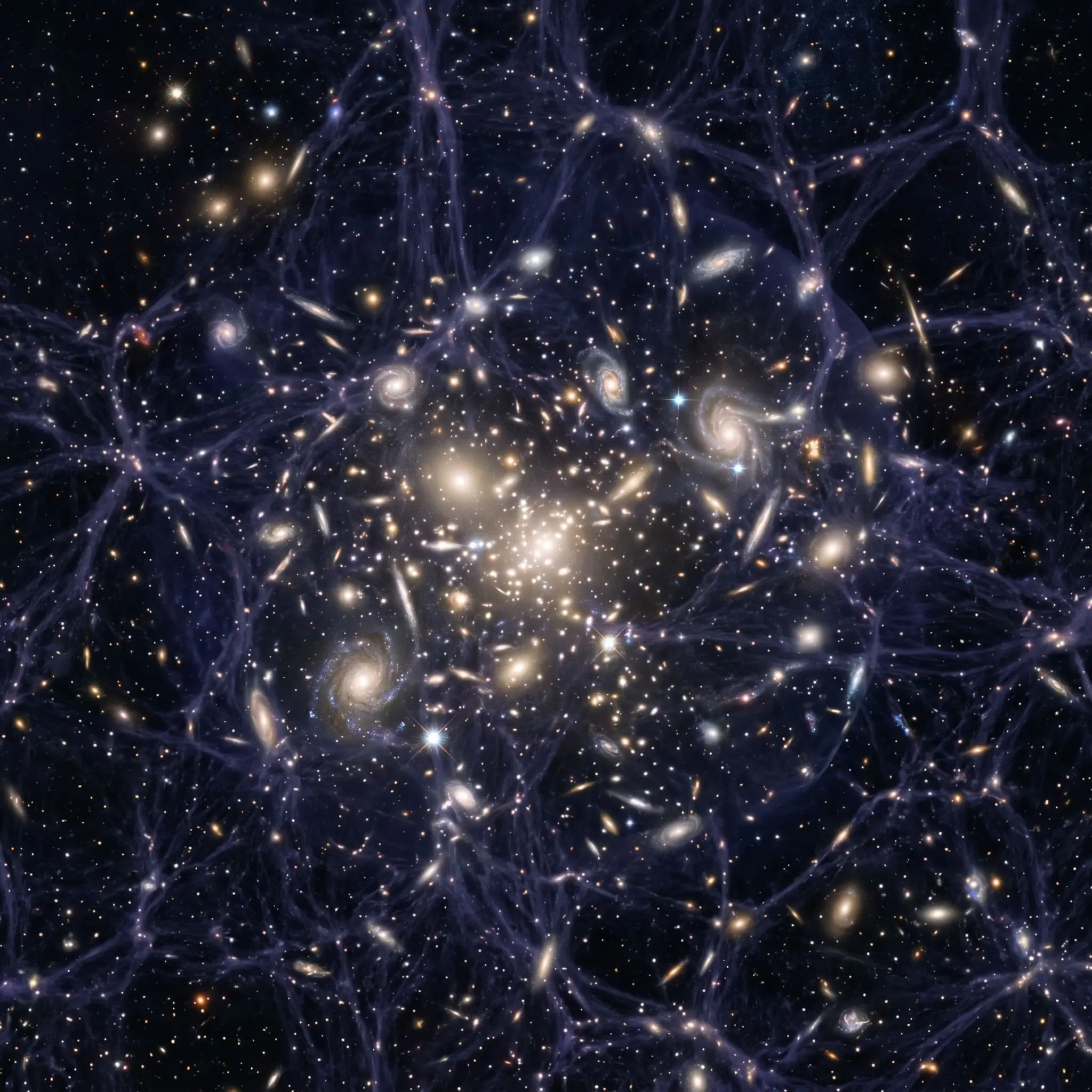
Gravitational waves detected by the LIGO-Virgo-KAGRA (LVK) network are now being scrutinized for a surprising signal: potential evidence of dark matter. Physicists at MIT and in Europe have developed a new model predicting how gravitational waves would appear if generated by black holes moving through dense regions of this elusive substance, offering a specific, testable signature to seek within existing data. Analyzing signals from the LVK’s first three observing runs, the team identified one event, GW190728, exhibiting possible signs of a dark matter imprint, though researchers emphasize this is not a definitive detection. “We know that dark matter is around us. It just has to be dense enough for us to see its effects,” says Josu Aurrekoetxea, a postdoc in the MIT Department of Physics, highlighting the potential for gravitational waves to reveal the universe’s hidden mass.
Dark Matter Interaction via Gravity and Lensing
Black holes, once primarily studied for their own extreme properties, are now serving as potential lenses through which to observe the universe’s hidden mass. Physicists are actively analyzing gravitational waves for subtle distortions indicative of dark matter interactions. This approach stems from the fundamental understanding that dark matter, constituting over 85 percent of the matter in the universe, interacts with its surroundings solely through gravity, presenting a unique detection challenge and opportunity. Unlike conventional matter, it doesn’t interact with light or electromagnetic fields, rendering traditional detection methods ineffective, and making gravitational waves a potentially singular channel for its discovery. This model doesn’t simply suggest dark matter might affect these waves, but rather outlines a specific, testable signal. Applying this technique to data collected by the LIGO-Virgo-KAGRA (LVK) network during its first three observing runs, the team scrutinized 28 of the clearest gravitational wave signals.
While 27 aligned with expectations of originating from black hole mergers in a vacuum, one signal, designated GW190728, exhibited a “preference,” or agreement, with the model predicting a dark matter imprint. The underlying principle relies on the behavior of dark matter particles, theorized to act as coordinated waves near black holes. As these waves interact with a rapidly spinning black hole, the black hole’s rotational energy can be transferred to the dark matter, amplifying it in a process called superradiance. This amplification could create extremely dense concentrations of dark matter, leaving a detectable imprint on the gravitational waves emitted during a black hole merger. The team’s model predicts what this imprint would look like, accounting for the distance the wave travels before reaching Earth. Aurrekoetxea explains, “We know that dark matter is around us.”
Modeling Gravitational Waves in Dark Matter Environments
Rather than solely using these ripples in spacetime to study the black holes that create them, physicists are now analyzing the signals for subtle “imprints” of dark matter, opening a new avenue for indirect detection of this elusive substance. This approach hinges on the unique nature of dark matter, which, unlike conventional matter, interacts with the universe almost exclusively through gravity. The team’s work, published in Physical Review Letters, details a method for predicting the waveform, the specific pattern, of gravitational waves produced by colliding black holes in a dark matter environment, allowing for comparison with observed signals. They meticulously simulated black hole binaries, varying parameters like mass and the density of surrounding dark matter, to predict how these factors would alter the resulting gravitational waves.
However, the signal GW190728 exhibited a “preference” for the dark matter model, suggesting a potential imprint. The model accounts for superradiance, where the rotational energy of a rapidly spinning black hole can amplify surrounding dark matter waves, creating extremely dense concentrations. Aurrekoetxea adds, “What we think is important to highlight is that without waveform models like ours, we could be detecting black hole mergers in dark matter environments, but systematically classifying them as having occurred in vacuum.”
Black holes provide a mechanism to enhance this density, which we can now search for by analyzing the gravitational waves emitted when they merge.
Josu Aurrekoetxea, a postdoc in the MIT Department of Physics
LIGO-Virgo-KAGRA Analysis of Black Hole Binary Signals
Researchers are increasingly turning to an unexpected source in the hunt for dark matter: the gravitational waves rippling across spacetime. This approach differs from traditional dark matter searches, which typically focus on direct detection experiments or observations of its gravitational effects on large-scale structures. Detailed numerical simulations were performed, varying black hole mass, environmental conditions, and dark matter density to map out expected waveform patterns. This makes gravitational waves a particularly promising detection channel, as the waves themselves are distortions of spacetime caused by gravity. Specifically, the model considers dark matter particles, theorized to behave as waves when interacting with rapidly spinning black holes. This interaction could amplify the dark matter’s density through a process called superradiance, creating a detectable signature in the emitted gravitational waves. Aurrekoetxea notes, “We know that dark matter is around us.”
We now have the potential to discover dark matter around black holes as the LVK detectors keep collecting data in the coming years.
Soumen Roy, who led the data analysis part of the work
GW190728 Signal Shows Potential Dark Matter Imprint
The search for dark matter may have gained an unexpected ally: merging black holes. This approach is particularly compelling given dark matter’s limited interactions; it interacts with its surroundings only through gravity, making gravitational waves a uniquely suited channel for observation. A new modeling technique, developed by researchers at MIT and in Europe, is central to this effort. The team’s simulations considered various black hole properties, including mass and spin, alongside differing dark matter densities, to predict the resulting waveform. GW190728, originating from a black hole binary with a combined mass of approximately 20 times the mass of the sun, showed a pattern consistent with a merger occurring within such a dense dark matter cloud. This isn’t a definitive discovery, but a promising new method for sifting through gravitational wave data.
We know that dark matter is around us. It just has to be dense enough for us to see its effects.
Josu Aurrekoetxea, a postdoc in the MIT Department of Physics


See today’s quantum computing news on Quantum Zeitgeist for the latest breakthroughs in qubits, hardware, algorithms, and industry deals.