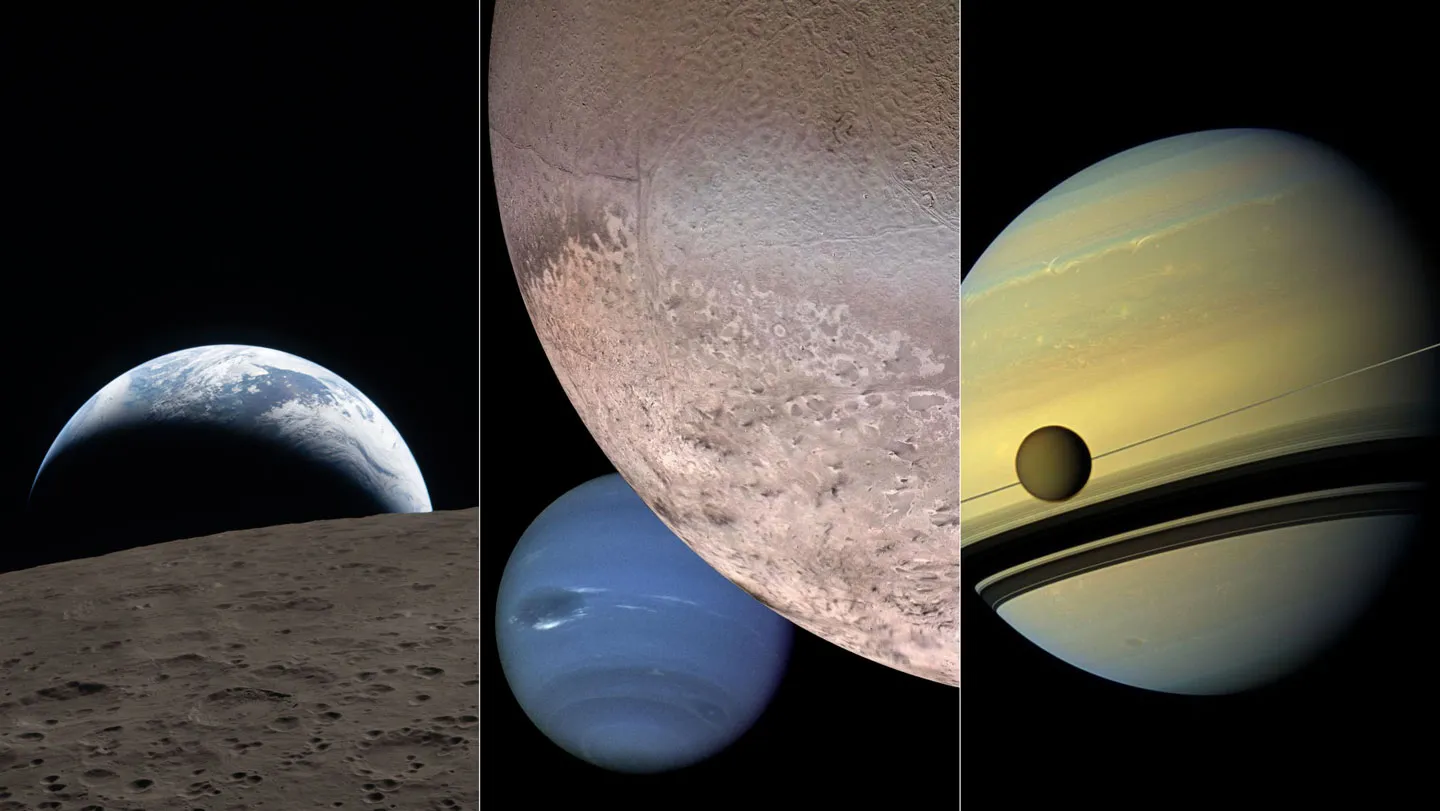
The recent Artemis II mission delivered striking new views of Earth and the moon, revealing a crescent Earth as a luminous sliver surrounded by darkness. These images, reminiscent of those captured by decades of robotic exploration, underscore the power of space photography to connect us to worlds beyond our own. Planetary scientist Candice Hansen-Koharcheck dedicated nearly 50 years to capturing such images, touching almost every planet in the solar system and its moons; she was the first to see the “Pale Blue Dot,” the portrait of Earth that inspired Carl Sagan. “Even with the best possible telescope, you’ll never get a perspective like this from the Earth,” Hansen-Koharcheck once observed, recognizing that the camera may be the most meaningful piece of equipment on any space mission, bringing the wonders of the cosmos within reach for those of us on Earth.
Artemis II and Iconic Earth Views from Space
Nearly 50 years of dedication to planetary science culminated in a unique perspective on the cosmos for Candice Hansen-Koharcheck, a scientist whose career spanned nearly every planet in our solar system and numerous moons, shaping how we visualize these distant worlds. Her legacy extends beyond scientific data; Hansen-Koharcheck understood the profound impact of imagery, recognizing its power to connect humanity with the vastness of space, a skill vividly demonstrated by recent missions like Artemis II.
This dramatic contrast recalls the iconic image captured by Voyager 1 in 1990, a photograph Hansen-Koharcheck was the first to see, the portrait of Earth that inspired Carl Sagan’s famous description of Earth as “a mote of dust suspended in a sunbeam.” Hansen-Koharcheck’s influence extended to the Voyager missions from their inception, where she designed camera sequences for all flybys over twelve years, ensuring optimal timing, filters, and exposures to maximize scientific return and aesthetic impact. “I feel like Voyager really belongs to everyone in the world,” she told me in 2024, emphasizing the inclusive nature of the mission’s visual output. The moon’s farside, revealed in Artemis II imagery, presented a landscape rippled with craters, a surprisingly relatable comparison that transformed a distant, alien terrain into something almost familiar.
This ability to make the unfathomable feel accessible was central to Hansen-Koharcheck’s approach; she actively solicited public suggestions for targets on Mars through the HiRISE camera, which has been photographing Mars since 2006, and encouraged open access to raw data from the JunoCam mission, allowing enthusiasts to process images and reveal Jupiter’s atmosphere in stunning detail. Her commitment to sharing these perspectives extended to her belief that “Why go to outer space if you’re not going to show everyone else what you witnessed?” a sentiment that continues to drive space exploration and inspire future generations of planetary scientists and image-makers.
Candice Hansen-Koharcheck’s Work with Voyager Missions
Beyond the recent imagery delivered by missions like Artemis II, a legacy of planetary exploration extends back decades, built upon the dedication of scientists like Candice Hansen-Koharcheck. This early experience shaped her approach to space photography, emphasizing the importance of thoughtful planning and execution to reveal hidden details of distant worlds. The Voyager probes, traveling past Jupiter, Saturn, Uranus, and Neptune over twelve years, generated a wealth of data, but Hansen-Koharcheck understood the power of visual communication. She recognized that a single frame could dramatically shrink the vast distances of space, making the wonders of the cosmos accessible to a wider audience. Her commitment to sharing these discoveries extended to later missions, including Cassini at Saturn and Juno at Jupiter, where she led the camera teams. Her passing on April 11th, the day after the Artemis II crew returned, marks the loss of a dedicated scientist who consistently championed the power of imagery to connect humanity with the cosmos.
Even with the best possible telescope, you’ll never get a perspective like this from the Earth.
Juno and HiRISE Cameras Reveal Planetary Detail
The meticulous work of planetary imaging extends beyond high-profile missions; for nearly 50 years, Candice Hansen-Koharcheck dedicated her career to capturing detail from across the solar system, influencing almost every robotic exploration. Hansen-Koharcheck’s influence was particularly notable on the Juno mission to Jupiter, where she led the camera team, and on HiRISE, the high-resolution imaging science experiment aboard the Mars Reconnaissance Orbiter. HiRISE, since photographing Mars in 2006, has provided unprecedented views of the planet’s surface, revealing details down to the size of a small table, and allowing scientists to study seasonal changes in the frosted polar regions. “It’s hard not to think about her anywhere you go in the solar system,” notes Alfred McEwen, a planetary geologist at the University of Arizona in Tucson and her HiRISE colleague, highlighting the breadth of her impact.
The artistry of planetary photography isn’t solely about technical skill; Hansen-Koharcheck consistently emphasized public engagement, soliciting suggestions from enthusiasts for HiRISE targets on Mars and establishing a similar open-data policy for JunoCam, the camera aboard the Jupiter-orbiting probe. This approach allowed the public to process raw data, revealing Jupiter’s atmospheric storms in striking detail, with cloud formations resembling “cold cream swirling in coffee” as described by Hansen-Koharcheck herself. Juno’s close approach to Jupiter’s Great Red Spot yielded images so detailed that they evoked a sense of immediacy, prompting Hansen-Koharcheck to share an artist’s illustration depicting a child gazing up at the colossal storm, capturing the emotional resonance of the experience.
She was instrumental in convincing mission leaders to capture this final look back at Earth, a photograph that, as she noted, showed “our little spacecraft was so far away, that this was a picture of home, and somewhere in that little bright speck, I was sitting at my desk.” Her legacy extends to future missions, with continued excitement for upcoming explorations of Jupiter’s icy moons and a renewed call for a dedicated mission to Neptune’s intriguing moon, Triton, where Voyager 2 detected geyserlike activity and a possible subsurface ocean.
That our little spacecraft was so far away, that this was a picture of home, and somewhere in that little bright speck, I was sitting at my desk.
Future Exploration of Icy Moons and Triton
Future exploration increasingly focuses on worlds beyond Mars, particularly the icy moons orbiting Jupiter and Saturn, and the distant, enigmatic Triton circling Neptune; these destinations represent compelling targets for unraveling the mysteries of potential habitability within our solar system. Building on the legacy of missions like Voyager and Cassini, upcoming endeavors such as NASA’s Europa Clipper and the European Space Agency’s Juice mission are poised to investigate subsurface oceans believed to exist beneath the icy shells of Europa and Ganymede, respectively. These probes will carry sophisticated instruments designed to penetrate the ice and analyze the composition of these hidden oceans, searching for biosignatures and assessing the potential for life.
While surface conditions on these moons are inhospitable, the presence of subsurface oceans, potentially warmed by tidal forces generated by their host planets, offers a more promising environment. Planetary scientist Fran Bagenal notes that Candice Hansen-Koharcheck, before her death, was particularly eager for a spacecraft to return to Neptune’s largest moon, Triton, where Voyager 2 spotted geyserlike activity in 1989; scientists suspect a liquid ocean lies beneath its frigid surface, which would make Triton one of the most distant ocean worlds in the solar system. Understanding the composition and dynamics of these oceans is a primary goal, requiring innovative technologies capable of operating in extreme environments. Beyond Europa and Ganymede, Triton presents a unique and compelling target. As Hansen-Koharcheck envisioned, a dedicated mission to Triton could reveal whether its internal ocean exists and, if so, its characteristics.
The moon’s retrograde orbit, moving in the opposite direction of Neptune’s rotation, suggests it may be a captured Kuiper Belt object, offering a glimpse into the building blocks of the outer solar system. “I would say, emotionally, this captures it for me,” Hansen-Koharcheck said, referencing an artist’s illustration depicting a sense of wonder and anticipation as a spacecraft approaches a distant world. The pursuit of these distant, icy realms is not merely a search for life; it’s a quest to understand the fundamental processes that shape planetary systems and the potential for habitability beyond Earth, a legacy Hansen-Koharcheck championed throughout her nearly 50-year career.
Just moving in closer and closer and seeing this world. And as you get closer, you don’t know what you’re gonna see.
See today’s quantum computing news on Quantum Zeitgeist for the latest breakthroughs in qubits, hardware, algorithms, and industry deals.