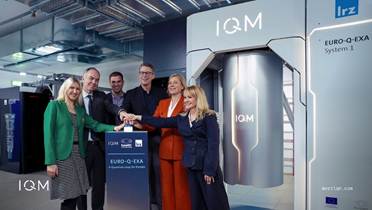
Europe has fired a significant shot in the global quantum race with the deployment of Euro-Q-Exa, the continent’s first EuroHPC Joint Undertaking quantum computer, now operational at the Leibniz Supercomputing Centre (LRZ) in Munich. Delivered by IQM Quantum Computers and built on its Radiance platform, the system is poised to advance Europe’s long-term quantum capability as a core component of its sovereign digital infrastructure. This isn’t a future promise, but “operational reality,” according to Henna Virkkunen, European Commission Executive Vice-President for Technological Sovereignty, Security and Democracy. Euro-Q-Exa will serve researchers and industry across Germany and Europe, fostering hands-on development within Europe’s existing high-performance computing ecosystem, with a substantial upgrade already planned for early 2027.
Euro-Q-Exa Deployed: Europe’s First Sovereign Quantum Computer
The system, developed by IQM Quantum Computers using its Radiance platform, is designed to allow European institutions to build, operate, and evolve their own quantum resources, rather than relying on external access. Euro-Q-Exa’s installation, hosting, and operation at LRZ are central to this ambition, ensuring local control and fostering long-term expertise. “Researchers operate, maintain, and evolve the system directly, developing practical expertise rather than relying on remote, black-box access,” highlighting the focus on internal capability building.
This approach is intended to retain European intellectual property and support sustained scientific and industrial value creation, as algorithms and applications developed on the system will remain within European institutions. The system’s deep integration with LRZ’s supercomputing infrastructure is also key, enabling realistic hybrid quantum–classical workflows and accelerating progress from experimentation to application. The impetus behind Euro-Q-Exa extends beyond scientific advancement; it’s a deliberate effort to shape the emerging quantum market. She further emphasized that, “Through EuroHPC, and together with Member States, we have already procured and co-funded the first six European quantum systems. Four are operational, and two more are under procurement.” This coordinated investment, co-funded by the EuroHPC Joint Undertaking, the German Federal Ministry of Research, Technology and Space, and the Bavarian State Ministry of Sciences and the Arts, demonstrates a commitment to anchoring strategic technologies within Europe.
Looking ahead, Euro-Q-Exa will be complemented by a more powerful 150-qubit system by the end of 2026, and a substantial upgrade is planned for early 2027, promising even more complex quantum computations. “The countries that own their open quantum infrastructure, not just access to the cloud will lead,” stated Dr Jan Goetz, CEO of IQM Quantum Computers, underscoring the strategic importance of this sovereign approach. The system is one of six being integrated across Europe, solidifying a coordinated effort to build a robust and independent quantum future.
IQM Radiance Platform Enables HPC-Quantum Integration at LRZ
This installation, utilizing IQM Quantum Computers’ Radiance platform, isn’t simply about adding quantum capability; it’s about fostering a uniquely European approach to building and retaining expertise in a critical technology. Unlike systems offering remote access, Euro-Q-Exa is designed for hands-on operation, allowing researchers to directly manage, maintain, and evolve the system, cultivating practical skills vital for long-term innovation. The system, featuring 54 superconducting qubits, is deeply integrated with LRZ’s existing supercomputing infrastructure, a deliberate strategy to accelerate the development of hybrid quantum-classical workflows. This tight coupling allows scientists to move beyond isolated experimentation and begin tackling real-world problems in fields like neurodegenerative disease research, computational pharmacology, and climate modelling. Co-funded by the EuroHPC Joint Undertaking, alongside German and Bavarian funding, Euro-Q-Exa is one of six quantum computers being strategically positioned across Europe – in Czechia, France, Italy, Poland, and Spain – to create a coordinated and sovereign digital infrastructure. The system’s launch isn’t a future aspiration, but “operational reality,” she states. This hands-on approach is designed to cultivate practical expertise and retain intellectual property within the continent, ensuring long-term scientific and industrial benefits.
As the quantum market is still nascent, the European Commission is actively shaping it: Through EuroHPC, and together with Member States, we have already procured and co-funded the first six European quantum systems. Four are operational, and two more are under procurement.
Henna Virkkunen, European Commission Executive Vice-President for Technological Sovereignty, Security and Democracy
Unlike cloud-based quantum access, Euro-Q-Exa is designed to be operated, maintained, and evolved directly by European researchers, fostering a practical understanding that transcends mere usage. This hands-on approach is central to building a self-sufficient quantum ecosystem, allowing institutions to develop internal know-how rather than remaining reliant on external providers. Crucially, Euro-Q-Exa is part of a wider, coordinated European initiative. “This is not a distant promise; it is operational reality,” said Virkkunen, highlighting the immediate impact of this investment in European quantum capabilities.
Source: https://meetiqm.com/
See today’s quantum computing news on Quantum Zeitgeist for the latest breakthroughs in qubits, hardware, algorithms, and industry deals.