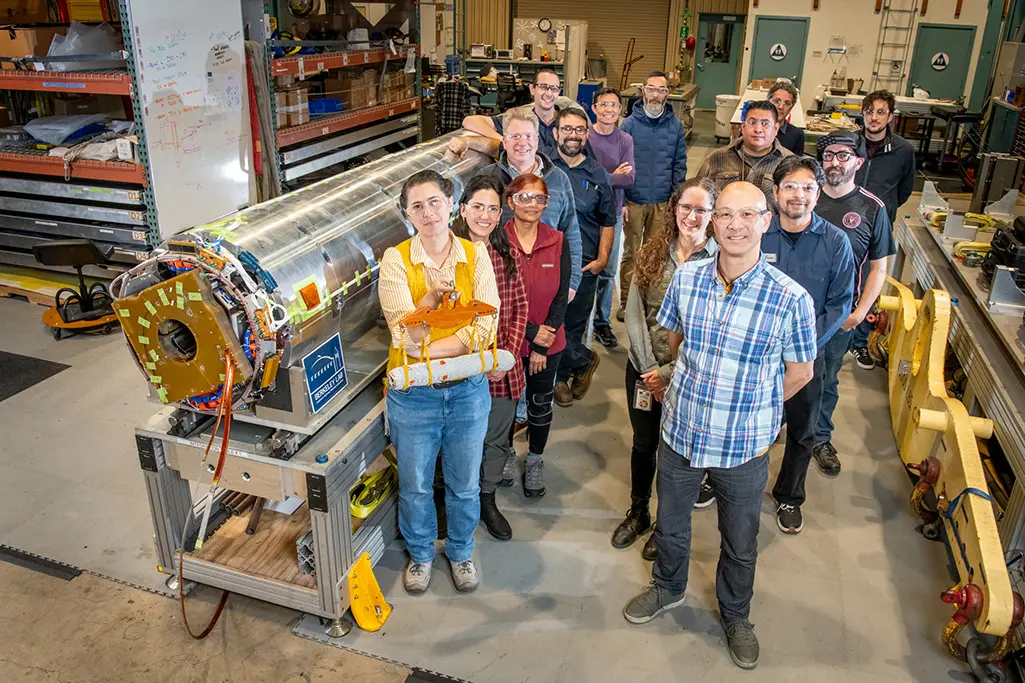
Lawrence Berkeley National Laboratory has delivered the 21st and final superconducting magnet for the $8 billion High-Luminosity Large Hadron Collider Accelerator Upgrade Project (HL-LHC AUP), marking a pivotal step towards enhanced particle physics research. These groundbreaking quadrupole magnets, utilizing superconducting niobium-tin cables, will for the first time intensify magnetic fields within the LHC, leading to more focused beams and increased collision rates. This achievement is the culmination of over twenty years of dedicated research and development across four U.S. national laboratories and CERN. “This outstanding achievement is a testament to the hard work and successful collaboration between experts from across the DOE’s national laboratory complex and CERN,” says Cameron Geddes, director of the Accelerator Technology & Applied Physics (ATAP) Division at Berkeley Lab. The new magnets promise to unlock new avenues for scientific exploration at the world’s most powerful particle collider.
Niobium-Tin Quadrupole Magnets for HL-LHC Accelerator Upgrade
A leap in magnet technology is poised to dramatically amplify the power of the Large Hadron Collider, thanks to the completion of 21 novel quadrupole magnets utilizing niobium-tin (Nb3Sn) superconducting cables. These aren’t incremental improvements; they represent the first-ever use of Nb3Sn in a particle accelerator, promising significantly stronger magnetic fields than existing technology. The final magnet recently departed Berkeley Lab, beginning its journey to CERN in Switzerland for rigorous testing before installation.
The development of these magnets wasn’t a solitary endeavor, but a collaborative effort spanning over twenty years and involving four U.S. national laboratories – Berkeley Lab, Brookhaven National Laboratory, Fermi National Accelerator Laboratory, and the National High Magnetic Field Laboratory at Florida State University – alongside CERN. This extensive partnership was crucial in overcoming substantial engineering hurdles. Teams at Berkeley Lab focused on winding the Nb3Sn wire into cables, while Fermilab and Brookhaven Lab transformed these cables into magnet coils, demonstrating a complex division of labor.
The precision required during construction was astonishing; engineers discovered that a mere 50-micron tolerance – thinner than a human hair – could be the difference between a functioning magnet and a failure. One issue involved coils manufactured slightly undersized, leading to stretching and potential damage when energized to over 16,000 amps. Detailed 3D CT scans at CERN revealed broken strands within the cables, prompting a redesign to increase compression margins.
Another challenge involved microcracks forming in an aluminum shell due to heat treatment and design flaws, which was resolved by reverting to an earlier heat treatment and improving stress management. “Despite these and other challenges, the project maintained a healthy collaboration that avoided blame and focused on problem-solving,” explains a project engineer. This wasn’t simply a scientific exercise, but a formally managed DOE project adhering to strict cost and schedule constraints.
Michael Anerella, interim director of the Superconducting Magnet Division at Brookhaven Lab, emphasizes that “it is a formal DOE Project, and as such, is judged by, and conformed to, strict cost and schedule constraints.” The magnets will generate fields up to 12 Tesla, a substantial increase over the 8-9 Tesla produced by current LHC magnets, ultimately increasing luminosity, a measure of collision rate, by an order of magnitude. “They will be critical to increasing the luminosity of the LHC by an order of magnitude,” says Dimitri Denisov, deputy associate laboratory director for high-energy physics at BNL. This enhanced luminosity will allow scientists to probe rare processes and potentially unlock new insights into fundamental physics, including the nature of dark matter and dark energy, and further study the Higgs boson.
Year R&D Path to Nb3Sn Magnet Fabrication
The current landscape of particle accelerator technology relies heavily on superconducting magnets, primarily those utilizing niobium-titanium (NbTi). However, a push for higher energy collisions and increased luminosity at facilities like the Large Hadron Collider (LHC) demands stronger magnetic fields than NbTi can consistently deliver. This has driven over two decades of research and development focused on niobium-tin (Nb3Sn) – a material capable of generating significantly higher fields, but presenting substantial engineering hurdles.
The recent departure of the final Nb3Sn quadrupole magnet from Berkeley Lab to CERN marks not just a delivery, but the successful translation of a long-term R&D effort into a functional, high-performance component for the HL-LHC upgrade. The journey began in 2003, initially focused on creating subscale models just 30 centimeters long. This evolved into the design and fabrication of magnets exceeding 60 centimeters in diameter and 4.5 meters in length, a testament to the escalating ambition and growing expertise.
Berkeley Lab’s Center for Magnet Technology played a pivotal role, converting Nb3Sn superconducting wires into cables, which were then shipped to Fermilab and Brookhaven National Laboratory for coil winding and cryogenic testing. The process wasn’t linear; engineers encountered challenges demanding microscopic precision, with tolerances as tight as 50 microns – thinner than a human hair – separating success from failure.
This movement generated frictional heat, potentially causing a “quench” – a sudden loss of superconductivity. “One of the things we can be proud of is the ‘machinery’ that was put in place to execute the project using unique and critical capabilities in our labs,” says Giorgio Apollinari, project director for the HL-LHC-AUP at Fermilab. “This is not an easy accomplishment in a project in which work and dependencies were distributed across several laboratories; it therefore requires discipline similar to that in industry.” Ultimately, the HL-LHC AUP successfully transitioned Nb3Sn technology from a research concept to a reliable engineering standard, delivering 21 next-generation superconducting magnets poised to significantly enhance the LHC’s capabilities.
This outstanding achievement is a testament to the hard work and successful collaboration between experts from across the DOE’s national laboratory complex and CERN.
Cameron Geddes, director of the Accelerator Technology & Applied Physics (ATAP) Division at Berkeley Lab
Micron Tolerances & Superconducting Magnet Quench Issues
The relentless pursuit of higher energy physics at CERN demands increasingly precise engineering, a reality acutely felt by the teams constructing the next generation of superconducting magnets. At Berkeley Lab, mechanical engineer Daniel Cheng and his colleagues discovered the astonishing sensitivity of these devices, where the margin for error could be measured in microns – less than the width of a human hair. “The difference between a successful magnet and a failure was a tolerance limit of just 50 microns,” Cheng explained, highlighting the extreme precision required.
This wasn’t merely an academic exercise in miniaturization; it directly impacted the structural integrity and operational stability of magnets designed to focus particle beams within the High-Luminosity Large Hadron Collider. Initial setbacks revealed that even slight dimensional discrepancies could trigger catastrophic failures. Four magnets initially failed acceptance testing because the coils were manufactured slightly undersized, leading to a critical issue during operation. “This resulted in insufficient compression, allowing the coils to stretch and move when powered up to its nominal operating current of more than 16,000 amps,” Cheng detailed.
The team responded by increasing compression margins, ensuring sufficient force to counteract the microscopic dimensional variations. Beyond dimensional control, material science presented another hurdle. A prototype magnet suffered a major failure when an aluminum shell fractured due to stress concentrations at a sharp corner, exacerbated by specific heat treatments. The solution, according to Cheng, involved reverting to an earlier, more stable heat treatment and redesigning the shell to better distribute stress. “This modified approach prevented the production magnets from experiencing the same problems,” he stated. This iterative process of identifying, analyzing, and correcting flaws underscored the collaborative spirit of the project.
One of the things we can be proud of is the ‘machinery’ that was put in place to execute the project using unique and critical capabilities in our labs.
Giorgio Apollinari, project director for the HL-LHC-AUP at Fermilab
Multi-Lab Collaboration & Project Management at DOE Facilities
The successful delivery of advanced superconducting magnets to CERN isn’t simply a feat of engineering; it demonstrates a new paradigm for large-scale scientific projects at U.S. Department of Energy facilities. This more than 20-year development of niobium-tin (Nb3Sn)-based superconducting magnets has “transformed precision in accelerator engineering by pushing the boundaries of materials science, microscopic tolerance control, and advanced diagnostic testing.” The project’s scale demanded a collaborative approach, uniting expertise across multiple national laboratories to overcome unprecedented technical hurdles. Initially conceived in 2003 as a research and development project focused on subscale models, the endeavor rapidly evolved.
These components then returned to Berkeley Lab for final assembly into the complex quadrupole magnets. This intricate workflow necessitated rigorous testing at multiple stages; room-temperature assessments at Berkeley Lab were followed by cryogenic performance evaluations at Brookhaven Lab, and further validation within a cryo-assembly at Fermilab before shipment. Maintaining seamless communication proved paramount. Apollinari emphasizes that the primary challenges facing such a complex, multi-lab collaboration were “communication, communication, and communication.” He asserts that “openness and transparency are what make highly advanced technical activities successful,” because collaborative teams are often the first – and only – resource for addressing unforeseen problems.
A critical issue arose when coils manufactured slightly undersized stretched during operation, causing a sudden loss of superconductivity. “Most people unfamiliar with how national labs work might assume a somewhat undisciplined, purely scientific environment,” he says.


See today’s quantum computing news on Quantum Zeitgeist for the latest breakthroughs in qubits, hardware, algorithms, and industry deals.