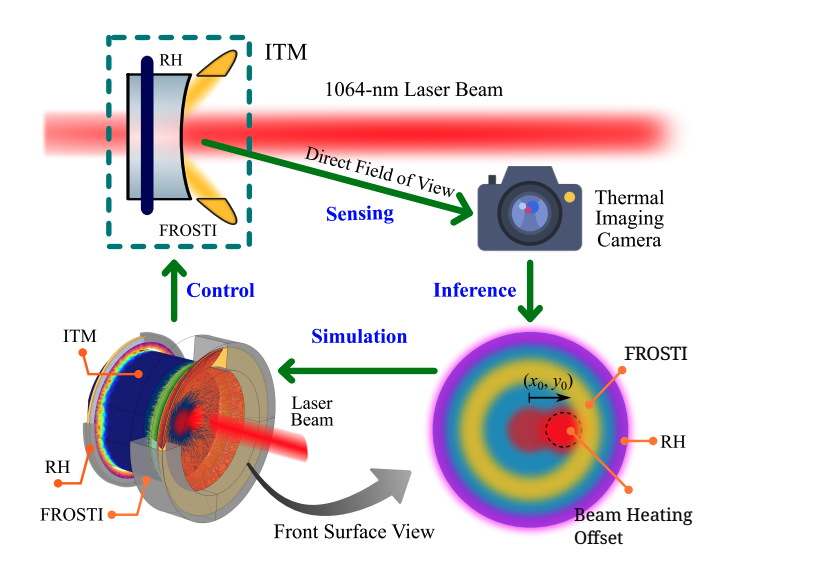
Gravitational-wave detectors currently face limitations imposed by laser power, hindering their ability to detect faint ripples in spacetime, but a new approach to overcoming these barriers promises significant improvements in sensitivity. Liu Tao, Pooyan Goodarzi, and Jonathan W. Richardson, all from the University of California, Riverside, demonstrate a method for finely controlling the mirrors within these detectors using thermal imaging. The team reveals that by mapping surface temperature profiles to a detailed model of each mirror, they can reconstruct wavefront errors with nanometer precision, providing the critical feedback needed for real-time control. This innovation has the potential to boost the strain sensitivity of existing detectors like LIGO A+ by up to 34%, extending the range at which binary neutron star mergers can be observed and paving the way for even more powerful future observatories such as Cosmic Explorer.
Correcting Thermal Aberrations in Gravitational-Wave Detectors
A major obstacle to improving the sensitivity of gravitational-wave observatories stems from thermal distortions of the test masses, which occur when high-power lasers are used. These distortions introduce aberrations that degrade the quality of the laser beam bouncing between the mirrors, ultimately limiting the detector’s ability to detect faint signals. Recent advances focus on a new approach to wavefront correction, where corrective heating is applied to the surfaces of the test masses to actively counteract these distortions, restoring beam quality and enabling operation at higher laser power. Consequently, this research investigates methods to generate and apply these corrective heating profiles with sufficient precision to enhance detector sensitivity.
Wavefront Error Mapping Using Laser Fluctuations
Reducing quantum noise in future detectors requires suppressing wavefront errors to nanometer precision across the entire mirror surface, a significant technical challenge. Currently, there is no direct way to measure these errors, necessitating an indirect methodology. The team employs a novel approach based on analysing the reflected laser beam, utilising the inherent fluctuations of the laser source to create a self-referencing measurement. This technique involves illuminating the mirror with a highly coherent laser and capturing the reflected wavefront using a sensor that measures the local tilts of the beam, providing a detailed map of the mirror’s surface deformation.
By repeatedly measuring this wavefront and analysing the resulting tilt measurements, the team can estimate the magnitude and spatial distribution of wavefront errors without prior knowledge of the error signal. This allows for a closed-loop control system to iteratively adjust the wavefront actuators, minimising errors and achieving a stable, low-noise mirror surface. The performance of this method has been evaluated through experiments, comparing the achieved noise reduction with theoretical predictions and alternative control strategies.
Advanced LIGO and Virgo’s Fourth Observing Run Performance
This collection of references details the ongoing improvements and performance of gravitational wave detectors, specifically Advanced LIGO and Virgo. The research highlights improvements to core detector performance during the fourth observing run, including detailed analysis of noise budgets, duty cycle, and overall sensitivity. Significant attention is given to mitigating thermal noise, a major limiting factor, through techniques like CO2 laser preheating and detailed thermal modelling. Adaptive optics and wavefront control systems are also crucial, correcting for distortions in the laser beam and maintaining a clean signal.
Ongoing development efforts aim to push the detectors beyond their current quantum limits and expand the observable universe. Key themes emerging from this body of work include continuous improvement, the critical importance of thermal noise mitigation, the paramount role of control systems, and the ongoing development of adaptive optics and wavefront control technologies. This comprehensive collection provides a solid foundation for understanding the current state of gravitational wave detection and the ongoing efforts to improve these remarkable instruments.
Thermal Mapping Boosts Gravitational Wave Sensitivity
This research demonstrates that thermal imaging of gravitational-wave detector test masses provides critical data for precisely controlling wavefront distortions, a major limitation on detector sensitivity. By mapping surface temperature profiles to a detailed model of the mirror, scientists can reconstruct the full wavefront and generate error signals for real-time correction, enabling significantly improved performance. The findings suggest a potential 34% improvement in strain sensitivity for the existing LIGO A+ detector, which translates to an 11 megaparsec increase in the range for detecting binary neutron star mergers. Importantly, this technology is not limited to current detectors; it is also a key enabling capability for future observatories like the planned 40-kilometer Cosmic Explorer. The authors acknowledge their analysis relies on the assumption of a thermal steady-state model, but note this is a realistic expectation for future detector designs, particularly given planned upgrades. This work represents a significant step towards enhancing the sensitivity of gravitational-wave detectors and expanding our ability to probe the universe.
🗞 Error Signals for Overcoming the Laser Power Limits of Gravitational-Wave Detection
🧠 ArXiv: https://arxiv.org/abs/2509.06840
See today’s quantum computing news on Quantum Zeitgeist for the latest breakthroughs in qubits, hardware, algorithms, and industry deals.