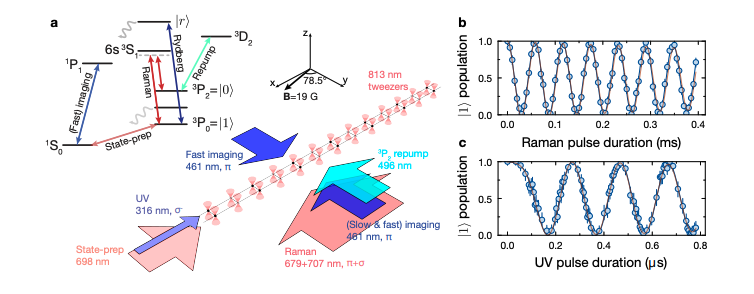
Researchers demonstrate a universal gate set for a qubit encoded in strontium-88, achieving single-qubit fidelities of 0.993 and two-qubit fidelities of 0.9945 after loss correction. A novel detection scheme enables high-fidelity qubit loss measurement, and mid-circuit error conversion utilises a stable ground state, positioning strontium as a viable platform for error-corrected quantum computation.
The pursuit of stable and scalable quantum computation increasingly focuses on atomic qubits, leveraging the predictable behaviour of individual atoms to encode and manipulate quantum information. A recent investigation, detailed in a paper by Tao et al, from the Max-Planck-Institut für Quantenoptik, presents significant advances in utilising strontium-88 atoms as a platform for quantum processing. The research demonstrates a universal set of quantum gates – the fundamental building blocks of any quantum computer – with high fidelity, alongside a novel error mitigation strategy. Specifically, the team achieves single-qubit gate fidelities of 0.993 and two-qubit gate fidelities of 0.9945, and introduces a method to convert certain errors into a more manageable form during computation. This work, titled ‘Universal gates for a metastable qubit in strontium-88’, establishes strontium-88 as a compelling candidate for building practical, error-corrected quantum computers, offering potential advantages in scalability and error management.
Strontium-88 atoms, possessing metastable properties, offer a promising avenue for scalable quantum computation, primarily due to their potential to transform problematic leakage errors into more tractable erasure errors during the execution of quantum circuits. Recent research demonstrates a universal set of quantum gates utilising the fine-structure qubit, encoded within the states of bosonic strontium-88, achieving single-qubit gate fidelities of 0.993(1) and two-qubit gate fidelities of 0.9945(6) following correction for losses incurred during gate operations.
Quantum processors require strategies to build larger and
Quantum processors require strategies to build larger and more reliable systems, and strontium-88 presents a unique approach to error mitigation that potentially simplifies the demands of full-scale quantum error correction. The research team developed a novel, state-resolved detection scheme, enabling high-fidelity identification of qubit loss, a critical factor in maintaining quantum coherence and allowing for accurate monitoring of qubit integrity. A key feature of this approach is the existence of a stable ground state, external to the qubit subspace, which facilitates mid-circuit erasure conversion through rapid, destructive imaging. This effectively transforms leakage errors, which typically corrupt quantum information, into detectable erasure errors. Leakage errors occur when quantum information escapes the intended computational subspace, while erasure errors signify a known loss of information.
This work establishes the strontium fine-structure qubit as a viable candidate for near-term error-corrected quantum computation, offering unique possibilities for scaling up the number of qubits in a quantum processor and demonstrating the platform’s inherent scalability. Researchers are actively investigating strategies to extend these results to larger qubit arrays, exploring the limits of scalability and investigating the impact of inter-qubit interactions on gate fidelity, and developing more sophisticated error correction protocols tailored to the specific characteristics of strontium qubits. The ability to convert errors in this manner represents a significant advantage, as erasure errors are generally easier to correct than arbitrary errors, and researchers leverage this capability to mitigate the impact of qubit loss, a common source of decoherence, the loss of quantum information due to interactions with the environment.
👉 More information🗞Universal gates for a metastable qubit
🗞 Universal gates for a metastable qubit in strontium-88
🧠 DOI: https://doi.org/10.48550/arXiv.2506.10714

See today’s quantum computing news on Quantum Zeitgeist for the latest breakthroughs in qubits, hardware, algorithms, and industry deals.