Rydberg atomic receivers demonstrate enhanced wireless communication potential. Theoretical analysis establishes closed-form expressions for achievable data rates in uncorrelated and correlated fading channels, surpassing classical massive MIMO systems. Simulations indicate improvements of up to bits/s/Hz/user, a reduction in transmit power, or an extended transmission distance.
The escalating demand for wireless data transmission necessitates exploration beyond the limitations of conventional radio frequency technologies. Researchers are now investigating the potential of utilising quantum mechanical principles to enhance receiver sensitivity and capacity. A team led by Tierui Gong, Chau Yuen, Chong Meng Samson See, M´erouane Debbah, and Lajos Hanzo, all affiliated with the IEEE, detail a novel receiver architecture in their paper, “Rydberg Atomic Quantum MIMO Receivers for The Multi-User Uplink”. They propose a system leveraging the unique properties of Rydberg atoms – atoms with highly excited electrons – to construct a multiple-input multiple-output (MIMO) receiver capable of improved performance in multi-user wireless networks. Their work establishes a signal model translating the physics of these atomic receivers into classical wireless communication parameters, and provides analytical derivations for achievable data rates, alongside a quantitative comparison with established massive MIMO systems.
Rydberg Atom-Based MIMO: Performance and Potential
Recent research demonstrates the potential of Rydberg atom-based multiple-input multiple-output (MIMO) systems as a disruptive technology for wireless communication. This work establishes a strong foundation for future investigation into novel modulation schemes, enhanced sensing capabilities, and innovative antenna designs.
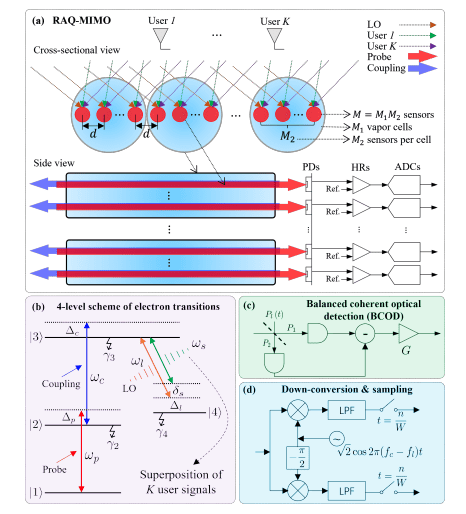
Researchers have constructed a signal model bridging Rydberg atom physics with classical wireless communication techniques. This model outlines the operational principles and transmission flow, ensuring a comprehensive understanding of the system’s functionality. The model’s linearity and feasible operational region have been validated, providing a solid basis for further analysis and optimisation.
Through theoretical analysis, researchers have derived closed-form asymptotic formulas for the ergodic achievable rate (EAR) of both maximum-ratio combining (MRC) and zero-forcing (ZF) receivers. The ergodic achievable rate represents the average data rate achievable in a random communication environment. These formulas provide a mathematical framework for evaluating receiver performance and characterising EAR differences across uncorrelated and correlated channels, enabling optimised receiver designs tailored to specific environments and user needs.
Quantitative analysis reveals significant performance gains for Rydberg Atom Quantum MIMO (RAQ-MIMO) receivers compared to conventional massive MIMO systems. Specifically, the research indicates the potential for increased EAR per user, reduced user transmit power, and extended transmission distance, contributing to a more efficient and sustainable wireless network. These gains are dependent on the number of single receivers and the path-loss exponent – a measure of signal attenuation with distance – providing clear metrics for evaluating the technology’s benefits.
Simulation results confirm the theoretical predictions, solidifying RAQ-MIMO’s potential. The RAQ-MIMO scheme achieves higher EAR, lower transmit power, or longer transmission distance in free-space conditions, particularly within the photon shot limit – the fundamental limit on signal detection due to the discrete nature of light – demonstrating robustness and efficiency in challenging environments.
This research opens exciting avenues for future work, including:
- Novel Modulation Schemes: Investigating advanced modulation techniques leveraging the quantum properties of Rydberg atoms to increase data rates and improve spectral efficiency.
- Enhanced Sensing: Exploring Rydberg atom-based sensing capabilities to detect and mitigate interference, improving wireless communication reliability.
- System Optimisation: Further refining the signal model and exploring innovative antenna designs to maximise system performance.
Researchers detail the operational principles of the RAQ-MIMO system, explaining how Rydberg atoms interact with electromagnetic waves to receive and process signals. Rydberg atoms, with their large principal quantum number, exhibit enhanced interactions with electromagnetic fields, making them suitable for receiving and processing wireless signals. This detailed explanation allows engineers to design and implement RAQ-MIMO systems effectively, facilitating further research and development in the field.
👉 More information
🗞 Rydberg Atomic Quantum MIMO Receivers for The Multi-User Uplink
🧠 DOI: https://doi.org/10.48550/arXiv.2506.01355
See today’s quantum computing news on Quantum Zeitgeist for the latest breakthroughs in qubits, hardware, algorithms, and industry deals.