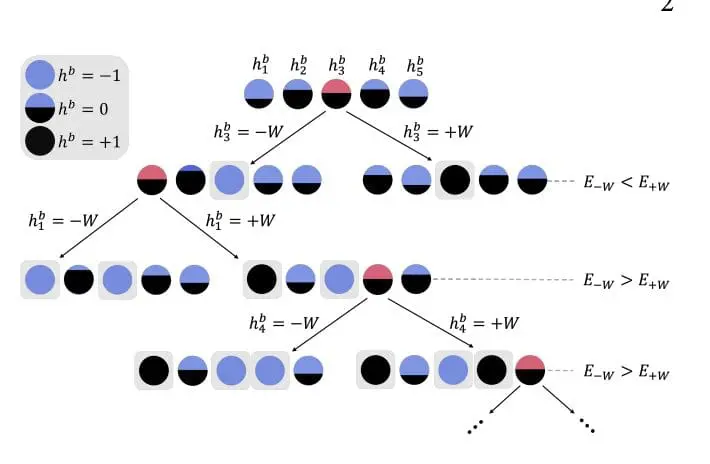
The paper introduces a novel quantum algorithm, BBB-DCQO, designed to efficiently solve Higher-Order Binary Optimization (HUBO) problems. This purely quantum approach avoids the need for variational methods and additional qubits typically required in HUBO-to-QUBO mappings, offering distinct advantages over classical branch-and-bound and other quantum techniques like BF-DCQO and Quantum Annealing. The algorithm’s effectiveness is validated through both noiseless tensor network simulations and experiments on IBM quantum processors, demonstrating superior performance with fewer function evaluations compared to classical Simulated Annealing (SA). These results highlight BBB-DCQO as a promising method for tackling large-scale optimization problems on current quantum hardware.
The BBB-DCQO algorithm integrates quantum sampling within a branch-and-bound framework, avoiding variational methods that can lead to challenges such as barren plateaus. This approach enhances reliability in certain optimization scenarios compared to other quantum techniques. When tested against Simulated Annealing (SA), the algorithm demonstrated efficiency by requiring fewer function evaluations, which involve measurements or samples from a quantum computer. Experimental results on both sparse 156-qubit instances using an ideal simulator and denser 100-qubit instances on IBM processors highlighted its effectiveness in finding optimal solutions more quickly than SA.
A key advantage of BBB-DCQO is its avoidance of HUBO-to-QUBO conversions, conserving qubit resources. This feature is particularly beneficial given the current limitations of quantum hardware, where qubit availability is often constrained. The algorithm’s efficiency suggests potential for tackling large-scale optimization tasks relevant to real-world applications such as scheduling and logistics.
The ability of BBB-DCQO to find solutions early
The ability of BBB-DCQO to find solutions early in the binary tree exploration reduces the need for exhaustive branching, thereby conserving computational resources. This characteristic underscores its promise as an efficient alternative to traditional branch-and-bound methods. Further investigation into the algorithm’s branching mechanisms and the impact of different bias magnitudes could provide deeper insights into its performance and efficiency.
The BBB-DCQO algorithm integrates quantum sampling within a branch-and-bound framework, avoiding variational methods that can lead to challenges such as barren plateaus. This approach enhances reliability in certain optimization scenarios compared to other quantum techniques. When tested against Simulated Annealing (SA), the algorithm demonstrated efficiency by requiring fewer function evaluations, which involve measurements or samples from a quantum computer. Experimental results on both sparse 156-qubit instances using an ideal simulator and denser 100-qubit instances on IBM processors highlighted its effectiveness in finding optimal solutions more quickly than SA.
A key advantage of BBB-DCQO is its avoidance of HUBO-to-QUBO conversions, conserving qubit resources. This feature is particularly beneficial given the current limitations of quantum hardware, where qubit availability is often constrained. The algorithm’s efficiency suggests potential for tackling large-scale optimization tasks relevant to real-world applications such as scheduling and logistics.
The ability of BBB-DCQO to find solutions early
The ability of BBB-DCQO to find solutions early in the binary tree exploration reduces the need for exhaustive branching, thereby conserving computational resources. This characteristic underscores its promise as an efficient alternative to traditional branch-and-bound methods. Further investigation into the algorithm’s branching mechanisms and the impact of different bias magnitudes could provide deeper insights into its performance and efficiency. The BBB-DCQO algorithm integrates quantum sampling within a branch-and-bound framework, avoiding variational methods that can lead to challenges such as barren plateaus. This approach enhances reliability in certain optimization scenarios compared to other quantum techniques. When tested against Simulated Annealing (SA), the algorithm demonstrated efficiency by requiring fewer function evaluations, which involve measurements or samples from a quantum computer. Experimental results on both sparse 156-qubit instances using an ideal simulator and denser 100-qubit instances on IBM processors highlighted its effectiveness in finding optimal solutions more quickly than SA.
External Link: Click Here For More



See today’s quantum computing news on Quantum Zeitgeist for the latest breakthroughs in qubits, hardware, algorithms, and industry deals.