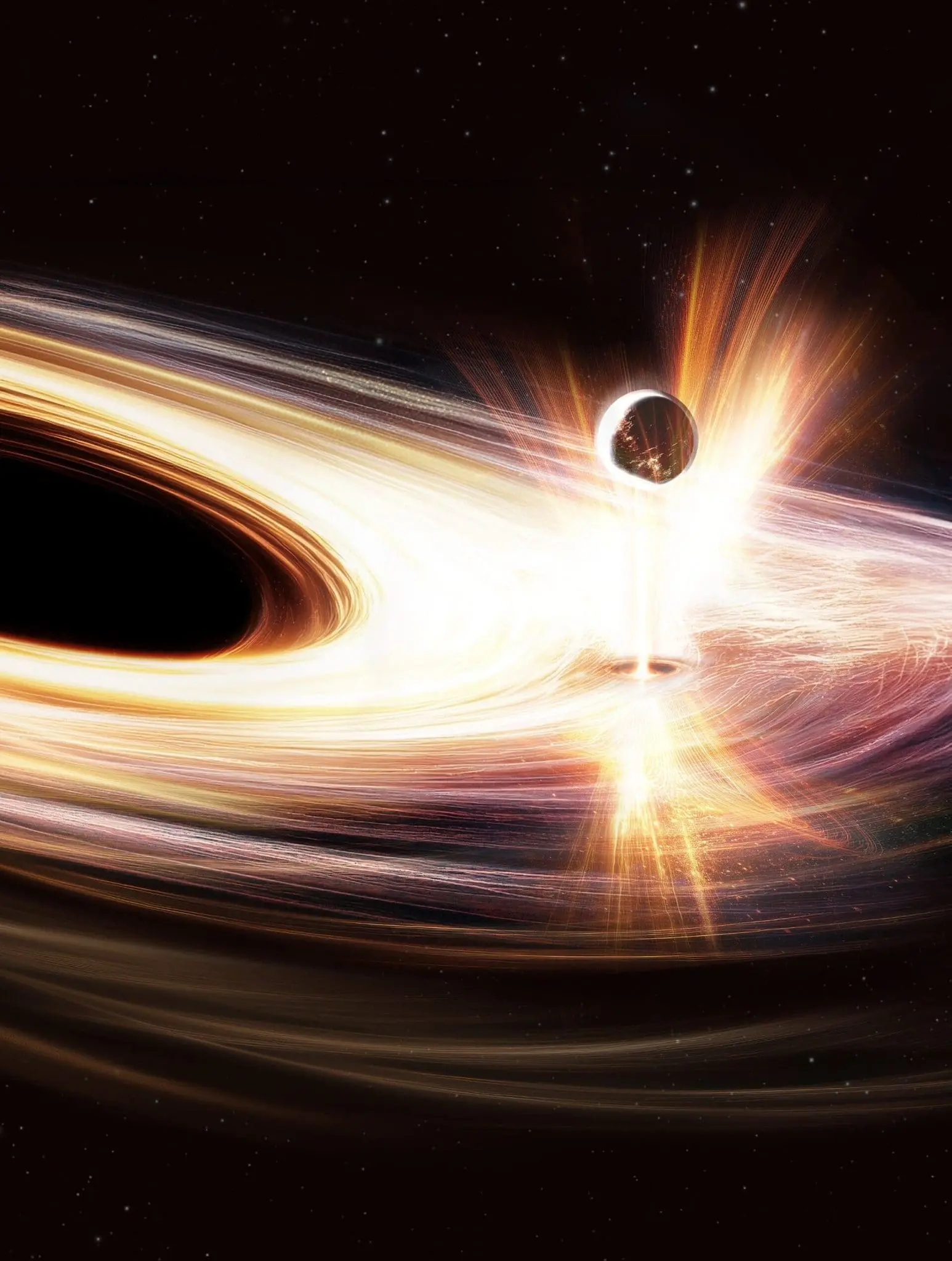
A supermassive black hole at the center of galaxy SDSS1335+0728, located 300 million light-years away in the Virgo constellation, has reactivated after decades of dormancy, emitting unprecedented X-ray bursts. The European Space Agency’s XMM-Newton telescope played a key role in detecting these recurring bursts, known as Quasi-Periodic Eruptions (QPEs), which are ten times longer and more luminous than typical QPEs, with a cadence of about 4.5 days. This discovery challenges existing models of black hole behavior and offers new insights into the mechanisms behind such energetic events.
The galaxy SDSS J1417+5306 has recently exhibited recurring X-ray bursts originating from its central supermassive black hole, marking a significant departure from its previous decades-long dormancy. These bursts are classified as Quasi-Periodic Eruptions (QPEs), characterized by their repetitive nature and exceptional luminosity. Notably, the QPEs observed in SDSS J1417+5306 are ten times longer in duration than typical events, making them an intriguing subject for further investigation.
A plausible explanation suggests that these bursts result from energetic shocks within the black hole’s accretion disk. These shocks may be triggered by a small celestial object disrupting the surrounding material, leading to periodic eruptions. This theory challenges conventional models attributing QPEs to the capture and subsequent spiraling of smaller objects into larger black holes.
The study of these bursts holds significant potential for advancing our understanding of massive black hole physics. Future missions like ESA’s LISA could detect gravitational waves associated with these events, offering complementary data that may elucidate the dynamics of black hole activity and their influence on cosmic evolution.
Watching a black hole in action: real-time observations
The galaxy SDSS J1417+5306 has recently come under scrutiny following the detection of recurring X-ray bursts from its central supermassive black hole. This activity marks a departure from the decades-long dormancy of the black hole, providing astronomers with a unique opportunity to study these enigmatic phenomena.
These X-ray bursts are categorized as Quasi-Periodic Eruptions (QPEs), distinguished by their repetitive occurrence and exceptional luminosity. Notably, the QPEs observed in SDSS J1417+5306 exhibit a duration tenfold longer than typical events, making them an intriguing subject for further investigation.
A plausible explanation posits that these bursts result from energetic shocks within the black hole’s accretion disk. These shocks may be triggered by a small celestial object disrupting the surrounding material, leading to periodic eruptions. This theory challenges conventional models attributing QPEs to the capture and subsequent spiraling of smaller objects into larger black holes.
The study of these bursts holds significant potential for advancing our understanding of massive black hole physics. Future missions like ESA’s LISA could detect gravitational waves associated with these events, offering complementary data that may elucidate the dynamics of black hole activity and their influence on cosmic evolution.
The future of gravitational wave and X-ray complementarity
The galaxy SDSS J1417+5306 has recently exhibited recurring X-ray bursts originating from its central supermassive black hole, marking a departure from its previous decades-long dormancy. These bursts are classified as Quasi-Periodic Eruptions (QPEs), characterized by their repetitive nature and exceptional luminosity. Notably, the QPEs observed in SDSS J1417+5306 are ten times longer in duration than typical events, making them an intriguing subject for further investigation.
A plausible explanation suggests that these bursts result from energetic shocks within the black hole’s accretion disk. These shocks may be triggered by a small celestial object disrupting the surrounding material, leading to periodic eruptions. This theory challenges conventional models attributing QPEs to the capture and subsequent spiraling of smaller objects into larger black holes.
Studying these bursts holds significant potential for advancing our understanding of massive black hole physics. Future missions like ESA’s LISA could detect gravitational waves associated with these events, offering complementary data that may elucidate the dynamics of black hole activity and their influence on cosmic evolution.
More information
External Link: Click Here For More