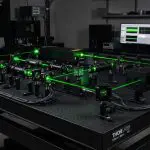
Researchers from Mainz, Olomouc, and Tokyo have significantly advanced quantum computing by creating a logical qubit from a single light pulse that can correct errors. This development could help overcome the current limitations of quantum computing, such as the insufficient availability of qubits and their susceptibility to external influences. The team used a laser-generated light pulse consisting of several photons to create a physical qubit equivalent to a logical qubit. This unique concept, however, still needs improvement to provide the necessary level of error tolerance. The research was led by Professor Peter van Loock of Mainz University and Akira Furusawa in Japan.
Quantum Computing: The Challenge of Qubits
Quantum computing has seen significant advancements, with tech giants like Google and IBM offering cloud-based quantum computing services. However, the full potential of quantum computers remains untapped due to the limited availability of qubits, the basic units of quantum information. Unlike binary bits in traditional computers that store information as 0 or 1, qubits can represent both 0 and 1 simultaneously, a phenomenon known as quantum superposition. This makes qubits highly sensitive to external influences, leading to the potential loss of stored information. To ensure reliable results, quantum computers must generate genuine entanglement, combining several physical qubits to form a logical qubit. However, the large number of physical qubits required poses a significant challenge to developing functional quantum computers.
The Potential of Photonic Quantum Computing
Various concepts are being explored to make quantum computing feasible. While large corporations currently rely on superconducting solid-state systems, these only function at temperatures close to absolute zero. Photonic concepts, which operate at room temperature, offer an alternative. In these systems, single photons serve as physical qubits. These photons operate faster than solid-state qubits but are more easily lost. To prevent qubit losses and other errors, several single-photon light pulses need to be coupled together to construct a logical qubit, similar to the superconductor-based approach.
A New Approach to Qubit Construction
Researchers from the University of Tokyo, Johannes Gutenberg University Mainz (JGU) in Germany, and Palacký University Olomouc in the Czech Republic have proposed a new method for constructing a photonic quantum computer. Instead of using a single photon, the team used a laser-generated light pulse that can consist of several photons. This quantum optical state, according to Professor Peter van Loock of Mainz University, has an inherent capacity to correct errors. This system eliminates the need to generate individual photons as qubits via numerous light pulses and then have them interact as logical qubits. A single light pulse can yield a robust logical qubit, making a physical qubit equivalent to a logical qubit in this system.
The Challenge of Error Tolerance
Despite the innovative approach, the logical qubit produced at the University of Tokyo was not of sufficient quality to provide the necessary level of error tolerance. However, the researchers have demonstrated the potential to transform non-universally correctable qubits into correctable qubits using advanced quantum optical methods. This marks a significant step towards the development of functional quantum computers.
The Future of Quantum Computing
The research, recently published in Science, is the result of a 20-year collaboration between the experimental group of Akira Furusawa in Japan and the theoretical team of Peter van Loock in Germany. While the current state of quantum computing still faces challenges, particularly in the area of qubit availability and error correction, these advancements offer promising avenues for future exploration and development.




See today’s quantum computing news on Quantum Zeitgeist for the latest breakthroughs in qubits, hardware, algorithms, and industry deals.