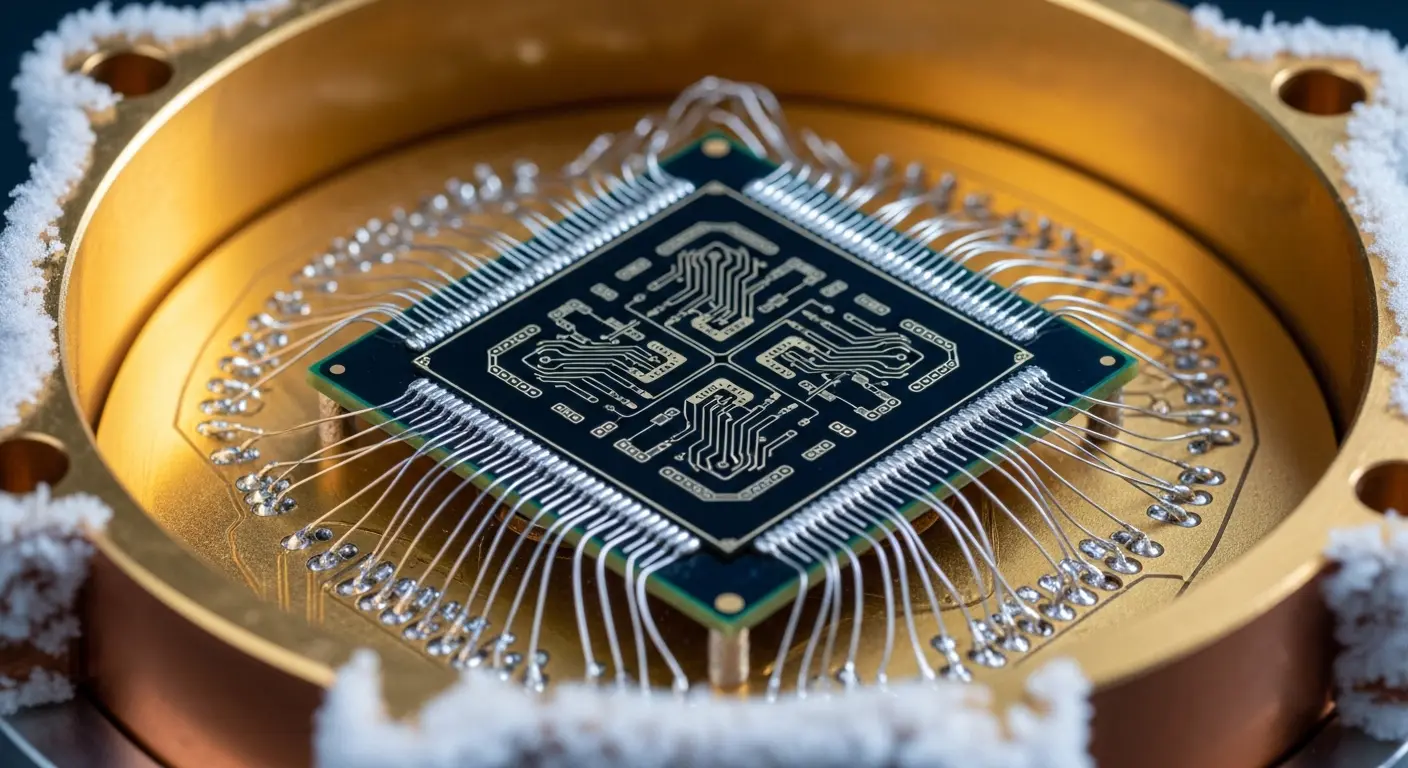
Quantum Elements, a Los Angeles-based quantum software start-up, has published research detailing the highest fidelity of entangled, logical qubits ever achieved on a superconducting quantum computer. The findings, appearing in Nature Communications, demonstrate a new error detection and suppression approach combining quantum error detection with a novel form of dynamical decoupling; researchers utilized a 127-qubit IBM processor for the experiments. This hybrid technique directly identifies and suppresses both logical and physical errors, resulting in average logical Bell state fidelities reaching 91, 94% and post-selected encoded Bell-state fidelities exceeding 98%. “We intend to fully integrate these new techniques into our existing software solutions to accelerate the development of fault-tolerant quantum computing for our customers and partners,” said Izhar Medalsy, co-founder and CEO of Quantum Elements.
High-Fidelity Entangled Qubits via Logical Dynamical Decoupling
This hybrid technique utilizes the normalizer elements of a standard quantum error detection code as logical-level decoupling pulses, a method that boosts the fidelity of entangled logical qubits on an IBM 127-qubit processor. The team achieved performance exceeding the breakeven point, meaning encoded logical Bell states maintained higher fidelity over time than the best unencoded physical Bell pairs, even with physical-level dynamical decoupling already applied. This improvement was accomplished without adding qubits, utilizing a small, fixed set of logical pulse generators for error suppression, and offers a low-cost strategy for enhancing code performance. “By integrating code-based dynamical decoupling directly into the logical layer, the research shows that we can suppress errors more effectively than with physical techniques alone,” said co-author Daniel Lidar, holder of the Viterbi Professorship of Engineering at USC and co-founder and Chief Scientific Officer for Quantum Elements. Founded in 2023, Quantum Elements focuses on making quantum computing more accessible through its AI-native software and quantum Digital Twins.
The pursuit of stable quantum computation took a significant step forward with the demonstration of record-high fidelity entangled logical qubits, achieved through a novel combination of quantum error detection and dynamical decoupling techniques. Current superconducting systems are susceptible to errors, and this research pushes the boundaries of qubit stability. This represents a substantial improvement over previous transmon-based demonstrations, which typically achieved 79, 93% fidelity.
The method allows us to protect a pair of entangled logical qubits at record high fidelities on superconducting hardware, a potentially valuable step on the path to more reliable quantum computation at the error-corrected, logical level.
Daniel Lidar, holder of the Viterbi Professorship of Engineering at USC and co-founder and Chief Scientific Officer for Quantum Elements


See today’s quantum computing news on Quantum Zeitgeist for the latest breakthroughs in qubits, hardware, algorithms, and industry deals.