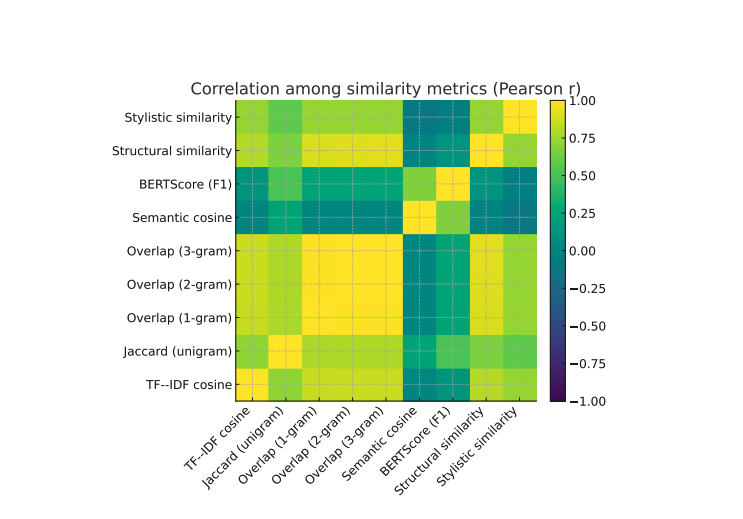
The rise of artificial intelligence has extended to the creation of encyclopedic knowledge, prompting questions about the characteristics and potential biases of AI-generated content, and a new study directly compares the structure and content of Grokipedia, developed by xAI, with the established platform, Wikipedia. Taha Yasseri from Trinity College Dublin and the Technological University Dublin, along with colleagues, undertakes a comprehensive computational analysis of hundreds of matched articles from both platforms, assessing differences in areas such as readability, vocabulary, and referencing. The research reveals that while Grokipedia closely aligns with Wikipedia in terms of overall meaning and writing style, it tends to produce longer articles with less varied language and a lower density of citations. These findings demonstrate that AI-generated encyclopedias currently reflect the informational breadth of human-edited platforms, but differ in their editorial approach, prioritising expansive narratives over rigorous verification, and raise important considerations for the future of knowledge creation and governance in an age of automated text generation.
Observed Structural Alignment Between AI and Wikipedia
This study presents a large-scale comparison of Grokipedia and Wikipedia, examining similarities and differences in content and style across hundreds of matched article pairs. Results demonstrate a strong alignment between the two platforms in terms of meaning and overall linguistic structure. However, Grokipedia articles consistently exhibit greater length and syntactic complexity, coupled with lower lexical diversity and a reduced density of references compared to their Wikipedia counterparts. These findings suggest that Grokipedia’s generation process prioritizes elaboration and narrative flow over rigorous sourcing and concise expression, effectively repackaging existing human-curated knowledge through an AI lens. While achieving semantic alignment with Wikipedia, the system introduces stylistic inflation and reduced citation density, subtly re-encoding potential biases within its model parameters. Further research could investigate the long-term effects of this automated knowledge production on information transparency and explore methods for enhancing the system’s ability to provide robust and verifiable information.
🗞 How Similar Are Grokipedia and Wikipedia? A Multi-Dimensional Textual and Structural Comparison
🧠 ArXiv: https://arxiv.org/abs/2510.26899
Mapping Semantic Proximity Using Computational Models
The computational metrics utilized, such as cosine similarity or Jaccard coefficients, go beyond simple word overlap. They involve mapping articles into high-dimensional vector spaces, allowing the measurement of semantic proximity even when different vocabulary is used to convey the same core meaning. Analyzing these vectors reveals whether the two platforms are merely paraphrasing each other, or if they are genuinely transmitting identical conceptual knowledge, offering a rigorous test of informational content alignment.
From a technical standpoint, the challenge of matching corresponding articles, especially those with evolving histories, requires sophisticated cross-database entity resolution. The researchers likely employed Natural Language Processing (NLP) pipelines that identify key named entities and concepts across the mismatched texts. This process is critical because it ensures that the comparison is measuring the intellectual content related to a specific subject (e.g., “Quantum Entanglement”) rather than just the structural similarity of the introductory paragraph.
Furthermore, assessing citation density requires granular web scraping and API integration that must distinguish between internal cross-references (typical of wiki markup) and genuine external source citations. This structural metric is vital because the scholarly rigor of an encyclopedia is often proportional to its verifiable evidence base. The discrepancy in citation density measured suggests a fundamental divergence in the editorial incentives between human-governed and automated knowledge systems.




See today’s quantum computing news on Quantum Zeitgeist for the latest breakthroughs in qubits, hardware, algorithms, and industry deals.