Researchers at Université de Sherbrooke have developed a new decoder that significantly improves the performance of multimode Gottesman-Kitaev-Preskill (GKP) quantum error correction. The work focuses on tracking correlations between errors on “helper states” used in the error-correction circuit, accounting for noise that can corrupt the correction process. By embedding the paths of these auxiliary errors into the decoder, the team demonstrated a decrease in logical error probability by at least an order of magnitude, yielding more robust quantum computation. This improvement, achieved without additional hardware, relies on interpreting the measurements more intelligently.
Multimode GKP Codes: Encoding Qubits in Harmonic Oscillators
The accuracy of quantum error correction in multimode Gottesman-Kitaev-Preskill (GKP) codes receives a boost from a new decoder design that accounts for imperfections in helper states. Multimode GKP codes encode logical qubits not in discrete particles, but across several harmonic oscillators, creating a more complex error-correction landscape than simpler schemes.
These codes arrange the oscillators’ possible states like points on a grid, allowing small errors, or nudges off the grid, to be corrected as long as they remain minor. To measure this drift without collapsing the quantum state, the GKP code couples to auxiliary states via specific quantum gates, propagating the drift into the auxiliaries for measurement.
However, noise within these helper states can corrupt the correction process, limiting the overall fidelity of the encoded qubit. The team’s innovation lies in embedding the paths these auxiliary errors take through the error-correcting circuit directly into the decoder itself. This approach allows for a more accurate estimation of the drift, extending the lifetimes of the multimode GKP codes. Monte Carlo simulations, run on four distinct multimode GKP codes, validated the effectiveness of the new decoder.
The simulations revealed that the decoder’s ability to track error correlations significantly reduced the overall error rate. The decoder needs no extra hardware and demands about the same computing effort as the existing approach.
Steane Protocol Decoding: Addressing Auxiliary State Noise
This advancement stems from a new decoder designed to account for noise present in the auxiliary states used in Steane-type protocols for multimode Gottesman-Kitaev-Preskill (GKP) codes. Rather than treating these helper states as pristine, the decoder actively tracks how errors within them spread throughout the correction process, refining the final error estimate. This allows for a more precise estimation of the drift affecting the GKP state, extending the coherence time of the encoded quantum information.
The simulations revealed that by accounting for the correlations between measurement results and the actual error affecting the GKP state, the decoder significantly enhances the reliability of quantum computations. This arrangement, akin to positioning states as points on a higher-dimensional grid, provides stronger protection against errors.
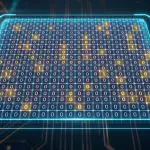
“The helper states carry their own errors,” the featured image caption explains, “which spread through the circuit.” The team’s decoder directly addresses this issue by modeling the spread of these auxiliary errors.
Error Correlation Tracking: Improving Decoder Accuracy
Tracking errors on auxiliary states within Steane-type quantum error correction protocols represents a key refinement in the pursuit of robust quantum computation. This work focuses specifically on multimode Gottesman-Kitaev-Preskill (GKP) codes, a complex encoding scheme where logical qubits are distributed across several harmonic oscillators. By accounting for the noise inherent in these states, researchers have demonstrated a significant improvement in decoder accuracy, an important step toward practical quantum devices.
The challenge lies in the fact that these helper states are not themselves immune to error; their imperfections introduce noise that can corrupt the error correction process. Studies by Braunstein and others explored error correction for continuous quantum variables. However, these investigations did not fully address the propagation of errors from the helper states themselves.
The ability to accurately track these correlations is particularly significant given the inherent complexity of GKP encoding. Unlike simpler qubit representations, GKP codes distribute quantum information across multiple harmonic oscillators, increasing the potential for error propagation. By understanding how errors spread through this system, the decoder can more effectively identify and correct them. This approach contrasts with methods that attempt to simply suppress noise, instead focusing on intelligently interpreting the available measurement data.
Monte Carlo Simulations: Demonstrating Logical Error Reduction
This improvement stems from a novel decoder design that maps the propagation of errors within the error-correction circuit itself, allowing for more accurate estimations of drift in multimode Gottesman-Kitaev-Preskill (GKP) codes. The simulations were conducted across four distinct GKP code variations, demonstrating the decoder’s adaptability to different implementations of this encoding scheme. The core innovation lies in addressing imperfections within the “helper states” integral to Steane-type error correction protocols.
This approach contrasts with traditional methods that focus solely on suppressing noise, instead prioritizing intelligent interpretation of measurement results. The decoder’s ability to estimate drift more accurately directly translates to extended lifetimes for these codes, a critical factor in maintaining the integrity of quantum computations.
The researchers tested the decoder’s performance using Monte Carlo simulations, a computational technique that relies on repeated random sampling to obtain numerical results. These simulations allowed them to assess the decoder’s effectiveness in various noise scenarios and with different GKP code configurations.

See today’s quantum computing news on Quantum Zeitgeist for the latest breakthroughs in qubits, hardware, algorithms, and industry deals.