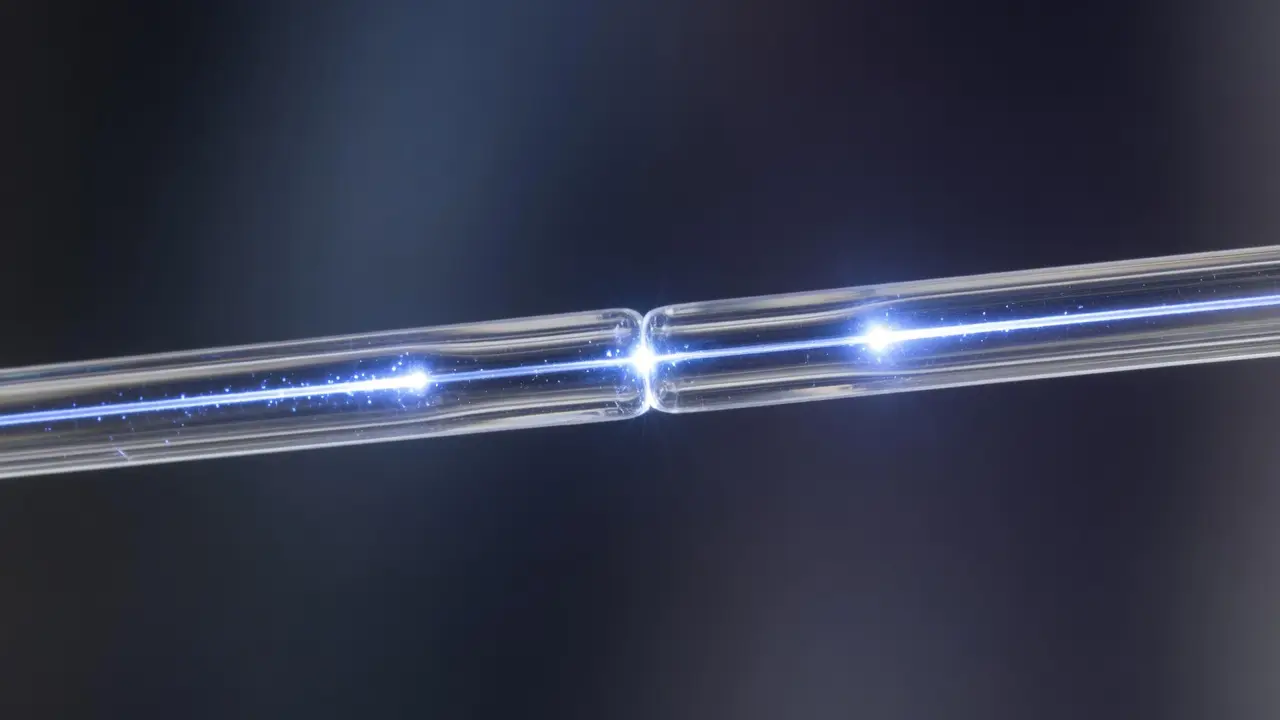
Researchers at the Universidade Federal de Goiás have demonstrated that photon pairs hyperentangled in polarization and transverse spatial variables can carry two key bits per pair in quantum key distribution. This approach potentially doubles information transfer compared to traditional methods by using the combined properties of light’s polarization and its spatial characteristics.
The team developed a technique called class-resolved sifting, assigning detected pairs to categories based on measurement compatibility, and applied it to data from a two-crystal spontaneous parametric down-conversion source read out in intermediate fractional-Fourier planes. Their analysis revealed a measured spatial-polarization coupling below predicted levels, falling at the limit of current measurement sensitivity.
Hyperentangled Photon Pairs Enable Quantum Key Distribution
The team’s approach allows for separate estimation of error and key rates within each class. Comparing different classes of detected pairs served as a quantitative consistency test for cross-dependencies between the two degrees of freedom. Examining the data by polarization analyzer setting, the team identified an approximately twofold dependence of spatial error on the polarization setting in one readout arm, attributing this to the measurement apparatus itself rather than the source. This finding highlights the importance of carefully characterizing and mitigating basis-dependent side channels in quantum key distribution systems.
Class-Resolved Sifting Protocol for Polarization and Spatial Variables
This method assigns each detected pair to a class based on the compatible bases used to measure its degrees of freedom, enabling a more refined analysis of entanglement quality. The protocol’s implementation recovers the key yield of independent sifting while simultaneously transforming the comparison between classes into a quantitative consistency test for cross-dependencies between polarization and spatial variables.
The team’s approach embeds a consistency test, requiring polarization error to remain constant across combinations of spatial bases and spatial error to be consistent for each polarization analyzer setting, directly into the sifting protocol, quantifying it with exact tests and confidence intervals. This allows for a direct comparison with the predicted spatial-polarization coupling for the source, revealing a measured dependence that falls at the edge of the current statistical sensitivity. The researchers determined the error rate at which a single-variable spatial encoding would yield more key for their specific source.
Two-Crystal SPDC Source and Intermediate Fractional-Fourier Planes
This approach allows for the extraction of 0.71 secret bits per detected pair with uniform basis choice, and an increased 1.15 bits per pair when a basis bias of 0.9 is applied, a result mirroring the efficiency of independent sifting techniques. Researchers found that class resolution does not inherently increase key yield, but it offers a valuable diagnostic tool for identifying potential spatial-polarization dependencies within the system.
Spatial-Polarization Coupling Impacts Polarization Concurrence
The intermediate planes used in this work only partially erase information about the originating crystal, resulting in a predicted reduction of polarization concurrence to approximately 0.93 for compatible spatial configurations and 0.96 when those configurations are incompatible. Researchers developed a class-resolved sifting method, assigning each detected photon pair to one of four classes based on the measured degrees of freedom, and estimating error rates separately within each class to refine data analysis.
This approach allows for the estimation of key bits, 2, 1, 1, or 0, contributed by each pair, offering a more granular assessment of entanglement quality. An acquisition with an order of magnitude more data is planned to determine whether the predicted spatial-polarization coupling is present.
Both hyperentanglement and a single four-dimensional system yield the same key per detected pair and obey the same entropic bound. But they differ in their tensor-product structure: hyperentanglement factors the bases into separate two-outcome measurements, which are simpler to implement and allow errors to be attributed to each degree of freedom, whereas a single variable gives access to non-product bases that can increase the noise tolerance.
Quantitative Consistency Test Validates Degree of Freedom Independence
Analysis of the data revealed that the observed errors align with expectations for independent degrees of freedom, though at the limit of current statistical sensitivity. The team’s work also demonstrates that the method recovers the key yield achieved through independent sifting, confirming that the class-resolved approach does not compromise information transfer. This behavior highlights the explicit contribution of partially compatible rounds in the class-resolved formulation, offering diagnostic information about the entanglement source.
Basis-Dependent Errors Identified in Measurement Apparatus
The observed effect does not align with predictions based solely on the source’s inherent spatial-polarization coupling, indicating an external influence on the measurement process. Treating spatial readout as an effective qubit measurement assumes a consistent basis and avoids unaccounted detection bias, an assumption the team further examined in subsequent analyses. However, the resulting key rates are conditional on this spatial filtering and effective-qubit description, representing estimates within a specific measurement model rather than a complete security proof for the entire experimental setup.
Every detected pair is assigned to a class according to which degrees of freedom were measured in compatible bases, and error and key rates are estimated separately in each class. This formula, Y(p) = [ + ] + q(1-q)[ + ], demonstrates how key rates are affected by the interplay between different measurement classes.
The observed discrepancy between classes An and C, when aggregated across analyzer settings, cannot be attributed to an intrinsic property of the source itself. A source-induced coupling would not vary based on which party implements the polarization measurement, whereas the current data show a clear dependence on the readout arm. “This points to a setting-dependent effect associated with the measurement apparatus, rather than being explained by the source model alone, with implications for basis-dependent side channels,” the researchers state.
The difference in spatial error rates between these classes is sensitive to the measurement configuration, and should not be interpreted as evidence of a source-induced spatial-polarization coupling, but rather as a signal of potential vulnerabilities. This dependence of error on the basis setting of another degree of freedom is precisely the type of behavior that must be monitored and bounded in secure key distribution protocols.
Hyperentanglement Versus Single Four-Dimensional Encoding
A single four-dimensional variable encoding could outperform hyperentanglement in quantum key distribution if its error rate remains below approximately 3.7-5.4%, according to new analysis of photon pairs entangled in polarization and transverse spatial variables. This finding highlights a subtle trade-off between the complexity of measurement and the potential for increased key generation, challenging the assumption that hyperentanglement always provides a superior approach.
The work, detailed in a recent paper, directly compares the performance of hyperentangled systems with those using a single degree of freedom for encoding. While both hyperentangled and single-variable systems can yield the same key per detected pair and adhere to the same entropic bounds, their underlying structure differs significantly.
Conversely, a single variable allows access to non-product bases that can potentially enhance noise tolerance, a benefit that becomes more pronounced with increased dimensionality. The current study focused on a source limited by partial which-crystal erasure, a factor influencing polarization coherence. The researchers found that hyperentanglement offers advantages beyond simpler readouts, including a separate key contribution from each degree of freedom and a diagnostic tool for assessing cross-dependencies. As polarization coherence in the source improves, hyperentanglement becomes increasingly preferable.
Entropic Bound and Key Yield Comparison for Encoding Methods
A single four-dimensional variable allows access to non-product bases potentially increasing noise tolerance, but for sources limited by polarization coherence, hyperentanglement presents advantages in readout simplicity. This contrasts with hyperentanglement’s reliance on simpler two-outcome readouts, a characteristic that facilitates error analysis by attributing errors to individual degrees of freedom. (3),” the paper states, emphasizing the fundamental similarity in information capacity despite differing approaches to encoding. The research suggests that hyperentanglement’s diagnostic tools and simpler readouts offer a pathway toward enhanced performance as polarization coherence in quantum sources continues to advance.
👉 More information
🗞 Class-resolved sifting for quantum key distribution with photon pairs hyperentangled in polarization and transverse spatial variables
✍️ Murilo H. Magiotto, Millena B. Novaes, Wesley B. Cardoso, Ardiley T. Avelar, Guilherme L. Zanin and Rafael M. Gomes (Instituto de Física, Universidade Federal de Goiás, Goiânia, Goiás, Brazil)
🧠 ArXiv: https://arxiv.org/abs/2611.33055v1

See today’s quantum computing news on Quantum Zeitgeist for the latest breakthroughs in qubits, hardware, algorithms, and industry deals.