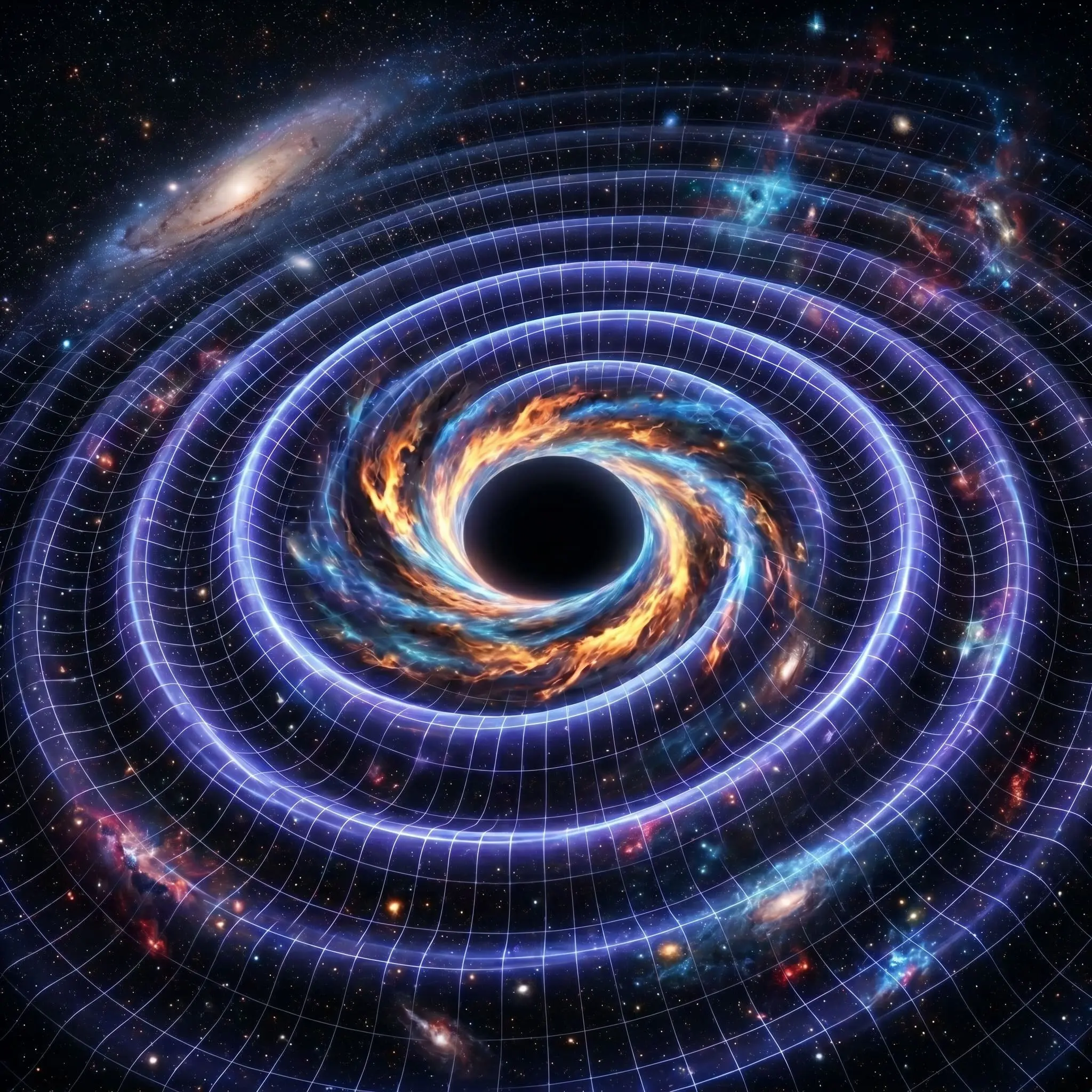
Scientists at the University of Portsmouth have contributed to an international effort resulting in the detection of 161 new gravitational wave signals, bringing the total number of confirmed detections to 390. This number would have seemed extraordinary just a decade ago. These ripples in spacetime, created by cataclysmic events like colliding black holes billions of light-years away, are now being observed at a rate of three to four signals per week when detectors are active. The latest findings, published as part of the Gravitational Wave Transient Catalogue 5.0, are increasing in both number and detail, allowing researchers to analyze how these events unfold. “Our results are steadily getting better, which paints an exciting picture for the future of cosmology,” said Professor Tessa Baker, from the University of Portsmouth’s Institute of Cosmology and Gravitation, who has been using these detections to measure the universe’s expansion rate.
LIGO-Virgo-KAGRA Collaboration Releases Gravitational Wave Transient Catalogue 5.0
The catalogue details 161 new detections made between April and January, bringing the total number of confirmed detections to 390, a number researchers acknowledge would have been considered extraordinary ten years ago. This increase in detections allows for increasingly detailed analysis of these cosmic collisions, moving beyond simply confirming that events occur to understanding how they happen. The catalogue includes signals like GW241011 and GW241110, where at least one black hole exhibits an unusual spin direction relative to its orbit; these peculiar spins suggest the black holes may be the products of previous mergers within dense stellar clusters. These black holes are thought to form through repeated collisions in crowded regions of space, offering clues about their formation history. The increased precision of GWTC-5 has also enabled a new, independent measurement of the Hubble constant, the rate at which the universe is expanding, that is approximately 25 percent more precise than previous gravitational wave estimates.
GW250114 Signal Validates General Relativity with Precise Black Hole Ringdown
The detection of gravitational waves has rapidly matured from a novel confirmation of Einstein’s theories to a routine observation of cosmic violence. With a total of 390 confirmed detections, a figure considered extraordinary just a decade ago, the field is now characterized by a steady stream of new events. Currently, detectors are registering three or four signals each week when operational, a pace that demands increasingly sophisticated analytical techniques. This surge in data is allowing scientists to move beyond simply identifying these mergers to dissecting the specifics of how they occur, as evidenced by recent analyses of signals like GW241011 and GW241110. In these instances, the peculiar rotational alignment of at least one black hole offers clues about their formation pathways, suggesting repeated collisions within dense stellar environments. A particularly pristine signal, GW250114, detected on January 14, stands out as the sharpest gravitational wave ever observed, originating from the merger of two black holes weighing 32 and 34 solar masses, over a billion light-years away. The exceptional clarity of this event allowed researchers to observe the resulting black hole “ring”, the characteristic vibrations following a merger, and identify three distinct vibrational tones. These tones precisely matched predictions derived from Einstein’s general theory of relativity, constituting the most precise test of the theory to date using gravitational waves and independently confirming Stephen Hawking’s black hole area theorem.
Our results are steadily getting better and better, which paints a really exciting picture for the future of cosmology.
Professor Tessa Baker, Institute of Cosmology and Gravitation
Population Studies Reveal Second-Generation Black Holes and Hubble Constant Refinement
A particularly intriguing aspect of this growing dataset is the emergence of evidence for black holes, identified through signals like GW241011 and GW241110. These objects are theorized to form through repeated collisions within dense stellar clusters, where black holes can merge multiple times. The unusual spin characteristics observed in these events strongly suggest they are the products of prior mergers, offering a glimpse into the life cycles of black holes across cosmic time. This new calculation, alongside tests confirming the validity of Einstein’s theory of General Relativity on cosmological scales, provides crucial insights into the fundamental properties of the universe and the mysterious force known as dark energy; the data indicate that Einstein’s theory does, in fact, hold true for the universe.
Our results are steadily getting better and better, which paints a really exciting picture for the future of cosmology.
Professor Tessa Baker, Institute of Cosmology and Gravitation


See today’s quantum computing news on Quantum Zeitgeist for the latest breakthroughs in qubits, hardware, algorithms, and industry deals.