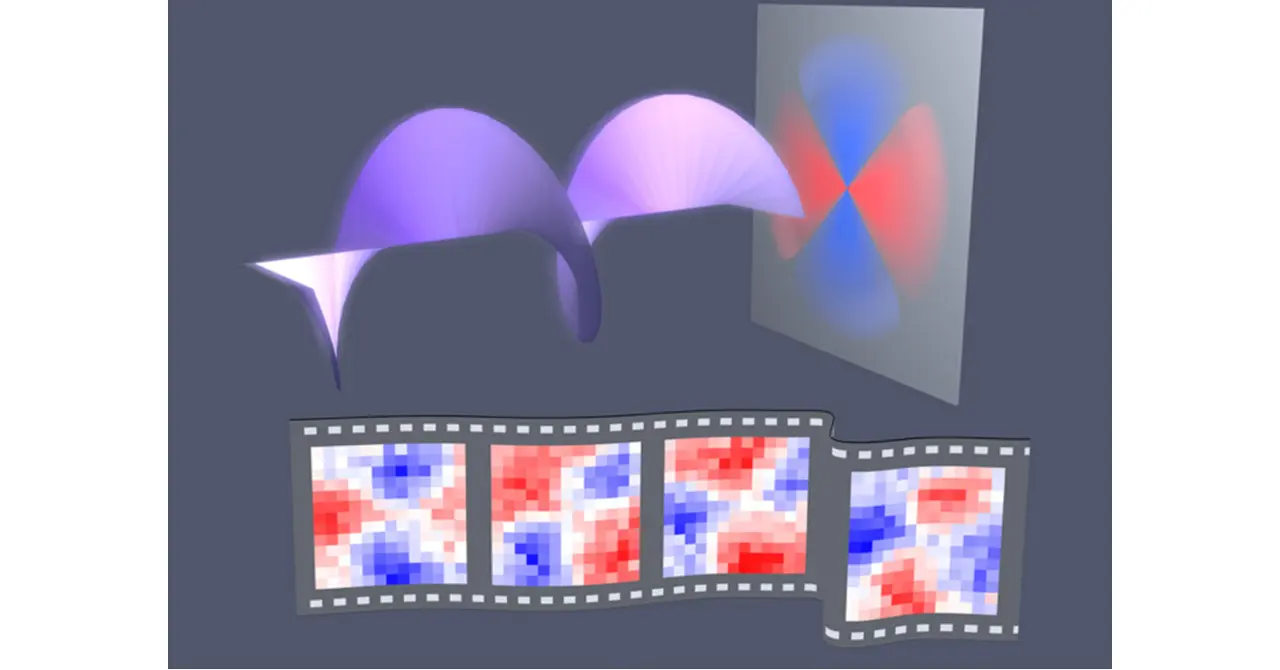
Researchers at the University of Tokyo and Kyoto University have, for the first time, transferred orbital angular momentum from a spiral wavefront of light to a superconducting thin film of niobium nitride. By converting terahertz waves into a light vortex and irradiating the superconductor, the team observed Higgs mode vibrations rotating in real space, a phenomenon linked to the Higgs particle.
The researchers report that this research suggests a pathway toward light-based control of quantum materials. This research, selected as a featured paper in “Editors’ Suggestions” by Physical Review Letters, is expected to contribute to ultra-fast control of quantum materials.
Light Vortex Transfer Induces Rotating Higgs Mode
This transfer demonstrates a potential pathway for manipulating macroscopic quantum states with light, moving beyond electrical control methods. The team, led by Professor Ryo Shimano of the University of Tokyo and Professor Takahiro Morimoto of Kyoto University, measured the Higgs mode vibrations in both position and time after irradiating the superconductor. Theoretical analysis confirmed that the rotating Higgs mode carries the orbital angular momentum of the superconductor itself, indicating a direct coupling between light and the material’s quantum properties.
The ability to control superconducting states using the wavefront structure of light could lead to ultra-fast control of quantum materials, potentially impacting areas like quantum computing and sensing. The team’s findings suggest that light, with its inherent angular momentum, can be harnessed to directly influence and manipulate the collective behavior of electrons in a superconductor.




See today’s quantum computing news on Quantum Zeitgeist for the latest breakthroughs in qubits, hardware, algorithms, and industry deals.