

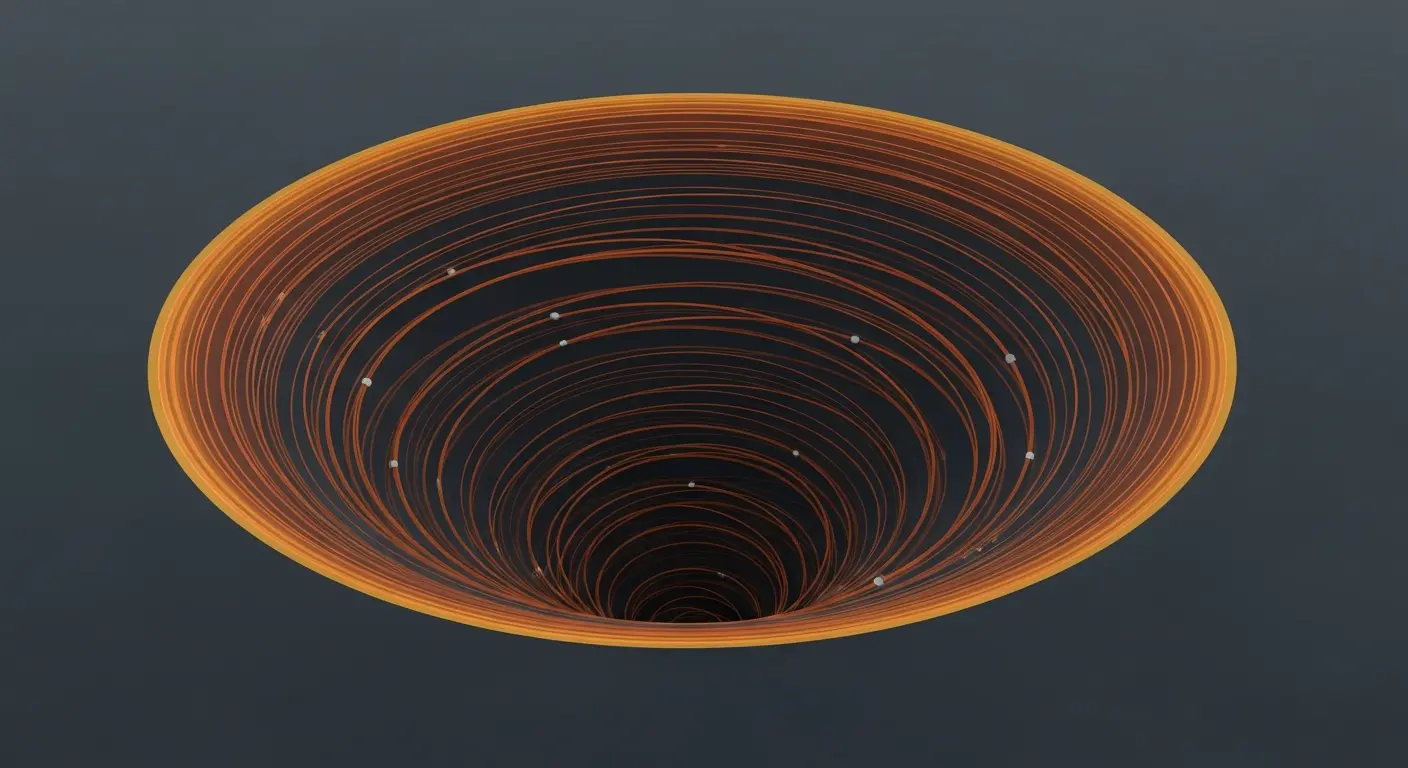
Simulating large-scale interacting quantum spins with short-range interactions was previously limited by conventional spin-wave theories. A new semiclassical framework using generalised spin-wave approximations now models open quantum dynamics, enabling efficient simulation. Investigations on a two-dimensional Ising model reveal how tuning interaction range alters the universality class of a continuous phase transition when dissipation acts along the drive axis.
Zejian Li of The Abdus Salam International Center for Theoretical Physics and colleagues have created a method to computationally model the behaviour of complex quantum materials, allowing for simulations of larger and more realistic systems than before. The method addresses shortcomings in current techniques when dealing with materials exhibiting limited or abrupt changes in interactions between their components. Specifically, investigations into a two-dimensional material revealed that altering how these components interact fundamentally changes the material’s behaviour during phase transitions, a shift with potential applications in materials science.
Zejian Li of The Abdus Salam International Center for Theoretical Physics and colleagues have developed a computational method for simulating the behaviour of complex quantum materials, particularly those with interactions that change rapidly or abruptly between their components. This advancement overcomes limitations in existing techniques, such as spin-wave approximations, which can be visualised as a ripple effect representing the collective behaviour of many tiny magnetic components. The team demonstrated their method using a two-dimensional material, revealing that altering the range of interaction between components can fundamentally change how the material transitions between different states. Key to this, the research shows that tuning these interactions alters the ‘universality class’ of a continuous phase transition, impacting the material’s properties and potential applications.
Unravelling quantum trajectories via extended semiclassical spin-wave theory
Generalised spin-wave approximations represent a key methodological leap forward, enabling more effective modelling of complex quantum systems. Representing a semiclassical approach, this technique builds on the concept of collective magnetic behaviour analogous to ripple effects across a pond. In particular, it unravels quantum trajectories from the master equation, a set of rules describing quantum system changes, allowing simulation of systems with both short-range interactions and abrupt quantum jumps.
Extending conventional spin-wave theories allowed scientists to efficiently simulate larger interacting spin systems, overcoming previous computational limitations. Generalised spin-wave approximations were employed to model driven-dissipative spin systems, building upon existing semiclassical methods. The master equation is utilised to unravel quantum trajectories, simulating systems with both short-range interactions and localized quantum jumps.
Modelling Dissipative Phase Transitions in Extended Ising Systems
A five-fold increase in the scale of simulated interacting spins has been achieved, moving from systems limited by conventional spin-wave theories to those encompassing large-scale interactions and localized quantum jumps. This breakthrough overcomes a key barrier in modelling complex quantum materials, as accurately simulating these systems was previously computationally prohibitive. Investigations into a two-dimensional Ising model demonstrate that altering the range of interaction between spins, from fully-connected to nearest-neighbour, fundamentally changes the universality class of a continuous phase transition when dissipation acts along the drive axis. Furthermore, switching dissipation to act along the interaction axis induces a first-order transition, a more abrupt change in the system’s properties.
Semiclassical modelling extends simulations of magnetic spin transitions
Accurately modelling state changes in complex materials is fundamental to materials science, yet remains a significant challenge for systems subject to both external forces and internal dissipation. This new semiclassical framework offers a promising step forward, allowing simulation of larger, more realistic spin systems than previously possible. The authors acknowledge the method’s current limitations, having demonstrated it only on a two-dimensional Ising model, raising questions about its adaptability to more complex materials and physical scenarios.
Despite being presently limited to a two-dimensional model, an Ising model where ‘spins’ point up or down, this work represents genuine progress. Accurately simulating many interacting ‘spins’ is computationally expensive, but this new semiclassical framework offers a more efficient approach, extending the scale of investigable systems. By employing generalised spin-wave approximations, the framework efficiently models the behaviour of complex quantum materials, particularly those where interactions between components are not uniform or change suddenly. Scientists can now simulate systems with a scale five times larger than previously possible using conventional methods, overcoming longstanding computational limitations. Investigations using a two-dimensional Ising model, a simplified representation of magnetic materials, demonstrated that altering the range of interaction between ‘spins’ fundamentally changes how the material transitions between different states.
The research successfully demonstrates a new semiclassical framework for modelling the behaviour of driven-dissipative spin systems. This method allows for the efficient simulation of larger and more complex spin systems than previously achievable, extending the scale of investigable systems fivefold. Researchers found that the range of interaction between spins significantly alters the type of phase transition observed, with dissipation along different axes inducing either continuous or first-order transitions. This framework provides a valuable tool for understanding non-equilibrium dynamics and many-body phases in magnetic materials.
👉 More information
🗞 Generalized stochastic spin-wave theory for open quantum spin systems
🧠 ArXiv: https://arxiv.org/abs/2604.21574
See today’s quantum computing news on Quantum Zeitgeist for the latest breakthroughs in qubits, hardware, algorithms, and industry deals.



