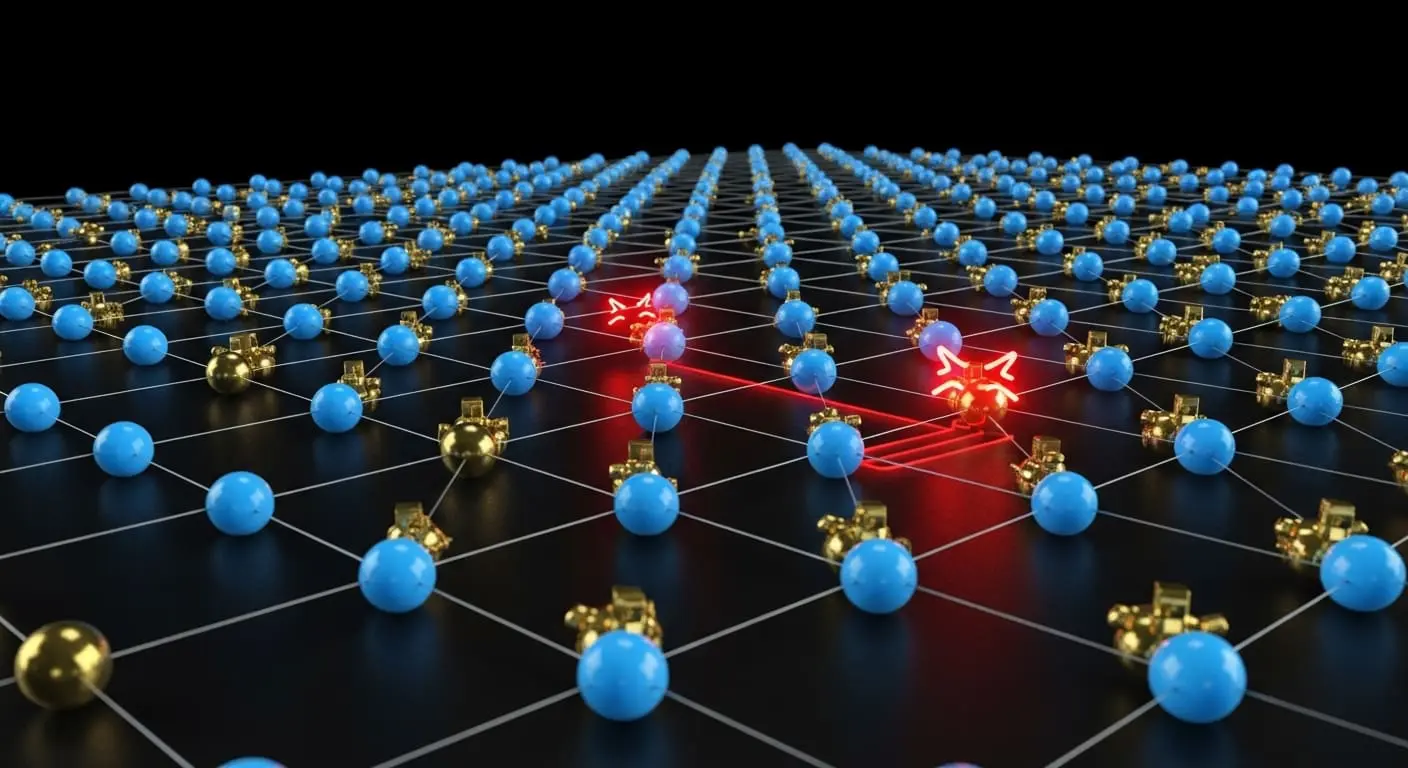
A new framework from Xiang Fang at University of California, and colleagues, addresses the growing need for rigorous evaluation of quantum error correction (QEC) protocols. LightStim, a system presented by the team, automates the construction of Detector Error Models alongside circuit compilation, circumventing the limitations of current manual annotation methods. This automation enables thorough, circuit-level assessment of QEC, extending beyond simple memory tests to complex distillation circuits and enabling the rapid exploration of new protocols, such as a novel heterogeneous cross-code lattice surgery design. LightStim therefore provides a unified infrastructure for systematic QEC protocol evaluation and exploration, promising to accelerate progress towards fault-tolerant quantum computing. The development of robust QEC is paramount as quantum computers scale, as even small error rates can quickly overwhelm computations without effective error mitigation strategies. Current approaches to QEC rely heavily on the ability to accurately model the errors that occur within the physical hardware, and this modelling process has historically been a significant bottleneck.
Automated Detector Error Model construction via concurrent circuit compilation and Pauli tableau
LightStim’s core innovation automates the construction of Detector Error Models, detailed maps of how errors occur in a quantum computer, concurrently with circuit compilation. These models are crucial for simulating the end-to-end logical error rates of a QEC protocol, providing a realistic assessment of its performance. A ‘Pauli tableau’, a mathematical table describing all possible error combinations augmented with measurement records, is maintained by the system, requiring no protocol-specific input from the user. The Pauli tableau systematically catalogues the effects of Pauli errors (bit flips, phase flips, and combinations thereof) on the quantum state, allowing for a comprehensive analysis of error propagation. By building these models automatically, LightStim bypasses the limitations of previous manual annotation methods, which were both time-consuming and prone to oversight. Manual construction often involved painstakingly tracing error pathways through the circuit, a process susceptible to human error and difficult to scale to larger, more complex designs. LightStim, a framework automating the creation of Detector Error Models, essential maps of error occurrences in quantum computers alongside circuit compilation, utilises a ‘Pauli tableau’ tracking error combinations with measurement records. Benchmarking across memory experiments and distillation circuits, with validation against existing implementations, confirmed accurate detector counts and consistent logical error rates; simulations ran on AMD EPYC 9534 CPUs and NVIDIA H100 GPUs, terminating after 100 detected errors or 109 shots. The use of both CPU and GPU resources allows for efficient parallelisation of the error simulation process, significantly reducing the time required for evaluation. The termination criteria of 100 detected errors or 109 shots ensures a balance between accuracy and computational cost.
Automated detector error modelling accelerates quantum error correction prototyping
Logical error rates dropped to approximately 10-7.6, achieved through Monte Carlo sampling terminating upon 100 detected errors or 109 shots; this represents a sharp improvement over previous manual annotation methods which limited logical error rate resolution. Monte Carlo sampling involves repeatedly simulating the quantum circuit with randomly generated errors, allowing for statistical estimation of the logical error rate. The ability to achieve such low logical error rates is a key indicator of the effectiveness of the QEC protocol and the accuracy of the error model. Constructing Detector Error Models was previously a laborious manual process, restricting analysis to simple experiments; LightStim automates this alongside circuit compilation, enabling systematic evaluation of complex distillation circuits and new designs like heterogeneous cross-code lattice surgery. Distillation circuits are used to increase the logical qubit’s fidelity by suppressing errors, and their evaluation is crucial for assessing the scalability of QEC. LightStim’s accuracy was validated by directly comparing detector counts and logical error rates (LERs) with existing open-source implementations of the rotated surface code, achieving ratios of 1.001×, 1.005×, and 0.984× for code distances of 3, 5, and 7 respectively. These ratios demonstrate a high degree of consistency between LightStim’s results and established benchmarks. Furthermore, LightStim identified 12 additional detectors per instance in the BB code Z-memory experiment, uncovering dependencies overlooked by manual annotation methods; this resulted in a consistent LER within a 2× margin, attributable to minor decoder configuration differences. The discovery of previously overlooked error dependencies highlights the importance of automated error modelling for uncovering subtle but significant sources of error. For protocols lacking public references, such as lattice surgery and Bell teleportation, LightStim employed three internal cross-checks, logical consistency, structural validation, and alignment with theoretical predictions, to ensure correctness. These cross-checks provide a robust mechanism for verifying the accuracy of the error model even in the absence of external benchmarks.
Evaluating adaptability of automated detector error model generation for novel quantum codes
Developing strong quantum error correction remains a formidable challenge, demanding increasingly sophisticated simulation tools. The complexity of quantum systems and the fragility of quantum states necessitate accurate and efficient methods for evaluating QEC protocols. LightStim automates a vital step, building detailed ‘Detector Error Models’, but its validation currently relies on comparison with existing, publicly available quantum code implementations. This approach, while sensible for initial verification, raises the question of how easily LightStim adapts to entirely new error correction designs lacking a pre-existing benchmark for comparison. The reliance on existing benchmarks is a common practice in scientific validation, but it is important to assess the generalisability of the framework to novel scenarios.
Acknowledging that LightStim’s validation presently relies on established quantum code implementations introduces a limitation, the framework nonetheless offers a major advance for quantum computing research. This acceleration is vital, enabling exploration of entirely new error correction strategies and rapid prototyping, moving beyond simply verifying existing designs. The ability to quickly evaluate new QEC protocols is crucial for accelerating the development of fault-tolerant quantum computers. By automating the creation of Detector Error Models, detailed maps of potential errors within a quantum computer, LightStim removes a significant obstacle to evaluating and designing quantum error correction protocols; this framework operates concurrently with circuit compilation, eliminating the need for manual, time-consuming annotation and enabling systematic assessment of complex designs like heterogeneous cross-code lattice surgery. Future work could focus on developing more robust methods for validating LightStim’s performance on entirely new QEC designs, potentially through the use of formal verification techniques or by incorporating theoretical error bounds.
LightStim automates the construction of Detector Error Models, detailed maps of potential errors in a quantum computer, alongside circuit compilation. This automation addresses a key bottleneck in evaluating quantum error correction protocols, previously reliant on slow and error-prone manual annotation. The framework was benchmarked using both memory experiments and distillation circuits, confirming accurate error counts and logical error rates. Researchers demonstrated its capabilities by exploring a novel heterogeneous cross-code lattice surgery design, and suggest future work may focus on validating performance on entirely new quantum error correction designs.
👉 More information
🗞 LightStim: A Framework for QEC Protocol Evaluation and Prototyping with Automated DEM Construction
🧠 ArXiv: https://arxiv.org/abs/2604.21472



See today’s quantum computing news on Quantum Zeitgeist for the latest breakthroughs in qubits, hardware, algorithms, and industry deals.