
Superconducting nanowire single-photon detectors (SNSPDs) now utilise an improved optical biasing scheme, employing a cryogenic InGaAs-InP photodiode as a local bias source and achieving an ultra-low intrinsic dark count rate of 1e-4 counts per second. Jia-Hao Hu and colleagues at the University of Chinese Academy of Sciences have devised a technique for powering single-photon detectors, devices that identify individual light particles. The method uses light to provide a bias current, sharply reducing unwanted false detections known as dark counts to levels comparable with existing electrical methods.
This provides a viable alternative for constructing more sensitive photonic devices, key for advancements in quantum technology and related fields. This new approach powers extremely sensitive light sensors, known as superconducting nanowire single-photon detectors, or SNSPDs, like a digital camera capable of registering individual light particles. These detectors are vital for emerging technologies such as quantum communication and advanced imaging.
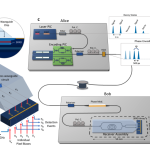
Traditionally, SNSPDs rely on electrical connections for power, which can introduce unwanted noise, but this approach uses light itself to provide the necessary bias current. The technique employs a cryogenic InGaAs-InP photodiode, a device that converts light into electrical current functioning similarly to a solar panel but optimised for faint signals, to generate a stable current. By carefully shielding the detector from stray light, researchers achieved an ultra-low intrinsic dark count rate of 1e-4 counts per second.
Optical biasing unlocks ultra-low noise superconducting nanowire single-photon detection
A remarkable ultra-low intrinsic dark count rate of 1e-4 counts per second was achieved, representing a significant improvement over previous optical biasing schemes that exhibited rates exceeding 31kcps. This threshold is crucial for detecting extremely weak signals in quantum photonics, as such low noise levels were previously only attainable with complex and thermally limited electrical biasing systems. The University of Geneva and the National Institute of Standards and Technology scientists demonstrated a superconducting nanowire single-photon detector with performance comparable to conventional methods, including 80.7% system detection efficiency and 57.5ps minimum timing jitter.
The new optical biasing technique mitigates stray photons, a common source of false detections, and offers a viable pathway towards fully photonic single-photon detectors for high-precision applications. A novel optical biasing scheme achieving an ultra-low intrinsic dark count rate of 1e-4 counts per second has now been demonstrated. It was accomplished using a cryogenic InGaAs-InP photodiode, a component converting light into electrical current, as a local bias source for a superconducting nanowire single-photon detector, or SNSPD. The detector also exhibited a system detection efficiency of 80.7%, accurately registering over eighty percent of incoming single photons, alongside a minimum timing jitter of 57.5ps, indicating precise timing resolution. Further analysis revealed stable photocurrent generated by the photodiode, with fluctuations primarily linked to the incident light’s power; careful shielding then blocked stray photons, minimising false detections. While these figures represent a strong advance, the demonstrated system’s performance under complex, real-world conditions, and its long-term stability outside a controlled laboratory setting, remain to be fully established.
Optical biasing presents a route to integrated photonic quantum systems despite noise limitations
Refining single-photon detectors is a key focus for scientists, as these are essential tools for emerging quantum technologies and sensitive measurement applications. This approach demonstrates a viable alternative to electrical biasing, and the authors note a residual background dark count rate of 32.6 counts per second, a persistent noise floor that limits ultimate sensitivity; this suggests fully eliminating noise via optical biasing remains a considerable challenge.
Acknowledging a dark count rate of 32.6 counts per second alongside an 80.7% detection efficiency does not dismiss the achievement, but rather frames it realistically. This optical biasing method offers a pathway towards fully integrated, all-photonic systems, important for scaling up quantum technologies like quantum computing and secure communication networks. Reducing electrical connections within cryogenic setups, the freezing environments needed for these detectors, minimises heat load and potential noise sources.
A new optical biasing method for single-photon detectors, important components in quantum technology, has been demonstrated by researchers. This technique utilises a cryogenic photodiode to provide stable bias, offering a low-noise alternative to electrical biasing and paving the way for fully integrated photonic systems. The development of a cryogenic InGaAs-InP photodiode as a local bias source for superconducting nanowire single-photon detectors, or SNSPDs, offers a compelling alternative to electrical biasing methods.
The team achieved an ultra-low intrinsic dark count rate of 1e-4 counts per second, a key metric for sensitive detection, by actively blocking stray photons from the photodiode. This comparable performance, including 80.7% detection efficiency and 57.5ps timing jitter, demonstrates the viability of fully photonic SNSPD systems. Consequently, this work shifts focus towards exploring methods for integrating multiple photodiodes, potentially enabling larger detector arrays and more complex quantum architectures for advanced applications.
Researchers demonstrated an improved optical biasing scheme for superconducting nanowire single-photon detectors, achieving an ultra-low intrinsic dark count rate of 1e-4 counts per second. This new method utilises a cryogenic photodiode as a stable bias source, offering a low-noise alternative to traditional electrical biasing and maintaining a system detection efficiency of 80.7%. The work suggests that fully photonic systems are viable for sensitive detection, although a residual background dark count rate of 32.6 counts per second remains a limitation. The authors indicate future work will focus on integrating multiple photodiodes to develop larger detector arrays.
👉 More information
🗞 Improved Cryogenic Photodiode Optical Biasing for Low-Noise and Low-Jitter Superconducting Nanowire Single-Photon Detectors
🧠 ArXiv: https://arxiv.org/abs/2606.07140
See today’s quantum computing news on Quantum Zeitgeist for the latest breakthroughs in qubits, hardware, algorithms, and industry deals.