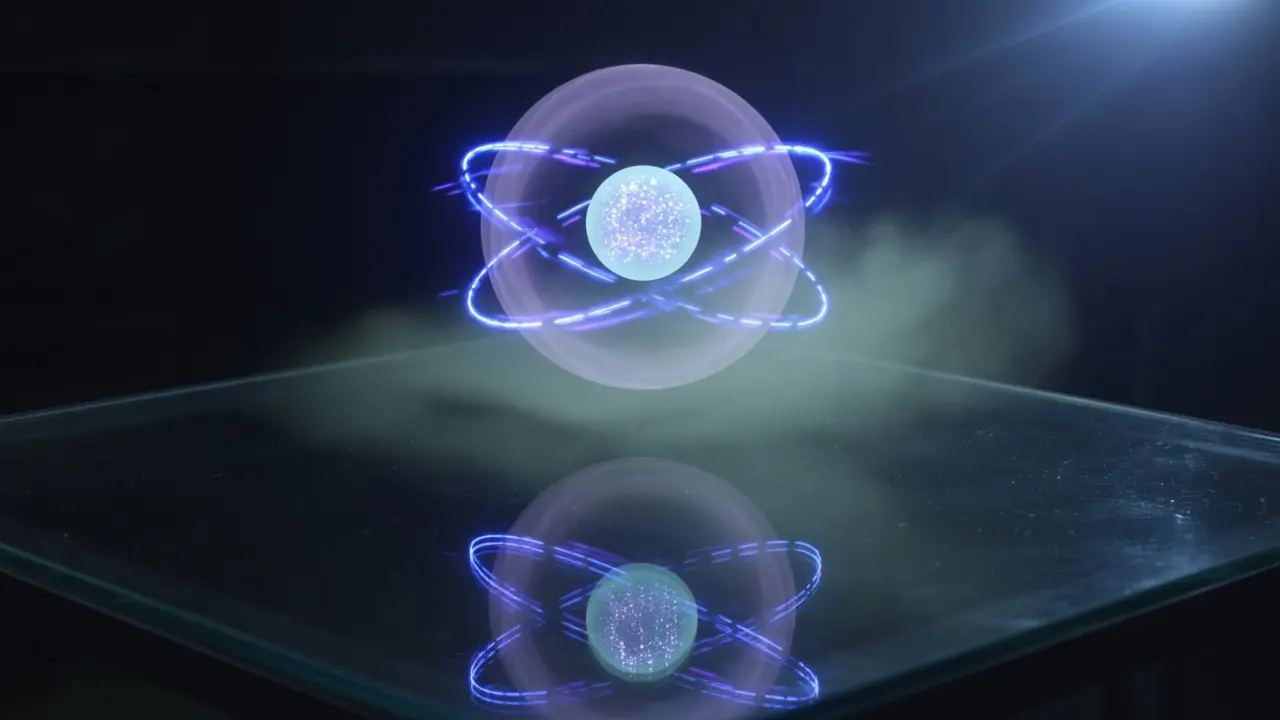
Pascal Naidon of Universität Ulm and colleagues propose using a Bose-Einstein condensate of ultracold atoms to tackle a decades-old question in quantum theory: how long it takes a particle to reach a detector. Their work details a realistic experimental setup that, rather than directly measuring arrival times, focuses on measuring the arrival flux as a function of detector position.
This novel approach circumvents the practical challenges of close-proximity detection and is designed to differentiate between competing theoretical predictions for particle arrival. The research raises prospects for resolving a long-standing debate about time itself within the framework of quantum mechanics.
Bose-Einstein Condensate as Platform for Arrival-Time Studies
This approach circumvents limitations imposed by the need for extremely close proximity between detectors and the quantum system under observation, a significant hurdle in prior research. Ultracold atoms have been an essential platform to verify numerous predictions of quantum theory, Bose-Einstein condensation being the most prominent and famous example. This proposal shifts the focus from confirmation to exploration, tackling a question for which quantum theory has historically offered an incomplete answer: how long does it take a particle to traverse a distance?
Researchers anticipate that the proposed method will allow for unambiguous differentiation between at least three major groups of predictions concerning arrival-time distributions. The experimental design incorporates a vertical detector positioned on a horizontal translation stage, enabling adjustments to its position between measurements and recording counts for varying horizontal distances from the initial atomic cloud.
The proposed detector setup is designed to probe arrival-time distributions within a limited time window, corresponding to the cloud’s passage in front of the detector, and is separated by a vertical distance of 45 centimeters from the source of atoms. Simulations suggest that, for a helium-4 atom within a condensate of 10000 atoms initially trapped in a harmonic trap, the predicted arrival-time distributions will vary depending on the chosen parameters.
Specifically, the coefficient α, used in the equations governing particle behavior, was set to 3.0 millimeters per second for one simulation and 0.4 millimeters per second for another, demonstrating the sensitivity of the predicted results to these variables. The team anticipates that this sensitivity will allow them to distinguish between competing theoretical models. The researchers emphasize that their experiment relies on a single expanding cloud with positive flux, avoiding theoretical difficulties encountered in other proposed methods.
The experimental signatures are expected to appear at detector positions relatively distant from the initial location of the cloud, simplifying the measurement process. This indirect measurement strategy is a key innovation, allowing scientists to infer arrival times from the observed distribution of atoms on the detector. The practicality of this approach is bolstered by its reliance on readily available technology, minimizing the need for novel or highly specialized equipment.
This contrasts with previous proposals that faced challenges due to complex instrumentation or the difficulty of minimizing interactions between the detector and the quantum system. Lucas Happ of the Few-Body Systems Physics Laboratory, RIKEN Nishina Centre, RIKEN, and colleagues acknowledge that fluctuations inherent in any experiment may affect the predicted average results, but maintain that the proposed setup offers a robust framework for investigating this fundamental question.
“Proposal of quantum arrival-time measurement with a Bose-Einstein condensate,” reads the title of their published work, signaling a focused effort to address a specific challenge within quantum theory. This work builds upon decades of research into Bose-Einstein condensates, using their unique properties to tackle a problem that has long eluded a definitive solution.
This proposed experiment represents a step towards resolving a decades-old debate, offering a realistic and potentially conclusive approach to measuring quantum arrival times. The reliance on established technology and a novel measurement strategy positions this research as a promising avenue for advancing their understanding of the fundamental nature of time within the framework of quantum theory.
Quantum Clock, Flux, and Stochastic Arrival-Time Predictions
Several theoretical approaches predict differing distributions of particle arrival times, a longstanding point of contention within quantum theory, and resolving this disagreement requires distinguishing between subtle predictions. This approach addresses challenges associated with detector proximity and offers a pathway to unambiguously identify which theoretical model best describes quantum behavior. The proposed experiment uses four distinct theoretical predictions of arrival-time distributions, each originating from a different conceptual framework.
A separate stochastic path approach, rooted in Nelson’s stochastic mechanics, suggests particles follow Brownian-motion-like trajectories. The Kijowski flux, derived from an axiomatic approach, also presents a unique prediction, while a Gross-Pitaevskii description provides another theoretical basis for comparison.
A key aspect of the experimental design involves using a Bose-Einstein condensate, a state of matter where atoms behave as a single quantum entity, to generate the particle source. Unlike previous proposals, this setup does not require maintaining vertical confinement of the atomic cloud, simplifying the experimental complexity. This constrained observation window, represented as a shaded area in the accompanying visualizations, focuses the measurement on a manageable portion of the overall distribution.
Kijowski Flux and Axiomatic Approaches to Arrival Times
Specifically, the setup aims to differentiate between predictions stemming from the quantum clock approach, the axiomatic approach, which yields the Kijowski distribution, and the Bohmian trajectory model. This difference could be experimentally confirmed or ruled out by observing the arrival flux at varying detector positions. Calculations reveal that the Kijowski flux exhibits small oscillations in a horizontal cigar configuration, a feature absent in other theoretical predictions, offering a potential signature for confirming the axiomatic approach.
However, resolving these oscillations with a single experiment using 10000 atoms may prove difficult due to shot noise, prompting consideration of experiments with larger atom counts. While increasing the number of atoms could improve resolution, the team acknowledges that fully resolving the oscillations may still present a challenge.
A more advanced scheme involving the measurement of arrival times of interfering clouds could be employed, but this introduces complexities due to the potential for negative flux, a phenomenon where particles appear to re-enter the detector, and increased dependence on assumptions about the detector’s impact on the system. This distance simplifies the experimental setup and reduces the technical demands on detector precision.
The team has also investigated the impact of fluctuations inherent in any experiment on the Kijowski flux, specifically focusing on the effect of shot noise, the sampling error around predicted average values, which scales with the square root of the average count number for each detector position. This analysis highlights the conditions under which the oscillations specific to the Kijowski prediction are observable, even in the presence of these fluctuations.
Microchannel Plate Detection of Quantum Arrival Fluxes
The ability to discern subtle differences in predicted arrival-time distributions relies heavily on detector placement, with calculations indicating significant distinctions are observable only when detectors are positioned relatively far from the initial atomic cloud’s location, a departure from some earlier proposals. This distance isn’t merely a practical convenience, simplifying technical demands on detection systems, but also minimizes potential disturbance of the evolving quantum system, ensuring measurements are taken only as the atoms reach the detector.
The proposed experimental setup uses microchannel plate detectors, a technology already established in quantum gas experiments for detecting metastable atoms, rather than fluorescence or absorption imaging which are less suited for precise arrival-time measurements. This choice allows for a configuration where a Bose-Einstein condensate, initially held in an optical trap, is released and its subsequent expansion monitored by detectors positioned in a lower chamber.
While complete separation of some predictions isn’t guaranteed, the experimental outcomes could still rule them out entirely, narrowing the field of viable theoretical models. The team acknowledges that the reliability of predictions may be compromised at detector positions too close to the initial cloud radius, due to potential back action of the detector on the evolving cloud. This work builds upon a long history of debate surrounding the interpretation of arrival times in quantum theory, a field where even the fundamental question of whether standard quantum theory provides a definitive answer remains contentious.
The researchers note that ongoing investigations are exploring the potential impact of the detector’s presence on these predictions, acknowledging the complex interplay between measurement and the quantum system itself. The team highlights the potential for resolving the decades-old debate on this fundamental issue. The researchers have also investigated how the choice of initial conditions affects the experimental outcomes, specifically exploring the use of both vertical and horizontal cigar-shaped condensates. The team’s work suggests that the observed differences in arrival-time distributions are stable and generic, resulting from the fundamental properties of the quantum system.
This stability is important for ensuring the reliability and reproducibility of the experimental results, and for providing a clear signal that can be used to validate or refute existing theoretical models. The ability to probe the arrival flux for different detector positions, rather than different times, is a key advantage of this approach, allowing for a more comprehensive and subtle understanding of quantum arrival dynamics.
👉 More information
🗞 Proposal of quantum arrival-time measurement with a Bose-Einstein condensate
✍️ Pascal Naidon, Lucas Happ and Denis Boiron
🧠 DOI: http://link.aps.org/doi/10.1103/683f-3qxt

See today’s quantum computing news on Quantum Zeitgeist for the latest breakthroughs in qubits, hardware, algorithms, and industry deals.