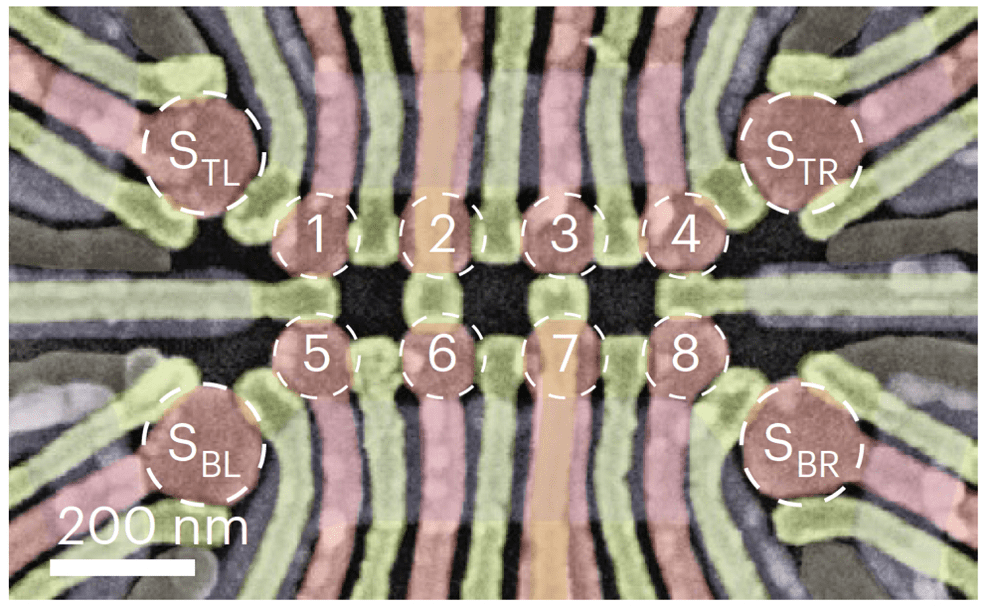
A team at QuTech has successfully demonstrated the initialization, readout, and universal control of four qubits made from eight germanium quantum dots. This breakthrough, published in Nature Nanotechnology and featured on its February cover, underscores the potential of semiconductor qubits as a platform for future quantum computation.
The team, comprising TU Delft and TNO researchers, has created a system of eight interacting spins encoding four semiconducting qubits, which can be controlled with high precision by many gate electrodes. This level of control enabled the team to precisely transfer quantum information between qubits, marking a significant milestone on the path towards full-scale quantum computation.
The system’s ability to entangle qubits is one of the hallmarks of a quantum computer, providing it with its unique computing power. The QuTech team demonstrated this capability by entangling the first and second qubit, then transferring the entanglement to the third and finally the fourth qubit, resulting in the first and fourth qubits being entangled with a 75% Bell state fidelity.
This work represents the next step towards larger numbers of spin qubits and offers physicists a versatile platform for investigating quantum phenomena with unparalleled control. Vandersypen, who led the team, notes, “Along the way, we are getting better at building and operating systems of multiple qubits.
Four Interacting Semiconducting Qubits
Four Interacting Semiconducting Qubits
The future of quantum computing lies in managing vast numbers of qubits, the quantum counterparts of classical bits. Unlike classical bits that can only be ‘0’ or ‘1’, qubits can exist in a superposition of all states between these two extremes. To build a full-scale quantum computer, achieving reliable control and coupling over increasing numbers of qubits is crucial. The QuTech team has now achieved this feat by creating a system of eight interacting spins that encode four semiconducting qubits, each controllable via numerous gate electrodes.
A Playground for Quantum Simulations
Xin Zhang, the study’s first author, explains the team’s initial aim: “Our goal was to create a playground for simulating quantum phase transitions or studying magnon propagation across arrays of spins. We began by developing methods to calibrate the coupling between neighboring spins and probe the system.” The team’s efforts resulted in a four-qubit system involving eight spins, each pair acting as a qubit with a spin singlet and triplet state representing ‘0’ and ‘1’.
Quantum Information Transfer
One of the defining features of a quantum computer is the ability to entangle qubits, allowing them to share quantum states. To showcase their 2×4 system’s capabilities, the QuTech team entangled the first and second qubit, then transferred the entanglement to the third and finally the fourth qubit. The result was an entangled state between the first and fourth qubits with a 75% Bell state fidelity. Lieven Vandersypen, who led the team, notes, “This is the first time anyone has realized this operation, and there’s plenty of room for improvement.”
A Versatile Platform forQuantum Research
A Versatile Platform for Quantum Research
Beyond advancing the path towards more significant numbers of spin qubits, this research provides physicists with a flexible platform to investigate quantum phenomena with unparalleled control. Vandersypen remarks, “As we progress, we are getting better at building and operating systems of multiple qubits. Our current levels of control, understanding, and engineering skills were unthinkable ten years ago. What was extremely hard then has become easy now. It’s kind of our motto: more, better, easier. Constantly moving the goalposts is essential if we want to arrive at full-scale quantum computation.”
External Link: Click Here For More



See today’s quantum computing news on Quantum Zeitgeist for the latest breakthroughs in qubits, hardware, algorithms, and industry deals.