
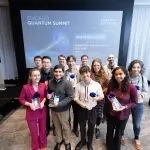
California Senator Adam Schiff recently toured a laboratory at Caltech where researchers demonstrated a 6,100-qubit tweezer array, a step toward what he describes as a “real, viable quantum technology.” The former chair of the House Intelligence Committee, who has followed the field for over a decade, witnessed firsthand the progress transforming quantum computing from a distant possibility into a developing reality. “I remember briefings from a decade ago, when there was still a great deal of technological uncertainty,” Schiff said, contrasting those early assessments with the current momentum. Professor Manuel Endres’ lab showcased the complex hardware and painstaking work required to harness quantum mechanics, sparking a discussion with Schiff that extended from technological advancements to the philosophical implications of entanglement.
Senator Schiff Explores Caltech’s 6,100-Qubit Tweezer Array
Professor Manuel Endres’ lab showcased this progress to Senator Schiff with a 6,100-qubit tweezer array. This demonstration was not merely a technical display, but a concrete visualization of the capabilities Schiff described, highlighting the transition from theoretical possibility to tangible reality. The tour extended beyond qubit count, encompassing discussions of optical qubit control and the critical challenge of quantum error correction, essential for building stable and reliable quantum systems. Schiff, formerly chair of the House Intelligence Committee, expressed particular fascination, indicating a personal intellectual curiosity that complements his policy concerns. The visit also prompted a discussion about sustaining scientific advancement amidst budgetary pressures. Schiff emphasized that “What has always helped this country prosper is our ability to attract the best and brightest minds,” noting the international composition of researchers in Endres’ lab and at the Jet Propulsion Laboratory.
He recounted a conversation at Reagan National Airport with a recent Johns Hopkins STEM graduate planning to work at NASA, saying the student told him that in his entire graduating class, he was the only one not leaving the country. Schiff warned of a potential exodus of talent due to a perceived lack of support for science.
Entanglement, Hidden Variables, and Quantum Interpretations
The exploration of quantum mechanics at Caltech extended beyond the progress in qubit technology to encompass its most perplexing conceptual challenges; Senator Adam Schiff’s visit revealed a particular fascination with a phenomenon central to the field’s counterintuitive nature. This interest stemmed not only from national security implications, but from a genuine intellectual curiosity regarding the foundations of reality, prompting detailed discussions with physicists John Preskill and Thomas Rosenbaum. Preskill explained how Bell-type experiments effectively dismiss the notion of pre-determined answers within entangled systems, moving beyond the simplistic analogy of paired mittens in separate boxes. Rosenbaum, grounding the discussion in experimental physics, clarified that measurement is not a subjective act, but rather a physical interaction irreversibly linking a system to its surroundings.
The conversation delved into interpretations like many-worlds, with Preskill describing measurement as a process where the observer becomes entangled with the observed. Schiff succinctly summarized this with, “My takeaway is Spider-Man is real,” a playful remark underscoring the profound shift in perspective required to grasp quantum phenomena. Beyond current applications, the discussion extended to the limits of physics itself, with Preskill pointing to quantum gravity and the universe’s origins as remaining open questions, noting that current models break down when describing the fluctuating spacetime at the earliest moments of existence. The setting within the Richard P. Feynman Lecture Hall further emphasized the historical weight of these inquiries, prompting reflection on how the legendary physicist might view modern advancements, including AI-generated lectures; Preskill said he would likely be interested in Schiff’s engagement demonstrated a rare combination of policy awareness and fundamental scientific inquiry, positioning quantum computing not just as a technological frontier, but as a continuing metaphysical exploration.
I remember briefings from a decade ago, when there was still a great deal of technological uncertainty and profound questions about whether this was really doable – whether it was some phantom we would be chasing for decades.
Quantum Technology’s Intersection with National Security & Policy
The escalating capabilities in quantum technology are prompting increased attention from policymakers, as evidenced by Senator Adam Schiff’s recent visit to Caltech and engagement with researchers like Professor Manuel Endres. “That is why it is so important to stay ahead in this race,” Schiff said, stressing the need for robust defenses and preparedness. The discussions extended beyond practical applications, delving into the philosophical implications of quantum mechanics, culminating in Schiff quipping he’d like course credit, to which Preskill replied, “Those were great questions.”
Now it feels much closer to becoming a real, viable quantum technology. It is fascinating to see what that looks like in the lab, to be on campus, and to be on the brink of these discoveries.
Attracting STEM Talent Amidst US Scientific Precarity
Schiff recounted a conversation at Reagan National Airport with a Johns Hopkins STEM graduate planning to work at NASA, revealing that the student was the only one not leaving the country, illustrating a worrying trend of outward migration among highly skilled professionals. This loss is not simply about numbers, but about the potential erosion of American scientific leadership, particularly in rapidly evolving fields like quantum computing. He observed scientists originating from Japan and Germany actively contributing to American research, a testament to the historical appeal of US institutions. However, this advantage is now perceived as precarious, with a growing “perception of hostility toward science” potentially driving talent away. The senator’s visit, which included a tour of Professor Manuel Endres’ lab showcasing a 6,100-qubit tweezer array, underscored the urgency of addressing this issue.
Beyond the technological advancements, described as feeling “much closer to becoming a real, viable quantum technology” after previously questioning its feasibility a decade ago, Schiff connected scientific progress to broader policy concerns, warning that maintaining a leading edge in fields like quantum computing requires sustained investment and a welcoming environment for international researchers. He concluded with a lighthearted observation following a discussion of quantum mechanics: “My takeaway is Spider-Man is real.”
I saw that in the lab today, with scientists from Japan and Germany. I saw it all the time at JPL: our institutions have been magnets for brilliant people from around the world because of the strength of American science.


See today’s quantum computing news on Quantum Zeitgeist for the latest breakthroughs in qubits, hardware, algorithms, and industry deals.