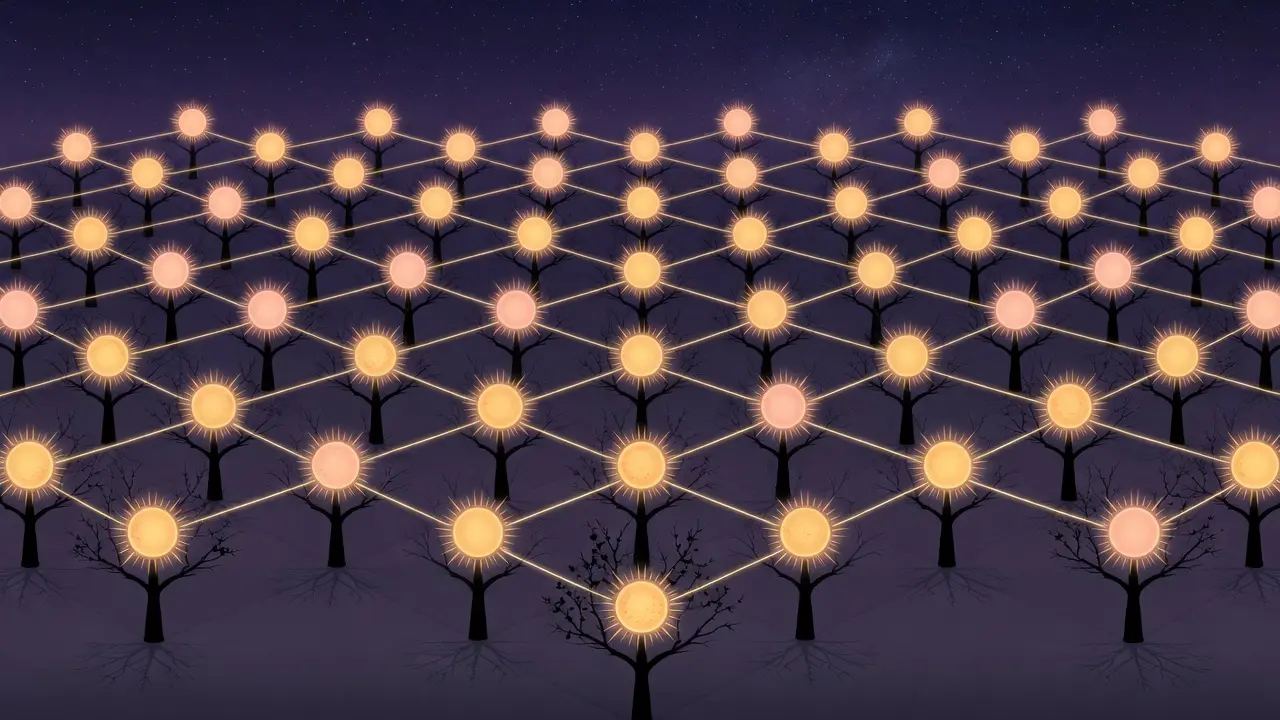
Classifying generalised Bethe trees that allow perfect state transfer, the reliable transmission of quantum information between vertices in a network, has long been a challenge. Previous work largely focused on highly symmetrical graphs or continuous-time models where only simple paths were known to exhibit this property. Researchers at the Indian Institute of Technology Guwahati have now fully classified these structures, proving such trees are either straight paths or uniform subdivisions of two specific tree types: B(2,3) and B(1,2,3).
The team definitively identified all tree-shaped networks capable of perfectly transmitting quantum information using “Grover walks”, a specific type of quantum process. Previously it was known only simple lines could achieve this reliably. These structures are either straight paths or subdivisions, networks created by replacing edges with longer pathways, of two particular branching trees: B(2,3) and B(1,2,3). Imagine these generalised Bethe Trees as a family of branching, symmetrical diagrams representing potential connections between points in a network, like different routes on a map.
Perfect state transfer, akin to sending a message through a perfect echo chamber where the entire signal arrives without distortion, relies on this Grover Walk which is essentially exploring all possible paths simultaneously instead of one after another. This breakthrough begs the question: what previously hidden structural properties allow for reliable quantum communication within these complex tree networks.
Spectral analysis identifies Bethe Tree topologies enabling flawless quantum transmission
Detailed spectral analysis examined inherent frequencies within the network’s structure to unravel which generalised Bethe Trees could support perfect state transfer. Understanding information propagation through each level of the tree is key, exploiting symmetry *within* those levels while accounting for changes at subsequent layers.
By carefully mapping this propagation and its corresponding ‘spectral signature’, configurations where quantum information arrives without distortion were identified; it’s akin to sending a message through a perfect echo chamber. Generalised Bethe trees were classified to determine structures supporting perfect state transfer in Grover walks, with quantum information arriving unaltered between points in the network.
The investigation revealed that only paths or subdivisions of two specific Bethe Trees, B(2,3) and B(1,2,3), exhibit this property, achieving minimum times of 6k for subdivided trees and ‘n’ for simple paths. All vertex pairs capable of perfectly transferring states were also precisely identified alongside calculating shortest required transmission times within these structures; further analysis focused on how branching degree impacts signal fidelity across different tree levels.
Perfect State Transfer Characterisation on Generalised Bethe Tree Subdivisions
Previously, perfect state transfer, the reliable transmission of quantum information, was definitively proven only on simple lines or highly symmetrical graphs. Now it appears to occur across generalised Bethe trees under specific conditions where no such structures were previously known beyond paths. Any such tree created by replacing each edge with a chain of exactly *k* edges will exhibit this property for some integer value of k.
Generalised Bethe trees enable perfect state transfer with limitations across diverse networks
Saptarshi Das from the Department of Mathematics and Debasree Chowdhury at Indian Institute of Technology Guwahati definitively mapped out which generalised Bethe trees support perfect state transfer, an important step towards designing strong quantum communication networks. However, their work remains confined to this specific class of graph; it’s a thorough answer for these structures, but leaves open whether similar principles govern other network topologies entirely. Previous studies largely focused on highly symmetrical arrangements or continuous-time models, approaches that may not translate effectively to more complex architectures.
Despite being limited to specific tree structures, identifying *any* network topology guaranteed to enable perfect state transfer is valuable for building future quantum technologies because it’s vital for secure communication and distributed computing. The team has definitively characterised all generalised Bethe trees capable of enabling perfect state transfer during Grover walks, a process exploring multiple pathways simultaneously to move data between points on a network. Their work proves these networks must either be simple paths or uniform subdivisions of two specific tree types, B(2,3) and B(1,2,3), establishing precise structural limits for achieving instantaneous communication; they are now investigating how altering edge weights affects transmission speed within these identified structures.
This research completely classifies generalized Bethe trees that allow perfect state transfer, the lossless movement of quantum information, during Grover walks. The study demonstrates this phenomenon occurs if and only if the tree is structured as a path or a subdivision of either B(2,3) or B(1,2,3). This classification provides definitive knowledge about which network topologies support ideal data transmission in this context. Researchers are currently examining how changing characteristics along edges impacts the speed of transmission within these defined networks.
👉 More information
🗞 Perfect state transfer in Grover walks on generalized Bethe trees
✍️ Koushik Bhakta (Affiliation: Department of Mathematics); Bikash Bhattacharjya (Affiliation: Indian Institute of Technology Guwahati)
🧠 ArXiv: https://arxiv.org/abs/2611.32469



See today’s quantum computing news on Quantum Zeitgeist for the latest breakthroughs in qubits, hardware, algorithms, and industry deals.