
Quantum Brilliance, established in 2019, is an Australian-based company that develops room-temperature miniaturized quantum computing products and solutions. And today, they have unveiled its newest development, the Qristal software suite, allowing various R&D teams to investigate integrating quantum systems in real-world applications, addressing the issues on the lab-scale availability of the quantum technology.
Developers and academics can now use Qristal to create and test unique quantum algorithms built for quantum accelerators instead of quantum mainframes. The Qristal Emulator in the suite allows users to determine the number of qubits essential to outperform classical computers in hybrid classical/quantum applications in data centers, aerospace, autonomous vehicles, mobile devices, and other areas.
Quantum Brilliance continues to aim and achieve mass deployment of its quantum technology in order to accelerate industry toward cutting-edge computing applications and next-generation supercomputers.
Thus, developing the Qristal SDK with an emulator will take quantum computing beyond the lab and into real-world applications in data centers, aerospace, transportation, and other fields.
“Qristal provides a powerful tool for developers and researchers in any field to explore the quantum utility or ‘usefulness’ of our quantum accelerators. Our software suite can help people discover for themselves that quantum computers don’t need to outperform supercomputers to provide value, moving the technology out of the lab and into practical solutions sooner.”
Mark Luo, CEO and co-founder of Quantum Brilliance
Qristal, a Versatile Solution for Quantum Computing Research.
Qristal users can construct high-performance software for production, testing on realistic models of Quantum Brilliance’s diamond-based quantum accelerators, mainly driven by its full integration of C++ and CUDA features. Qristal also allows embedded software development and will soon include support for Nvidia’s QODA, making it a versatile solution for quantum computing research.
Furthermore, the program takes advantage of MPI, the global standard for large-scale parallel computing, to allow for the investigation of prospective applications of parallelized room-temperature quantum accelerators in high-performance computing (HPC) installations.
“As an experienced quantum chemist but a relative newbie to quantum computing, I was impressed by the user experience and high-level abstractions of the Qristal SDK. I could set up and run my own quantum chemical simulations through Qristal with almost no knowledge of quantum circuits, quantum gates and other low-level quantum computing jargon.”
Dr. Marco De La Pierre, supercomputing application specialist at the Pawsey Supercomputing Centre and a Qristal beta user.
The efficiency of Miniature Technology
Quantum computers from Quantum Brilliance employ synthetic diamonds at normal temperatures in any environment. Unlike big mainframe quantum computers, Quantum Brilliance’s devices do not require cryogenics, vacuum systems, or precision laser arrays, which means the company’s technology consumes substantially less power and may be installed onsite or at the edge.
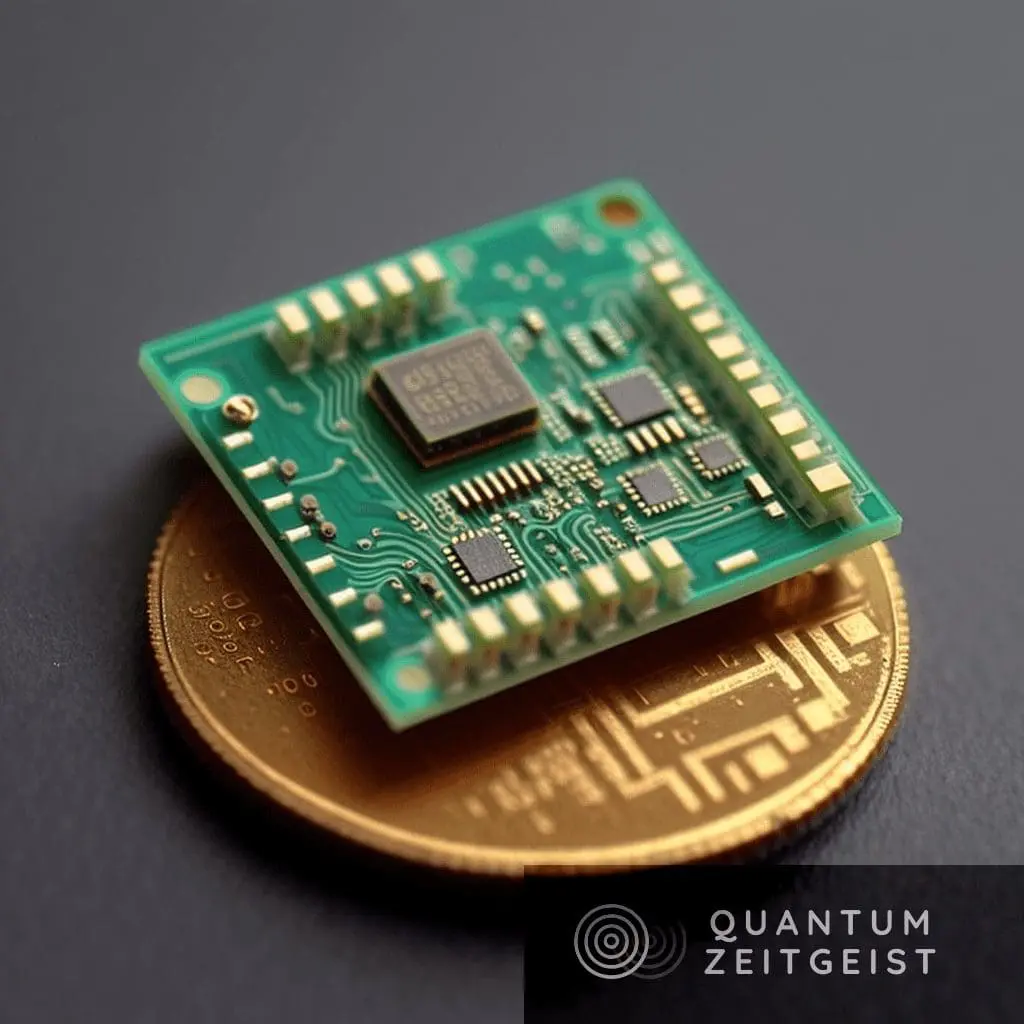
Currently, the size of a desktop PC, the company is seeking to further miniaturize its technology to the size of a semiconductor chip, which may be utilized on any device and everywhere conventional computers are now available, enabling practical quantum computing for everyone.