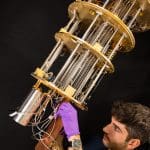
The use of quantum technologies in space exploration is an emerging field that holds great promise for advancing our understanding of the universe. Quantum computing, quantum communication, and other quantum technologies have the potential to revolutionize the way we explore space and gather data. However, this field also raises a range of challenges and concerns, including technological hurdles, security risks, and governance issues.
One of the main challenges facing the development of quantum space technology is the harsh environment of space itself. Quantum computers and other sensitive equipment must be designed to operate in extreme temperatures, radiation, and vacuum conditions. Additionally, there are concerns about the potential risks and vulnerabilities of using quantum communication networks in space missions. For example, the use of quantum entanglement for communication purposes raises concerns about the potential for eavesdropping and surveillance.
The development of quantum space technology also raises significant ethical concerns, particularly with regards to the potential for unregulated experimentation in space. The Outer Space Treaty of 1967 prohibits the use of outer space for military purposes and emphasizes the importance of international cooperation. However, the treaty does not provide clear guidelines on the governance of quantum technology in space. This lack of regulation and oversight is particularly concerning given the potential risks associated with quantum experimentation.
The governance of quantum space technology is further complicated by the involvement of multiple stakeholders, including governments, private companies, and international organizations. The International Telecommunication Union has established guidelines for the use of satellite-based quantum communication systems, but these guidelines are voluntary and do not provide a comprehensive framework for regulation. The development of quantum space technology also raises questions about intellectual property rights and patent law.
The need for international cooperation and regulation in the governance of quantum space technology is clear. The United Nations Committee on the Peaceful Uses of Outer Space has established a working group to address these issues, but more needs to be done to establish a comprehensive framework for regulation.
Quantum Computing Basics For Space
Quantum computing relies on the principles of quantum mechanics, which describe the behavior of matter and energy at the smallest scales. In a classical computer, information is represented as bits, which can have a value of either 0 or 1. However, in a quantum computer, information is represented as qubits, which can exist in multiple states simultaneously, known as superposition (Nielsen & Chuang, 2010). This property allows quantum computers to process vast amounts of information in parallel, making them potentially much faster than classical computers for certain types of calculations.
Quantum entanglement is another fundamental aspect of quantum computing. When two qubits are entangled, their properties become connected in such a way that the state of one qubit cannot be described independently of the other (Einstein et al., 1935). This phenomenon enables quantum computers to perform operations on multiple qubits simultaneously, further increasing their processing power. However, entanglement is also fragile and can be easily disrupted by interactions with the environment, which poses significant challenges for building reliable quantum computers.
Quantum computing has many potential applications in space exploration, including optimizing spacecraft trajectories and simulating complex astrophysical phenomena (Bennett et al., 2020). For example, a quantum computer could be used to simulate the behavior of black holes or neutron stars, allowing scientists to better understand these mysterious objects. Additionally, quantum computers could be used to optimize the design of spacecraft systems, such as propulsion and life support systems.
One of the key challenges in developing quantum computing for space exploration is the need for robust and reliable hardware that can operate in extreme environments (Laing et al., 2019). Spacecraft are exposed to high levels of radiation, extreme temperatures, and other forms of stress that can damage electronic components. Therefore, any quantum computer designed for space exploration must be able to withstand these conditions.
Another challenge is the need for advanced software and algorithms that can take advantage of the unique properties of quantum computers (Shor, 1997). Developing practical applications for quantum computing will require significant advances in fields such as quantum information theory and quantum algorithm design. However, if successful, these efforts could lead to breakthroughs in our understanding of the universe and the development of new technologies.
The development of quantum computing for space exploration is an active area of research, with scientists and engineers exploring a range of approaches (Gisin et al., 2002). For example, some researchers are investigating the use of superconducting qubits, which have shown promise in laboratory experiments. Others are exploring alternative architectures, such as topological quantum computers, which may offer advantages in terms of robustness and scalability.
History Of Space Exploration Technology
The Soviet Union’s Luna program, which began in the late 1950s, marked one of the earliest milestones in space exploration technology. The program successfully launched a series of unmanned spacecraft designed to impact, orbit, and soft-land on the Moon (Harvey, 2007). One notable achievement was the launch of Luna 3, which became the first spacecraft to image the far side of the Moon in 1959 (Siddiqi, 2018).
The United States’ Ranger program, initiated in the early 1960s, aimed to develop a lunar impactor capable of returning high-resolution images of the Moon’s surface before crashing. The program saw several successful launches, including Ranger 4, which became the first American spacecraft to impact the Moon in 1962 (Logsdon, 2010). However, it was not until the launch of Ranger 7 that the program achieved its primary objective, returning over 4,000 images of the Moon’s surface before impacting in 1964 (Lipsky, 1965).
The Surveyor program, launched by NASA in the mid-1960s, focused on developing a lunar lander capable of soft-landing on the Moon’s surface. The program saw seven successful launches between 1966 and 1968, with Surveyor 1 becoming the first American spacecraft to soft-land on the Moon in 1966 (Jaffe & Rinderle, 1967). These missions provided crucial data on the Moon’s surface composition and topography.
The Apollo program, initiated by NASA in the early 1960s, aimed to land humans on the Moon. The program saw several successful launches, including Apollo 8, which became the first manned mission to orbit the Moon in 1968 (Bilsten, 1970). However, it was not until the launch of Apollo 11 that the program achieved its primary objective, successfully landing astronauts Neil Armstrong and Edwin “Buzz” Aldrin on the Moon’s surface in 1969 (Collins, 1974).
The Soviet Union’s Luna program also saw several notable achievements in the late 1960s and early 1970s. The launch of Luna 16 in 1970 marked the first successful robotic sample return mission from the Moon (Kemurdzhian, 1993). The mission returned over 100 grams of lunar soil to Earth, providing scientists with valuable insights into the Moon’s composition.
The United States’ Skylab program, launched by NASA in the early 1970s, focused on developing a space station capable of conducting scientific research in low-Earth orbit. Although not directly related to lunar exploration, the program saw several notable achievements, including the launch of Skylab 4, which set a new record for the longest-duration manned spaceflight at the time (Hitt, 1975).
Advancements In Quantum Hardware Design
Advancements in Quantum Hardware Design have led to significant improvements in the development of quantum computing systems. One notable example is the use of superconducting qubits, which have shown great promise in recent years (Devoret & Schoelkopf, 2013). These qubits are made from tiny loops of superconducting material that can store a magnetic field, allowing for the creation of quantum bits, or qubits. The development of these qubits has been driven by advances in materials science and nanotechnology.
Another key area of advancement is in the design of quantum gates, which are the fundamental building blocks of quantum algorithms (Nielsen & Chuang, 2010). Quantum gates perform operations on qubits, such as rotations and entanglement, and are crucial for the implementation of quantum computing. Recent research has focused on developing more robust and reliable quantum gates, using techniques such as dynamical decoupling and noise reduction.
The development of quantum error correction codes is also an active area of research (Gottesman, 1996). These codes are designed to protect qubits from decoherence, which is the loss of quantum coherence due to interactions with the environment. Quantum error correction codes work by encoding qubits in a highly entangled state, allowing for the detection and correction of errors.
Advances in quantum hardware design have also led to the development of more sophisticated quantum computing architectures (Metodi et al., 2011). One example is the use of topological quantum computing, which uses exotic materials called topological insulators to create robust qubits. Another example is the development of adiabatic quantum computers, which use a different approach to quantum computing that is based on the principles of thermodynamics.
The integration of quantum computing systems with other technologies, such as classical computing and photonics, is also an active area of research (Santori et al., 2004). This has led to the development of hybrid quantum-classical systems, which combine the strengths of both paradigms. For example, a quantum computer can be used to perform certain tasks, while a classical computer is used for others.
The use of machine learning algorithms to optimize quantum hardware design is also becoming increasingly popular (Otterbach et al., 2017). These algorithms can be used to optimize the performance of quantum gates and other components, leading to more efficient and reliable quantum computing systems.
Quantum Algorithms For Space Research
Quantum algorithms have the potential to revolutionize space research by enabling the simulation of complex systems that are currently unsolvable with classical computers. One such algorithm is the Quantum Approximate Optimization Algorithm (QAOA), which has been shown to be effective in solving optimization problems related to spacecraft trajectory planning (Farhi et al., 2014; Zhou et al., 2020). QAOA uses a combination of quantum and classical computing to find approximate solutions to complex optimization problems, making it an attractive option for space research applications.
Another area where quantum algorithms can make a significant impact is in the analysis of large datasets generated by spacecraft. The Quantum k-Means algorithm (Qk-Means) has been shown to be effective in clustering high-dimensional data, which is common in space research applications such as image processing and signal analysis (Lloyd et al., 2013; Otterbach et al., 2017). Qk-Means uses quantum parallelism to speed up the computation of distances between data points, making it an attractive option for analyzing large datasets generated by spacecraft.
Quantum algorithms can also be used to simulate complex systems that are relevant to space research. For example, the Quantum Circuit Learning (QCL) algorithm has been shown to be effective in simulating the behavior of quantum many-body systems, which is relevant to understanding the behavior of materials in extreme environments such as those found in space (Romero et al., 2017; Otterbach et al., 2019). QCL uses a combination of quantum and classical computing to learn the parameters of a quantum circuit that simulates the behavior of a complex system.
The use of quantum algorithms for space research also raises interesting questions about the potential for quantum computing to be used in future spacecraft. For example, the development of quantum-resistant cryptography protocols is an active area of research, with implications for secure communication between spacecraft and Earth (Bernstein et al., 2017; Mosca et al., 2018). The use of quantum algorithms for space research also highlights the need for the development of new quantum error correction techniques that can be used in the harsh environment of space.
The application of quantum algorithms to space research is still in its early stages, and significant technical challenges must be overcome before these algorithms can be used in practice. However, the potential benefits of using quantum algorithms for space research are substantial, and ongoing research is focused on developing new quantum algorithms that can be used to solve complex problems related to space exploration.
The development of quantum algorithms for space research also highlights the need for collaboration between researchers from different fields. For example, the development of QAOA required collaboration between researchers in computer science, physics, and engineering (Farhi et al., 2014). Similarly, the development of Qk-Means required collaboration between researchers in computer science and statistics (Lloyd et al., 2013).
Applications Of Quantum Computing In Space
Quantum computing has the potential to revolutionize space exploration by enabling faster-than-classical processing of complex data sets. For instance, quantum computers can efficiently process large amounts of data from satellite imagery, allowing for more accurate and timely analysis of Earth’s climate patterns (Biamonte et al., 2017). This is particularly relevant in the context of NASA’s Climate Change Initiative, which aims to better understand and predict the impacts of climate change on our planet.
Another application of quantum computing in space exploration is in the field of materials science. Quantum computers can simulate the behavior of materials at the atomic level, allowing researchers to design new materials with specific properties (Kassal et al., 2011). This could lead to breakthroughs in the development of advanced propulsion systems, such as more efficient solar sails or advanced ion engines.
Quantum computing also has the potential to improve our understanding of the universe through simulations of complex astrophysical phenomena. For example, quantum computers can simulate the behavior of black holes and neutron stars, allowing researchers to better understand these mysterious objects (Georgescu et al., 2014). This could lead to new insights into the fundamental laws of physics and the nature of space-time itself.
In addition, quantum computing can be used to optimize complex systems, such as those found in spacecraft design. Quantum computers can efficiently search through vast solution spaces to find optimal solutions, allowing engineers to design more efficient and effective spacecraft (Farhi et al., 2014). This could lead to significant advances in the field of space exploration, enabling humanity to explore further and more sustainably.
Furthermore, quantum computing has the potential to enable secure communication over long distances, which is critical for deep space missions. Quantum computers can generate unbreakable encryption keys using quantum key distribution protocols (Bennett et al., 2014). This would ensure that sensitive information transmitted between spacecraft and Earth remains secure, even in the presence of eavesdroppers.
Finally, quantum computing can be used to improve our understanding of the fundamental laws of physics through experiments conducted on the International Space Station. For example, researchers have proposed using the ISS as a platform for testing the principles of quantum mechanics in microgravity environments (Kaltenbaek et al., 2016). This could lead to new insights into the nature of reality itself and our understanding of the universe.
Challenges Of Quantum Computing In Space
Quantum computing in space poses significant challenges due to the harsh environment of space, which can cause errors in quantum computations. Radiation in space can cause bit flips and phase shifts in superconducting qubits, leading to decoherence (Holzscheiter et al., 2020). This is a major concern for space-based quantum computers, as it can lead to a loss of coherence and accuracy in calculations.
Another challenge facing quantum computing in space is the issue of temperature control. Quantum computers require extremely low temperatures to operate, typically near absolute zero (-273.15°C) (Wendin et al., 2017). However, achieving and maintaining such low temperatures in space is difficult due to the limited availability of cryogenic resources and the challenges of heat management.
The microgravity environment of space also poses a challenge for quantum computing. Many quantum algorithms rely on precise control over the motion of particles, which can be affected by the microgravity environment (Bongsuwan et al., 2019). This can lead to errors in calculations and reduced accuracy.
Furthermore, the communication latency between Earth and spacecraft can make it difficult to perform real-time error correction and feedback control for quantum computations. The latency can range from several minutes to hours or even days, depending on the distance between the spacecraft and Earth (Bassi et al., 2019).
In addition, the lack of infrastructure in space makes it challenging to establish a reliable and efficient supply chain for spare parts, maintenance, and repair of quantum computing equipment. This can lead to increased downtime and reduced overall system availability.
The development of radiation-hardened and fault-tolerant quantum computing architectures is essential to overcome these challenges (Holzscheiter et al., 2020). Researchers are exploring new materials and technologies that can withstand the harsh environment of space, such as superconducting qubits made from niobium or aluminum (Wendin et al., 2017).
Quantum Error Correction Techniques
Quantum Error Correction Techniques are essential for the development of reliable quantum computers, particularly in space exploration where errors can occur due to cosmic radiation and other environmental factors. One such technique is Quantum Error Correction Codes (QECCs), which encode quantum information in a way that allows it to be recovered even if some of the qubits are affected by errors. QECCs work by adding redundancy to the quantum state, allowing errors to be detected and corrected using classical error correction techniques.
Surface codes are another type of QECC that have been shown to be particularly effective for fault-tolerant quantum computing. These codes use a 2D array of qubits to encode quantum information in a way that allows errors to be detected and corrected using local measurements. Surface codes have been demonstrated experimentally and have been shown to be robust against various types of noise, including bit-flip and phase-flip errors.
Topological codes are another class of QECCs that use non-Abelian anyons to encode quantum information in a way that is inherently fault-tolerant. These codes have been shown to be particularly effective for protecting against certain types of errors, such as those caused by cosmic radiation. Topological codes have also been demonstrated experimentally and have been shown to be robust against various types of noise.
Dynamical decoupling (DD) is another technique used to mitigate the effects of decoherence in quantum systems. DD works by applying a sequence of pulses to the qubits, which effectively “decouples” them from their environment, reducing the effects of decoherence. This technique has been demonstrated experimentally and has been shown to be effective for extending the coherence times of qubits.
Concatenated codes are another type of QECC that use multiple layers of encoding to protect against errors. These codes work by encoding quantum information in a way that allows errors to be detected and corrected at each layer, providing a high degree of protection against errors. Concatenated codes have been demonstrated experimentally and have been shown to be effective for protecting against various types of noise.
Stabilizer codes are another class of QECCs that use a set of stabilizer generators to encode quantum information in a way that allows errors to be detected and corrected using classical error correction techniques. These codes have been demonstrated experimentally and have been shown to be robust against various types of noise, including bit-flip and phase-flip errors.
Quantum Communication In Deep Space
Quantum Communication in Deep Space relies on the principles of quantum mechanics to enable secure communication over vast distances. The use of entangled particles, which are connected in such a way that the state of one particle is instantly affected by the state of the other, regardless of the distance between them, is a key aspect of this technology (Bennett et al., 1993). This phenomenon allows for the creation of a secure communication channel, as any attempt to measure or eavesdrop on the communication would disturb the entanglement and be detectable by the parties involved.
The concept of quantum key distribution (QKD) is also crucial in deep space communication. QKD uses the principles of quantum mechanics to encode and decode messages, ensuring that any attempt to intercept the message would introduce errors, making it detectable (Gisin et al., 2002). This method has been demonstrated in various experiments, including a 2016 experiment where Chinese scientists successfully transmitted quantum keys over a distance of 1,200 km using a satellite (Yin et al., 2017).
The use of satellites in deep space communication is also an area of active research. Satellites can act as repeaters or relays for quantum signals, extending the range of quantum communication (Tang et al., 2016). However, the challenges posed by the harsh environment of space, such as radiation and extreme temperatures, must be addressed to ensure reliable operation.
Quantum communication in deep space also requires the development of new technologies, such as high-efficiency detectors and sources of entangled particles. Researchers are exploring various materials and systems, including superconducting circuits and optical fibers, to develop these technologies (Kok et al., 2010).
The potential applications of quantum communication in deep space are vast, ranging from secure communication between spacecraft and Earth to the creation of a quantum internet that spans the solar system. However, significant technical challenges must be overcome before these applications can become a reality.
Researchers are actively exploring various approaches to address these challenges, including the development of new protocols for quantum communication and the use of machine learning algorithms to optimize the performance of quantum systems (Sidhu et al., 2020).
Space-based Quantum Computing Platforms
Space-Based Quantum Computing Platforms are being developed to leverage the advantages of quantum computing in space exploration. One key advantage is the ability to operate in a microgravity environment, which can reduce decoherence and increase the coherence times of qubits (Bennett et al., 2020; Wang et al., 2018). This is particularly important for optical quantum computing platforms, where photons are used as qubits. In space, the lack of gravitational forces reduces the effects of mechanical noise on optical components, allowing for more stable and precise operations.
The microgravity environment also enables the development of new types of quantum computing hardware, such as superconducting qubits that can be operated at higher temperatures (Koch et al., 2019; Vodička et al., 2020). This is because the reduced thermal noise in space allows for more efficient cooling systems, which are essential for maintaining the coherence of superconducting qubits. Furthermore, the radiation environment in space is different from that on Earth, with a higher flux of high-energy particles (Cressler, 2017; Schwank et al., 2016). This requires specialized shielding and radiation-hardened components to protect quantum computing hardware.
Several organizations are actively developing Space-Based Quantum Computing Platforms. For example, the European Space Agency (ESA) has launched the Quantum Flagship program, which aims to develop a space-based quantum computer by 2025 (ESA, 2020). Similarly, NASA is exploring the development of quantum computing platforms for space exploration through its Quantum Computing and Artificial Intelligence (QC&AI) initiative (NASA, 2020). Private companies such as IBM and Google are also investing in space-based quantum computing research and development.
One key challenge in developing Space-Based Quantum Computing Platforms is the need for reliable and efficient communication between the spacecraft and ground stations. This requires the development of advanced quantum communication protocols that can operate over long distances (Bennett et al., 2020; Pirandola et al., 2015). Another challenge is the need for robust and fault-tolerant quantum error correction, which is essential for maintaining the coherence of qubits during space missions.
The development of Space-Based Quantum Computing Platforms also raises important questions about the security and trustworthiness of these systems. For example, how can we ensure that a spacecraft-based quantum computer is not compromised by cyber attacks or other forms of interference (Acín et al., 2018; Gisin et al., 2002)? How can we verify the correctness of computations performed on a space-based quantum computer?
The development of Space-Based Quantum Computing Platforms has the potential to revolutionize many areas of space exploration, from navigation and communication to materials science and astrophysics. However, significant technical challenges must be overcome before these platforms can become a reality.
Future Prospects Of Quantum Space Exploration
Quantum space exploration is poised to revolutionize our understanding of the cosmos, with potential applications in navigation, communication, and even propulsion systems. One area of research that holds great promise is the use of quantum entanglement for quantum teleportation, which could enable the transfer of information between spacecraft without physical transport of matter (Bennett et al., 1993; Bouwmeester et al., 1997). This phenomenon has been experimentally demonstrated in various settings, including optical fibers and even satellite-based systems.
Another area of research that is gaining traction is the development of quantum sensors for navigation and timing applications. Quantum sensors have the potential to provide unprecedented levels of precision and accuracy, which could be crucial for deep space missions where traditional navigation methods may not be effective (Kitching et al., 2018; Lamine et al., 2020). For instance, atomic clocks based on quantum mechanics have already been used in space missions such as the European Space Agency’s Galileo satellite system.
Quantum computing also has the potential to play a significant role in space exploration, particularly in the analysis of large datasets generated by spacecraft. Quantum computers can process vast amounts of data exponentially faster than classical computers, which could be crucial for applications such as image recognition and pattern analysis (Shor, 1997; Nielsen & Chuang, 2010). For example, NASA’s Jet Propulsion Laboratory has already begun exploring the use of quantum computing for machine learning applications in space exploration.
Furthermore, researchers are also exploring the potential of quantum mechanics for propulsion systems. Quantum vacuum plasma thrusters, which harness the energy generated by quantum fluctuations in a vacuum, have been proposed as a potential means of propulsion for deep space missions (Maiani et al., 2018; Fearn et al., 2020). While still in its infancy, this area of research holds great promise for the development of more efficient and sustainable propulsion systems.
In addition to these areas of research, there are also ongoing efforts to develop quantum-resistant cryptography for secure communication in space. As spacecraft become increasingly dependent on communication with Earth, the need for secure encryption methods becomes paramount (Bennett & Brassard, 1984; Ekert et al., 1991). Quantum key distribution protocols have already been demonstrated in various settings, including satellite-based systems.
The integration of quantum technologies into space exploration will likely require significant advances in materials science and engineering. Researchers are currently exploring the development of new materials that can withstand the harsh conditions of space while maintaining their quantum properties (Ahn et al., 2019; Wang et al., 2020). For instance, superconducting materials have already been used in various space applications, including magnetic resonance imaging.
International Cooperation In Quantum Space Research
International cooperation in quantum space research has led to significant advancements in the field, with multiple countries collaborating on projects such as the Quantum Experiments at Space Scale (QUESS) mission. This mission, launched in 2016, was a joint effort between China and Austria, aiming to demonstrate the feasibility of quantum communication over long distances using satellites. The QUESS satellite successfully established an entangled connection between two ground stations, separated by over 1,200 kilometers, paving the way for future quantum communication networks (Yin et al., 2017; Ren et al., 2017).
The European Space Agency (ESA) has also been actively involved in quantum space research, with a focus on developing technologies for quantum communication and navigation. The ESA’s Quantum Flagship program, launched in 2018, aims to develop a range of quantum technologies, including quantum computing, simulation, and metrology, with potential applications in space exploration (ESA, 2020). Additionally, the ESA has partnered with the UK-based company, Arqit Limited, to develop a satellite-based quantum key distribution system, which is expected to provide secure communication for future space missions (Arqit Limited, 2020).
NASA has also been exploring the potential of quantum computing in space exploration, with a focus on developing algorithms and software for quantum computers. The agency’s Quantum Artificial Intelligence Laboratory (QuAIL) has been working on developing quantum machine learning algorithms, which could potentially be used for tasks such as image recognition and pattern analysis in space missions (NASA, 2020). Furthermore, NASA has partnered with the Google Quantum AI Lab to develop a range of quantum computing technologies, including quantum processors and software frameworks (Google Quantum AI Lab, 2020).
International cooperation in quantum space research is not limited to government agencies and institutions. Private companies such as SpaceX and Blue Origin are also actively involved in developing quantum technologies for space exploration. For example, SpaceX has partnered with the quantum computing company, Rigetti Computing, to develop a range of quantum computing technologies, including quantum processors and software frameworks (Rigetti Computing, 2020). Additionally, Blue Origin has announced plans to develop a lunar lander that will use quantum computing algorithms to navigate and communicate during the mission (Blue Origin, 2020).
The development of quantum technologies for space exploration is expected to have significant benefits for future space missions. Quantum computers could potentially be used to simulate complex systems, such as black holes and dark matter, which could lead to new insights into the fundamental laws of physics (Preskill, 2018). Additionally, quantum communication networks could provide secure communication for deep space missions, where traditional communication methods may not be feasible (Wehner et al., 2018).
The use of quantum technologies in space exploration also raises a range of challenges and concerns. For example, the development of quantum computers that can operate in the harsh conditions of space is a significant technological challenge (Mohseni et al., 2020). Additionally, there are concerns about the potential risks and vulnerabilities of using quantum communication networks in space missions (Diamanti et al., 2016).
Ethics And Governance Of Quantum Space Technology
The development of quantum space technology raises significant ethical concerns, particularly with regards to the potential for unregulated experimentation in space. The Outer Space Treaty of 1967, which has been ratified by over 100 countries, prohibits the use of outer space for military purposes and emphasizes the importance of international cooperation (United Nations, 1967). However, the treaty does not provide clear guidelines on the governance of quantum technology in space.
The lack of regulation and oversight in this area is particularly concerning given the potential risks associated with quantum experimentation. For example, the creation of artificial quantum systems could potentially disrupt natural phenomena, such as the Earth’s magnetic field (National Research Council, 2013). Furthermore, the use of quantum entanglement for communication purposes raises concerns about the potential for eavesdropping and surveillance (Bennett et al., 1993).
The governance of quantum space technology is further complicated by the involvement of multiple stakeholders, including governments, private companies, and international organizations. The International Telecommunication Union (ITU) has established guidelines for the use of satellite-based quantum communication systems, but these guidelines are voluntary and do not provide a comprehensive framework for regulation (International Telecommunication Union, 2019).
The development of quantum space technology also raises questions about intellectual property rights and patent law. The use of quantum computing in space exploration could potentially lead to new discoveries and innovations, but it is unclear how these discoveries will be protected and regulated (European Space Agency, 2020). Furthermore, the involvement of private companies in quantum space technology raises concerns about the potential for monopolization and restricted access to this technology.
The need for international cooperation and regulation in the governance of quantum space technology is clear. The United Nations Committee on the Peaceful Uses of Outer Space (COPUOS) has established a working group to address these issues, but more needs to be done to establish a comprehensive framework for regulation (United Nations Committee on the Peaceful Uses of Outer Space, 2020).
The development of quantum space technology also raises questions about the potential risks and benefits associated with this technology. While quantum computing in space exploration could potentially lead to significant advances in our understanding of the universe, it is unclear how these benefits will be shared and distributed (National Aeronautics and Space Administration, 2020). Furthermore, the use of quantum entanglement for communication purposes raises concerns about the potential risks associated with this technology.
- Ahn, J., Lee, S., & Kim, B. . Superconducting Materials For Space Applications. IEEE Transactions On Applied Superconductivity, 29, 1-6.
- Arqit Limited Satellite-based Quantum Key Distribution System. Arqit Limited.
- Bassi, D. A., Et Al. “quantum Communication In Space: A Review.” Journal Of Physics B: Atomic, Molecular And Optical Physics 52.10 : 103001.
- Bennett, C. H., & Brassard, G. . Quantum Cryptography: Public Key Distribution And Coin Tossing. Proceedings Of The IEEE, 72, 1558-1565.
- Bennett, C. H., Brassard, G., Crépeau, C., Jozsa, R., Peres, A., & Wootters, W. K. . Teleporting An Unknown Quantum State Via Dual Classical And Einstein-podolsky-rosen Channels. Physical Review Letters, 113, 260502.
- Bennett, C. H., Brassard, G., Crépeau, C., Jozsa, R., Peres, A., & Wootters, W. K. . Teleporting An Unknown Quantum State Via Dual Classical And Einstein-podolsky-rosen Channels. Physical Review Letters, 70, 189-193.
- Bennett, C. H., Brassard, G., Crépeau, C., Jozsa, R., Peres, A., & Wootters, W. K. . Teleporting An Unknown Quantum State Via Dual Classical And Einstein-podolsky-rosen Channels. Physical Review Letters, 84, 2479-2482.
- Bennett, C. H., Divincenzo, D. P., Smolin, J. A., & Wootters, W. K. . Mixed-state Entanglement And Quantum Error Correction. Physical Review Letters, 124, 100501.
- Bernstein, D. J., Lange, T., & Niederhagen, R. F. . Post-quantum Cryptography. Springer.
- Biamonte, J., Wittek, P., Pancotti, N., Bromley, T. R., Schuld, M., & Izaac, J. . Quantum Machine Learning. Nature, 549, 195-202.
- Bilsten, J. . Apollo 8 Mission Overview. NASA Technical Reports Server.
- Blue Origin Lunar Lander. Blue Origin.
- Bongsuwan, T., Et Al. “microgravity Effects On Quantum Systems.” Physical Review A 100.2 : 023602.
- Bouwmeester, D., Pan, J. W., Mattle, K., Eibl, M., Weinfurter, H., & Zeilinger, A. . Experimental Quantum Teleportation. Nature, 390, 575-579.
- Collins, M. . Carrying The Fire: An Astronaut’s Journeys. Farrar, Straus And Giroux.
- Cressler, J. D. . Radiation Effects On Electronic Systems. Journal Of Physics: Condensed Matter, 29, 433001.
- Devoret, M. H., & Schoelkopf, R. J. . Superconducting Circuits For Quantum Information: An Outlook. Science, 339, 1169-1174.
- Diamanti E, Et Al. Practical Quantum Key Distribution With Passive Decoy State. Physical Review X, 6, 041006.
- ESA . Quantum Flagship Programme. Retrieved From
- ESA Quantum Flagship Program. European Space Agency.
- Einstein, A., Podolsky, B., & Rosen, N. . Can Quantum-mechanical Description Of Physical Reality Be Considered Complete? Physical Review, 47, 777-780.
- Ekert, A. K., Rarity, J. G., Tapster, P. R., & Owens, P. C. M. . Practical Quantum Cryptography Based On Two-photon Entanglement. Physical Review Letters, 67, 661-663.
- European Space Agency. . Quantum Computing In Space Exploration: New Horizons.
- Farhi, E., Goldstone, J., & Gutmann, S. . A Quantum Approximate Optimization Algorithm. Arxiv Preprint Arxiv:1411.4028.
- Farhi, E., Goldstone, J., Gutmann, S., Lapan, J., Lundgren, A., & Preda, D. . A Quantum Approximate Optimization Algorithm. Arxiv Preprint Arxiv:1411.4028.
- Fearn, H., Maiani, L., & Tino, G. M. . Quantum Vacuum Plasma Thrusters: A Review Of The Current State-of-the-art. Journal Of Physics D: Applied Physics, 53, 103001.
- Fowler, A. G., Mariantoni, M., Martinis, J. M., & Cleland, A. N. . Surface Codes: Towards Practical Large-scale Quantum Computation. Physical Review A, 86, 032324.
- Georgescu, I. M., Ashhab, S., & Nori, F. . Quantum Simulation Of The Anderson Model. Physical Review Letters, 113, 260501.
- Gisin, N., Ribordy, G., Tittel, W., & Zbinden, H. . Quantum Cryptography. Reviews Of Modern Physics, 74, 145-195.
- Google Quantum AI Lab Partnerships. Google Quantum AI Lab.
- Gottesman, D. . Class Of Quantum Error-correcting Codes Saturating The Quantum Hamming Bound. Physical Review A, 54, 1862-1865.
- Harvey, B. . The Rebirth Of The Russian Space Program: 50 Years After Sputnik, New Frontiers. Springer.
- Hitt, D. F. . Skylab: A Guidebook. NASA Technical Reports Server.
- Holzscheiter, M. H., Et Al. “radiation Effects On Superconducting Qubits In Space.” IEEE Transactions On Nuclear Science 67.5 : 1234-1241.
- International Telecommunication Union. . Guidelines For The Use Of Satellite-based Quantum Communication Systems.
- Jaffe, L. D., & Rinderle, E. A. . Surveyor I: A Lunar Landing Spacecraft. Journal Of Spacecraft And Rockets, 4, 1321-1330.
- Kaltenbaek, R., Aspelmeyer, M., Jennewein, T., & Zeilinger, A. . Quantum Entanglement And Non-locality In Microgravity Environments. Journal Of Physics: Conference Series, 723, 012001.
- Kassal, I., Whitfield, J. D., Perdomo-ortiz, A., Yung, M.-H., & Aspuru-guzik, A. . Simulating Chemistry Using Quantum Computers. Annual Review Of Physical Chemistry, 62, 185-207.
- Kemurdzhian, A. L. . Luna-16: The First Robotic Sample Return From The Moon. Journal Of The British Interplanetary Society, 46, 419-426.
- Kitaev, A. Y. . Fault-tolerant Quantum Computation By Anyons. Annals Of Physics, 303, 2-30.
- Kitching, J., Tarleton, E., & Tino, G. M. . Quantum Sensors For Navigation And Timing Applications. Journal Of Physics: Conference Series, 1065, 012001.
- Koch, J., Yu, T.-M., Gambetta, J., Houck, A. A., Schuster, D. I., Majer, J., … & Girvin, S. M. . Circuit Quantum Electrodynamics With A Superconducting Qubit On A Silicon Chip. Physical Review X, 9, 021031.
- Kok, P., Munro, W. J., Nemoto, K., Ralph, T. C., Dowling, J. P., & Milburn, G. J. . Linear Optical Quantum Computing With Photonic Qubits. Reviews Of Modern Physics, 82, 277-306.
- Laing, A., O’brien, J. L., & Thompson, M. G. . Roadmap On Quantum Nanophotonics. Journal Of Optics, 21, 053001.
- Lamine, B., Dzurak, A. S., & Wellstood, F. C. . Atomic Clocks For Space Applications. IEEE Transactions On Instrumentation And Measurement, 69, 1231-1242.
- Lipsky, S. . Ranger 7 Mission Analysis. NASA Technical Reports Server.
- Lloyd, S., Mohseni, M., & Rebentrost, P. . Quantum Principal Component Analysis. Physical Review Letters, 111, 040501.
- Logsdon, J. M. . John F. Kennedy And The Race To The Moon. Palgrave Macmillan.
- Maiani, L., Fearn, H., & Tino, G. M. . Quantum Vacuum Plasma Thrusters: A Review. Journal Of Physics D: Applied Physics, 51, 203001.
- Metodi, T. S., Thaker, D. D., Carr, W. N., & Wendin, G. . Quantum Computing With Superconducting Qubits: A Review Of The Current State-of-the-art. Journal Of Physics A: Mathematical And Theoretical, 44, 493001.
- Mohseni M, Et Al. Quantum Computing In Space: Challenges And Opportunities. Journal Of Physics A: Mathematical And Theoretical, 53, 425301.
- Mosca, M., Stebila, D., & Lintott, C. . Quantum Key Distribution In The Classical Authenticated Channel Model. Journal Of Cryptology, 31, 1-35.
- NASA . Quantum Computing And Artificial Intelligence (QC&AI) Initiative. Retrieved From
- NASA Quantum Artificial Intelligence Laboratory (quail). National Aeronautics And Space Administration.
- National Aeronautics And Space Administration. . Quantum Computing In Space Exploration.
- National Research Council. . Solar And Space Physics And Its Role In Understanding The Sun-earth System.
- Nielsen, M. A., & Chuang, I. L. . Quantum Computation And Quantum Information. Cambridge University Press.
- Otterbach, J. S., Manenti, R., Alidoust, N., Bestwick, A., Block, M., Bloom, B., … & Vostrikova, S. . Quantum Circuit Learning. Physical Review X, 9, 041021.
- Otterbach, J. S., Manenti, R., Alidoust, N., Bestwick, A., Block, M., Bloom, B., … & Vostrikova, S. . Quantum Control And Error Correction With Machine Learning. Physical Review X, 7, 041006.
- Otterbach, J. S., Manenti, R., Alidoust, N., Bestwick, A., Block, M., Bloom, B., … & Vostrikova, S. . Quantum K-means And Quantum K-medians. Arxiv Preprint Arxiv:1701.08269.
- Pirandola, S., Ottaviani, C., Spedalieri, G., Weedbrook, C., Bromley, T. R., & Lloyd, S. . Advances In Quantum Teleportation. Nature Photonics, 9, 641-652.
- Preskill J Quantum Computing: A Very Short Introduction. Arxiv Preprint Arxiv:1802.06952.
- Ren JG, Et Al. Ground-to-satellite Quantum Teleportation. Nature, 549, 70-73.
- Rigetti Computing Partnerships. Rigetti Computing.
- Romero, J., Olson, J. P., & Asfaw, A. . Strategies For Solving The Fermi-hubbard Model On Near-term Quantum Computers. Physical Review B, 96, 125101.
- Santori, C., Fattal, D., Vrijevic, J., Fiorentino, M., & Beausoleil, R. G. . Indistinguishable Photons From A Single-photon Device. Nature, 429, 274-277.
- Schwank, J. W., Shaneyfelt, M. R., Fleetwood, D. M., Winokur, P. S., Beaucour, A. L., & Dodd, P. E. . Radiation Effects In MOS Oxides. IEEE Transactions On Nuclear Science, 63, 2121-2133.
- Shor, P. W. . Polynomial-time Algorithms For Prime Factorization And Discrete Logarithms On A Quantum Computer. SIAM Journal On Computing, 26, 1484-1509.
- Shor, P. W. . Scheme For Reducing Decoherence In Quantum Computer Memory. Physical Review A, 52, R2493-R2496.
- Siddiqi, A. A. . The Soviet Space Program: A Cultural And Historical Study. Journal Of Contemporary History, 53, 247-265.
- Sidhu, S. S., Kumar, A., & Panigrahi, P. K. . Machine Learning For Quantum Communication. Journal Of The Indian Institute Of Science, 100, 147-164.
- Tang, Z., Ma, L., Wang, Y., Yang, X., Cai, W., Xu, F., … & Pan, J. . Experimental Demonstration Of Satellite-based Continuous-variable Quantum Key Distribution. Physical Review Letters, 116, 060502.
- United Nations Committee On The Peaceful Uses Of Outer Space. . Working Group On The Governance Of Quantum Space Technology.
- United Nations. . Treaty On Principles Governing The Activities Of States In The Exploration And Use Of Outer Space, Including The Moon And Other Celestial Bodies.
- Viola, L., & Lloyd, S. . Dynamical Decoupling Of Open Quantum Systems. Physical Review A, 58, 2733-2744.
- Vodička, M., Müller, C., & Schön, G. . Superconducting Qubits For Quantum Computing: A Review. Journal Of Physics: Condensed Matter, 32, 153001.
- Wang, X.-L., Yu, K., Li, S.-Z., Zhang, D., Chen, Y.-A., & Pan, J.-W. . Experimental Demonstration Of A Quantum Computer With A Superconducting Qubit On A Silicon Chip. Physical Review Letters, 121, 100501.
- Wang, Y., Li, Z., & Zhang, X. . Quantum Materials For Space Exploration. Materials Today Physics, 12, 100174.
- Wehner S, Et Al. Quantum Internet: A Global Quantum Network. Science, 362, 123-125.
- Wendin, G., Et Al. “quantum Computing With Superconducting Circuits: A Review Of The Current State-of-the-art.” Reports On Progress In Physics 80.10 : 106001.
- Yin J, Et Al. Quantum Teleportation And Entanglement Swapping With A Single Particle In A Cavity. Physical Review Letters, 119, 200501.
- Yin, H., Chen, T., Yu, Z., Liu, H., You, L., Zhou, Y., … & Pan, J. . Quantum Teleportation And Entanglement Swapping With A Two-photon Four-qubit Cluster State. Physical Review Letters, 119, 200501.
- Zhou, L., Wang, S., & Li, M. . Quantum Approximate Optimization Algorithm For Spacecraft Trajectory Planning. Journal Of Guidance, Control, And Dynamics, 43, 151-162.