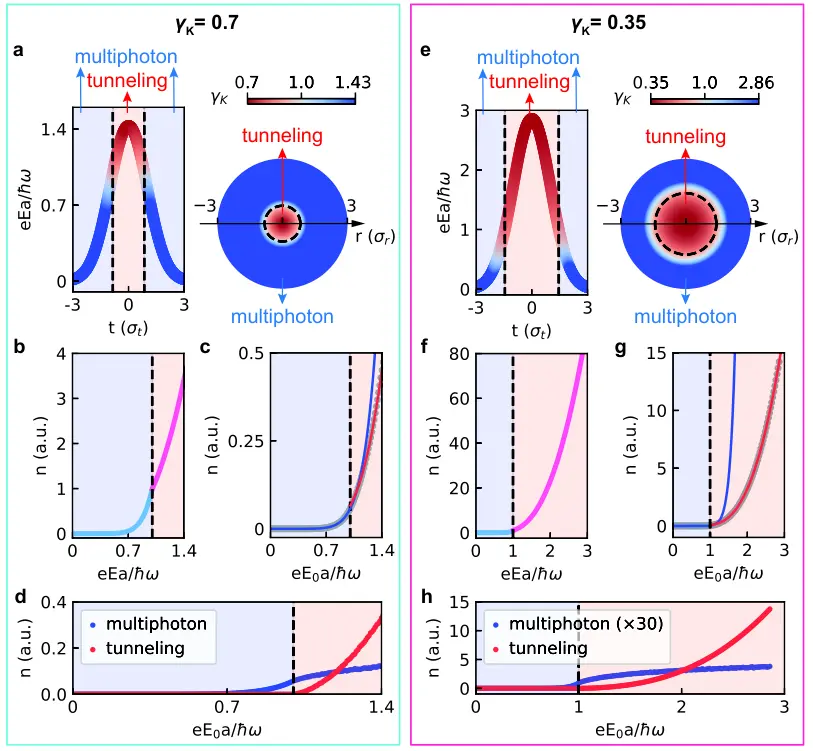
Researchers at Caltech and Seoul National University have observed a surprising combination of quantum phenomena while studying the correlated van der Waals insulator NiPS3. Their time-resolved optical spectroscopy revealed multiphoton-like resonances, blue-shifted by ponderomotive effects, occurring within a channel dominated by quantum tunneling. This observation clarifies microscopic mechanisms of charge excitation in the “Keldysh crossover” regime, a state where strong optical fields reshape electronic states, and identifies a key factor for controlling strong-field nonlinear dynamics in correlated materials.
Time-Resolved Spectroscopy Reveals NiPS3 Photocarrier Dynamics
Researchers systematically tuned both the drive electric field and frequency while observing photocarrier generation in the material, allowing them to pinpoint the “Keldysh crossover” regime where this nonadiabatic tunneling occurs. The charge-transfer gap of NiPS3 is 1.8 eV, providing a baseline for calibrating the observed optical responses to varying excitation levels. Following initial excitation above the gap at 2 eV, a rapid drop in differential reflectivity, ΔR/R, was observed, proportional to the number of photocarriers generated and scaling quadratically with the peak electric field.
This behavior aligns with expectations for linear optical absorption, establishing a reference point for comparison with the more complex phenomena observed in the Keldysh crossover regime. The team then investigated photocarrier generation through quantum tunneling, noting that the microscopic mechanisms and robustness of the resulting field and photon-energy dependencies are detailed in Supplementary Text S3.
Analysis of data across varying values of ħω and γK revealed blueshifts in the observed resonances for N = 3, 5, and 6, at electric fields of 14, 17.8, and 19 MV/cm respectively. These blue-shifted multiphoton-like resonances, occurring within the tunneling-dominated absorption channel, represent a clear spectroscopic signature of adiabaticity breakdown, indicating a departure from the expected behavior of either purely perturbative multiphoton absorption or adiabatic tunneling.
Keldysh Parameter Defines Adiabaticity in Driven Insulators
The dimensionless Keldysh parameter, traditionally used to assess adiabaticity in interband excitations, reveals a more detailed role in the behavior of driven insulators than previously understood. This parameter, defined as the ratio of the Keldysh tunneling time to the laser period, is fundamentally a comparison between light frequency and amplitude, scaled by material properties like bandgap and electron mass. While often used to predict excitation rates, researchers found its utility extends to characterizing the breakdown of adiabaticity itself, particularly within the “Keldysh crossover” regime.
This approach allows for a paradigmatic understanding of the transition between tunneling and multiphoton absorption, even with inherent model limitations. The work highlights that the Keldysh parameter, while traditionally viewed as a predictor of excitation, is a key indicator of when the adiabatic approximation, a cornerstone of many solid-state calculations, begins to fail. The researchers emphasize that the parameter’s value, , must be significantly less than one for the adiabatic condition to hold, a threshold critical for interpreting observed resonances.
NiPS3 Structure Enhances Photocarrier Generation Sensitivity
Absolute reflectivity transients measured at varying electric fields demonstrated a rapid drop following excitation, a signal directly linked to the generation of these photocarriers within the material. Further investigation focused on photon energies below the bandgap of 1.8 eV, where the team observed deviations from the linear absorption model, specifically in the field dependence of photocarrier generation. This momentum-dependent response, even as the field dependence became nonperturbative, suggests that the material’s band and channel structure still influences the excitation process.
Hubbard Model Simulates Nonadiabatic Tunneling
Hubbard model simulations corroborate the observed interplay between tunneling and multiphoton absorption in NiPS3, providing a theoretical framework for understanding the complex photocarrier generation process. Calculations based on a time-dependent Gaussian variational approach successfully reproduce the qualitative features seen in time-resolved optical spectroscopy experiments, strengthening the conclusion that the observed phenomena are not simply explained by either adiabatic tunneling or perturbative multiphoton absorption.
Differential Reflectivity Measures Charge Carrier Density
Differential reflectivity measurements served as a relative proxy for photoexcited carrier population in NiPS3, enabling researchers to probe the dynamics beyond the initial optical coherence. This approach allowed for a focus on carrier behavior after substantial intraband redistribution, before the onset of interband recombination processes. This simplification confirmed that the observed signal directly correlated with changes in carrier population.
Electric Field Dependence Confirms Tunneling Mechanism
Measurements of differential reflectivity revealed a direct relationship between peak electric field strength and photocarrier generation in NiPS3, scaling quadratically as expected from linear optical absorption processes. This proportionality allowed researchers to calibrate their observations and establish a baseline for analyzing more complex excitation mechanisms. Confirming the reliability of these measurements was critical, as multiphoton and tunneling absorptions are highly sensitive to the peak electric field, and pulse duration impacts photocarrier density.
To ensure consistent pulse duration across varying photon energies, the team employed both in-situ coherent response characterization and ex-situ sum frequency generation techniques. These methods verified that observed nonlinear optical processes were not artifacts of changing pulse characteristics, but genuine responses of the material itself.
Frequency-Domain Approach Probes Nonadiabatic Excitation
Precise measurements were critical to realizing this frequency-domain approach, as sub-gap tunneling generates modest photocarrier densities requiring quantitative resolution across a wide range of field strengths. Researchers employed transient reflectivity measurements on the antiferromagnetic insulator NiPS3, a material whose van der Waals structure enhances both photocarrier generation and coherent longitudinal acoustic phonons that sensitively probe photo-excited electron-hole pair density. By systematically tracking this density across the ~ 1 regime, pronounced resonant features emerged at frequencies near integer fractions of the bandgap, resembling multiphoton absorption.
These resonances, however, do not tell the whole story. Their field dependence reveals a tunneling-dominated excitation mechanism, a surprising combination of behaviors. The transient differential reflectivity ΔR/R and coherent acoustic phonon amplitude served as complementary probes of the photoexcitation yield under dilute excitation conditions. The timescale interpretation of remains consistent with established theory. ≫ 1 denotes the multiphoton limit, ≪ 1 the quasi-static tunneling limit, and ~ 1 marks the nonadiabatic crossover. The atomic ponderomotive energy corresponds to the combined electron-hole quiver energy , shifting the effective excitation threshold.
👉 More information
🗞 Observation of nonadiabatic quantum tunneling in a driven correlated insulator
✍️ Mingyao Guo and David Hsieh (Department of Physics, California Institute of Technology, Pasadena, CA, USA); Radu Andrei and Eugene Demler (Institute for Theoretical Physics, ETH Zurich, Zurich, Switzerland); Jaena Park and Je-Geun Park (Center for Quantum Materials, Department of Physics and Astronomy, Seoul National University, Seoul, Korea)
🧠 ArXiv: https://arxiv.org/html/2611.28980v1



See today’s quantum computing news on Quantum Zeitgeist for the latest breakthroughs in qubits, hardware, algorithms, and industry deals.