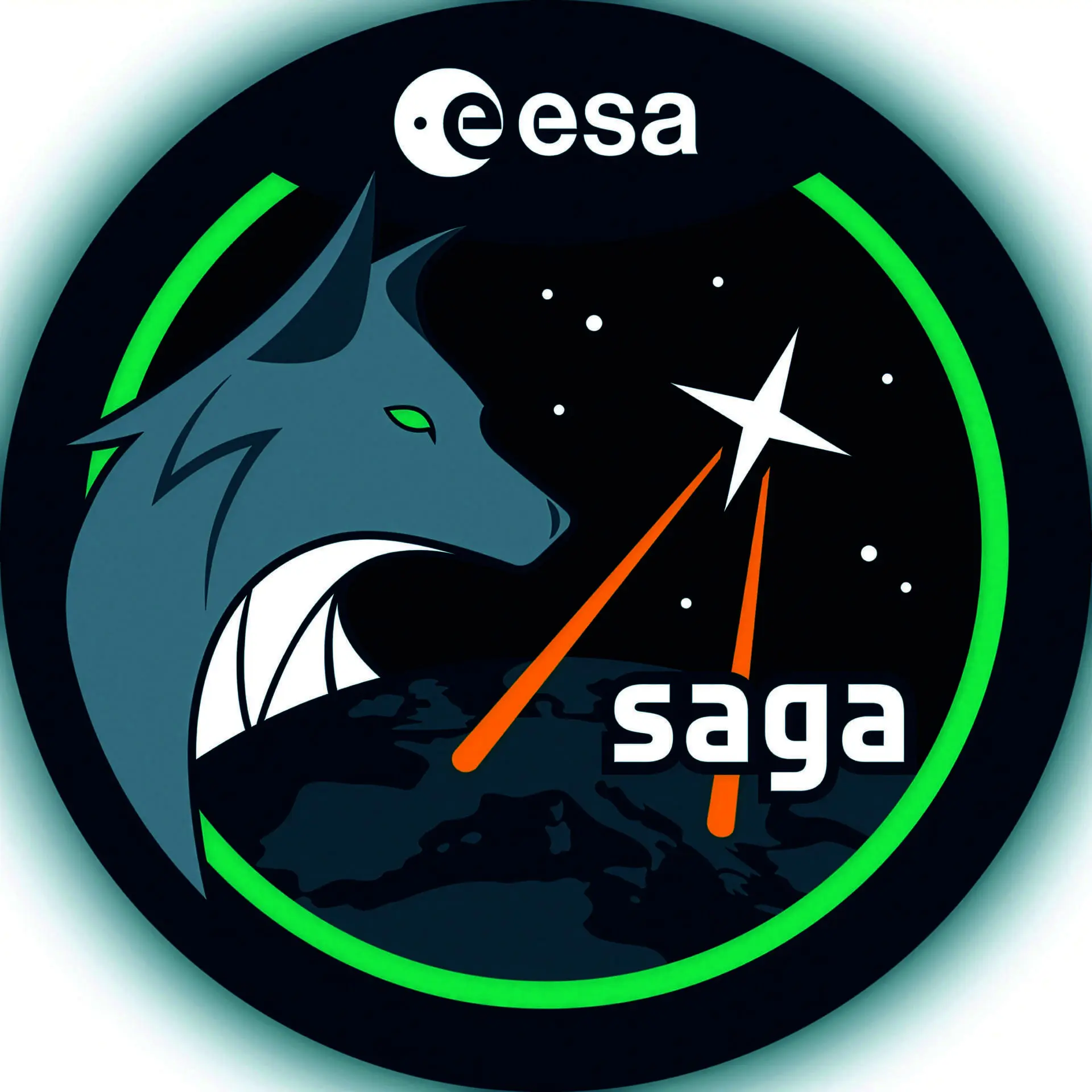
Europe is bolstering its digital defenses with the Secure and cryptographic (Saga) mission, an initiative from the European Space Agency designed to transmit encryption keys using the fundamental laws of quantum physics. The mission employs Quantum Key Distribution (QKD) technology, sending key information as single particles of light, called photons; any attempt to intercept these photons immediately alters their quantum state, revealing eavesdropping. “The idea of quantum key distribution is that you want to share a secret between two parties so that they can use this secret as a key to encrypt their data,” explains Daniele Dequal, Saga QKD Lead Engineer at ESA. Reflecting this complex technology, the Saga team has uniquely incorporated a wolf, a symbol of coordination, vigilance, and protection, into the mission patch. Animal imagery is relatively rare among ESA mission patches, and the wolf visually represents the mission’s goal of safeguarding Europe’s communications. Riccardo Duca, Saga’s end-to-end Performance Lead, stated that he personally likes the wolf and that it is widespread throughout Central Italy, his home region.
Quantum Key Distribution and Secure Communication
Any attempt to intercept the quantum signals used in secure communication immediately betrays the eavesdropper, a principle at the heart of the European Space Agency’s Secure and cryptographic (Saga) mission. Designed to bolster Europe’s digital resilience and strategic autonomy, Saga utilizes Quantum Key Distribution (QKD) technology to establish exceptionally secure communication channels, moving beyond the limitations of conventional encryption methods. Unlike traditional key exchange, QKD relies on the fundamental laws of quantum physics; encryption keys are transmitted as single particles of light, photons, and any observation irrevocably alters their state, alerting both sender and receiver to interference. You are not directly doing encryption or transmitting any form of information, but rather sharing a common secret, which is a random string. This shared secret, encoded in quantum bits, which can exist in multiple states simultaneously unlike classical bits, forms the basis for unbreakable encryption. Saga’s implementation leverages laser links to transmit these quantum bits, enabling secure key exchange over significantly greater distances than terrestrial QKD systems, which are typically limited to around 150 kilometers without repeaters. The mission’s visual identity, embodied in its unique patch featuring a wolf, reflects both the technical sophistication and broader purpose of the project; according to Saga’s Project Manager, Pablo Sarasa Delgado, animal imagery is relatively rare among ESA mission patches.
Symbolism of the Wolf in Mission Design
The ESA’s Secure and cryptographic (Saga) mission distinguishes itself from typical space endeavors not only through its implementation of Quantum Key Distribution (QKD) technology, but also through a deliberate embrace of symbolic imagery in its mission patch design. Animal imagery is relatively rare among ESA mission patches, making Saga’s choice particularly noteworthy. Beyond the technical innovation, the team sought a visual representation that encapsulated both the mission’s core principles and its broader European identity, ultimately settling on the wolf. This decision wasn’t arbitrary; the wolf holds significant cultural and practical resonance with the mission’s objectives. Pablo Sarasa Delgado, Saga’s Project Manager, explains that he likes having an animal as a symbol associated with a mission because it is more versatile. The wolf’s nocturnal nature, capable of navigating low-light environments, mirrors the mission’s reliance on extremely weak optical signals, quantum bits transmitted via laser links.
Riccardo Duca, Saga’s end-to-end Performance Lead, personally likes the wolf and notes that it is widespread throughout Central Italy, where he comes from. The animal’s inherent symbolism of coordination, vigilance, and protection aligns with the mission’s objectives. The collaborative spirit underpinning Saga is also reflected in the wolf imagery; wolves operate within packs, a principle mirroring the mission’s potential to scale into a larger network. “A lone wolf can achieve many things, but through cooperation it can achieve much more, and this is exactly what we will do with Saga first and then EuroQCI,” emphasized Sarasa Delgado. Even the wolf’s howl, capable of traveling vast distances, finds a parallel in space-based QKD, which extends secure communications beyond the limitations of terrestrial systems. Ultimately, the wolf on the patch serves as a visual embodiment of Saga’s core function, as Lucie Bricout, Saga Lead Space Segment Engineer, succinctly put it: “The wolf on the patch is guarding Europe.”
The idea of quantum key distribution is that you want to share a secret between two parties so that they can use this secret as a key to encrypt their data. You are not directly doing encryption and you’re not transmitting any form of information. You’re just sharing a common secret, which is a random string,” explains Daniele Dequal, Saga QKD Lead Engineer at ESA.
Daniele Dequal, Saga QKD Lead Engineer at ESA
Saga Mission Patch Represents European Collaboration
ESA’s Saga mission utilizes Quantum Key Distribution (QKD), a method employing single photons to transmit encryption keys; any interception fundamentally alters the photons’ quantum state, immediately revealing tampering. The team selected the wolf as the central image, a creature deeply rooted in European heritage and a symbol of coordination, vigilance, and protection. Riccardo Duca, Saga’s end-to-end Performance Lead, stated that he personally likes the wolf and that it is widespread throughout Central Italy, his home region. The patch visually depicts laser beams extending across the European continent, representing connectivity and collaboration between ESA Member States, and this collaborative spirit extends beyond geographical representation.
We have Europe underneath the star and we have two rays connecting different nations of Europe, which gives a nice message about the role of ESA supporting ESA Member States’ cooperation,” says Enrico Casini, Saga Security Engineering Lead.
Enrico Casini, Saga Security Engineering Lead
See today’s quantum computing news on Quantum Zeitgeist for the latest breakthroughs in qubits, hardware, algorithms, and industry deals.